


P2404 Code: EVAP Leak Detection Pump Sense Circuit Range/Performance

P2404 isn't a fuel-vapor leak — it's an electrical fault. Your engine computer is getting an out-of-range or erratic signal from the EVAP leak detection pump's sense circuit, the part that's supposed to test the system for leaks. It won't hurt the engine or strand you, but it will fail emissions. The fix is usually the pump, its wiring, or — on some vehicles — a software update, not a leak repair.
P2404 = "Evaporative Emission System Leak Detection Pump Sense Circuit Range/Performance" — the PCM is reading a signal from the EVAP leak detection pump's sense circuit that's out of its expected range, erratic, or implausible.
Some vehicles use a small leak detection pump (LDP) — also called an Evaporative Leak Check Module (ELCM) — to pressurize the EVAP system and check for fuel-vapor leaks. A sense circuit reports the pump's operation back to the computer. P2404 means that feedback signal is wrong — pointing to a circuit, sensor, or pump fault, not necessarily a real leak. The Check Engine Light comes on and the EVAP readiness monitor won't complete, so the car can't pass an emissions test.
Diagnostic priority: (1) scan all codes + freeze frame; (2) check for an ECM software update (notably on Subaru) and read the live sense-circuit signal; (3) bidirectional-test the pump and watch the signal respond; (4) inspect the pump connector and sense wiring; (5) check the LDP filter and EVAP lines; (6) replace the pump/ELCM only after the cause is confirmed.
What does P2404 actually mean?
The EVAP system keeps fuel vapors from escaping into the air by sealing the fuel tank and routing vapor through a charcoal canister. To prove the system is sealed, many vehicles run a leak detection pump that pressurizes (or applies vacuum to) the EVAP system and watches how it holds. A sense circuit feeds the pump's status back to the PCM — on many designs via a sensor that produces a voltage related to pump speed or position.
P2404 sets when that sense signal lands outside the calibrated range, behaves erratically, or doesn't match what the pump should be doing. The key word is circuit: this is an electrical/performance fault in the monitoring hardware (or its software), not a confirmed hole in a hose or a loose gas cap. That distinction matters — chasing a physical leak when the code is really a pump-signal problem wastes time and parts.
What are the symptoms of P2404?
This is a quiet code — the dash light usually tells the whole story:
- Check Engine Light — almost always the only obvious symptom
- EVAP readiness monitor won't set — blocks emissions testing
- Failed emissions / smog inspection — guaranteed while the code is active
- Occasional fuel odor — only if there's also a genuine EVAP leak
- Slightly worse fuel economy — in some cases, not all
- Driver-assist disabled (some Subarus) — EyeSight / RAB switch off with the CEL on
- No change in how the car drives — power, acceleration, and braking are unaffected
Is P2404 serious?
Low severity. It's an emissions and diagnostics issue, not a mechanical one — here's the realistic picture:
- ECM software update (some Subarus)no engine damage · often free under TSB
- Wiring / connector repairno engine damage · $10–$200 fix
- Leak detection pump / ELCMno engine damage · $60–$600 fix
- Failed emissions inspectionguaranteed until cleared & monitor re-runs
- Driver-assist off (some Subarus)EyeSight / RAB disabled while the CEL is on
What causes a P2404 code? Ranked by frequency

An EVAP leak detection pump (LDP) — P2404 means its sense-circuit signal is out of the expected range.
Faulty Leak Detection Pump / Sense Sensor
35% of casesThe pump's built-in sensor wears, corrodes, or takes on moisture and starts reporting a value outside the calibrated window. Because the sensor is integral to the pump (or ELCM), the unit is usually replaced as a whole. The pump frequently lives in a wheel or fender well, where it's exposed to water and road salt that accelerate failure.
Fix: $60–$400 pump / ELCMWiring or Connector Fault in the Sense Circuit
28% of casesChafed insulation, a broken conductor, or a corroded/loose connector introduces resistance or an intermittent open, so the PCM reads an erratic or out-of-range signal even with a good pump. Inspect the pump connector for moisture and green corrosion and check the sense wiring along its run — especially where it's exposed under the vehicle.
Fix: $10–$200 wiring / connectorOutdated ECM Software / Oversensitive Logic
15% of casesOn some vehicles — Subaru is the standout — the hardware is fine and the real cause is overly sensitive diagnostic logic in the ECM. A dealer software update, documented in Technical Service Bulletins, is the primary fix for several model years. Always check for an applicable update before replacing the pump.
Fix: $0–$150 dealer software updateClogged Leak Detection Pump Filter
8% of casesVehicles with an LDP filter can set P2404 when that filter clogs with dirt or debris, restricting airflow so the pump's performance and signal drift out of range. Inspecting or replacing the filter is a cheap check worth doing before condemning the pump itself.
Fix: $10–$30 filterEVAP Leak or Vacuum-Line Problem
8% of casesA cracked vacuum line or a genuine EVAP leak near the pump can affect how the system holds pressure, dragging the pump's measured performance out of range. Inspect the hoses and fittings between the tank, canister, and pump for cracks and loose connections.
Fix: $10–$300 line / leak repairECM / Module Fault
6% of cases · RareRarely, the control module driving or reading the sense circuit is itself at fault. Confirm the pump, wiring, software, filter, and lines all check out before suspecting the module — module replacement is the most expensive and least common answer.
Fix: varies — diagnose everything else firstWhat you'll need
Tools
- All-system scanner with live data + bidirectional EVAP tests iCARZONE UR1000 ›
- Digital multimeter (voltage, ohms, continuity)
- Back-probe pins / test leads (to read the sense circuit)
- EVAP smoke machine (only if a real leak is suspected)
- Electrical contact cleaner + dielectric grease
- Wiring diagram + LDP/ELCM location for your vehicle
Parts & supplies
- Leak detection pump / ELCM$60–$400
- LDP filter (if equipped)$10–$30
- Connector / pigtail / terminals$10–$50
- Wiring repair supplies$10–$30
- EVAP hose / vacuum line$10–$40
- DM-TL module (some BMW / Mercedes)$80–$300
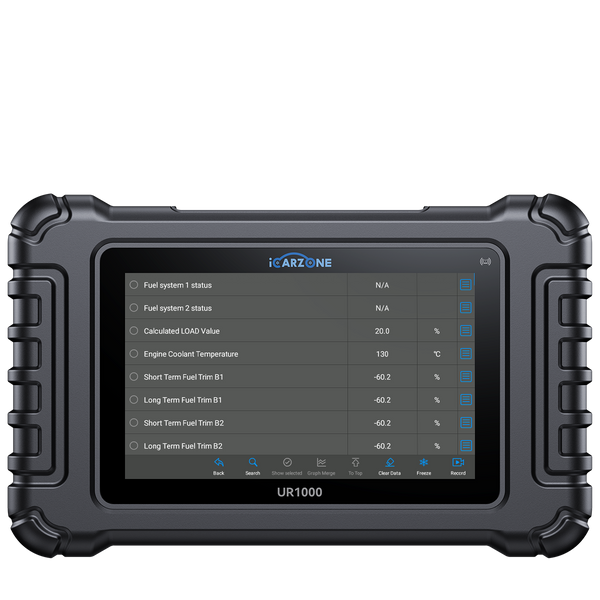
iCARZONE UR1000 — 7" Wireless All-System Scanner
P2404 is solved with active testing, not guesswork. The UR1000 commands the leak detection pump and EVAP components directly and shows the live sense-circuit signal as it responds — the fastest way to tell a faulty pump from a wiring problem. All-system, OE-level access reads the EVAP and PCM data a basic reader can't, and its 7-inch wireless screen lets you watch live data right at the pump.
- 7" wireless touchscreen (33 ft range)
- All-system OE-level diagnostics
- 40,000+ bidirectional / active tests
- 49 maintenance services + CAN FD
- TPMS programming built in
- 100+ brands · lifetime free updates
How do you fix a P2404 code?
Work the signal, not a smoke test. Because P2404 is an electrical/performance fault, the decisive steps are a software check and a live/bidirectional pump test — both free with a capable scanner.
Scan all codes and note the freeze frame
- Record P2404 and any companion EVAP codes (P0455 large leak, P0446 vent control, P0456 small leak, or P2401/P2402 pump control circuit). The mix shows whether it's just the sense circuit or a wider EVAP problem.
- Confirm your vehicle actually uses a leak detection pump or ELCM (common on Chrysler/Dodge/Jeep/RAM, VW/Audi/Porsche, Subaru, Mitsubishi, and some BMW/Mercedes) — that's where this code lives.
Check for a software update and read the live sense signal
- On Subaru (and a few others), an ECM software update via a TSB is the documented fix — look for one before buying parts, since the fault is often oversensitive logic, not hardware.
- With a capable scanner, read the leak-detection-pump sense signal live. A steady, in-range value is healthy; an erratic, flat, or out-of-range value confirms the fault.
Bidirectional-test the leak detection pump
- Command the pump (and EVAP solenoids) with a bidirectional tool and watch the sense signal respond. If the pump won't run or the signal doesn't track the command, the pump or its wiring is suspect.
- This active test is the quickest way to separate a faulty pump from a wiring fault — and it's exactly what a basic code reader can't do.
Inspect the pump connector and sense wiring
- The pump often sits in a wheel or fender well exposed to water and salt. Unplug the connector and check for corrosion, moisture, and bent or spread pins; clean or repair as needed.
- Follow the sense wiring for chafing, breaks, or a poor previous repair, and back-probe for opens or high resistance.
Check the LDP filter and EVAP lines
- If your vehicle has a leak-detection-pump filter, inspect or replace it — a clog skews the pump's performance and signal.
- Inspect the EVAP hoses and vacuum lines near the pump for cracks or loose fittings.
Replace the pump / ELCM — final step
- If the pump's sensor is confirmed faulty and software, wiring, filter, and lines all check out, replace the leak detection pump / ELCM with the correct part for your vehicle.
- Clear the code and run a drive cycle (or the scanner's EVAP monitor routine), then confirm the sense signal reads in range and the monitor completes.
How much does P2404 cost to fix?
Often inexpensive — a software update or a connector repair handles many cases, and even a new leak detection pump is moderate. Costs only climb on vehicles with a pricier module-based design.
| Repair | DIY | Shop | You save | Type |
|---|---|---|---|---|
| Diagnosis (scan + live data + bidirectional) | $0 (free with tool) | $90–$160 | Up to $160 | Free First Step |
| ECM software update (some Subarus) | Dealer flash | $0–$150 | Often under TSB | Dealer / TSB |
| LDP filter (if equipped) | $10–$30 | $60–$150 | Up to $140 | DIY Easy |
| Connector / wiring repair | $10–$60 | $90–$250 | Up to $240 | DIY Moderate |
| Leak detection pump / ELCM | $60–$400 | $200–$600 | Up to $540 | DIY Moderate |
| EVAP hose / vacuum line repair | $10–$40 | $120–$300 | Up to $290 | DIY Moderate |
| DM-TL module (some BMW / Mercedes) | $80–$300 | $250–$550 | Up to $470 | Often Shop |
Which vehicles are most prone to P2404?
P2404 only appears on vehicles whose EVAP system uses a leak detection pump or a similar module to test for leaks — not every car uses that method. These are the platforms where it shows up most, with the cause that's typical for each. Deep-dives below.
| Make | EVAP design | Years | Primary cause & notes | Risk |
|---|---|---|---|---|
| Chrysler / Dodge / Jeep / RAM | Leak detection pump / ESIM-ELCM | 2004–2020 | Pump & connector corrosion; common EVAP-code platform. | Medium |
| Volkswagen / Audi | Bosch leak detection pump | 2004–2018 | Pump (in fender well) + wiring; moisture/salt exposure. | Medium |
| Porsche | Bosch leak detection pump | 2005–2016 | Pump in fender well; a known, inexpensive replacement part. | Medium |
| Subaru | ELCM (electronic) | 2015–2023 | Often ECM software (TSB) on Legacy / Outback / Forester / Impreza; CEL disables EyeSight. | High |
| Mitsubishi | Leak detection pump | 2004–2017 | Pump / wiring; check the connector and filter. | Low |
| BMW / Mercedes-Benz | DM-TL module | 2004–2018 | Diagnostic module (tank leakage) fault; module or wiring. | Medium |
Circuit fault vs. an actual leak — don't confuse them
The single most useful thing to understand about P2404 is what it is not:
- P2404 is a signal/performance fault in the pump's sense circuit — the computer doesn't trust the feedback it's getting from the pump. It does not, by itself, mean there's a hole in a hose or a loose gas cap.
- Leak codes are different. P0455 (large leak), P0442 (small leak), and P0456 (very small leak) mean the system actually lost its seal. Those call for a gas-cap check and a smoke test; P2404 calls for a pump signal and wiring check.
- Why it matters. Reaching for a smoke machine on a pure P2404 wastes time. Read the live signal and bidirectionally test the pump first — fix the leak codes only if they're actually present.
Action plan: read the live sense signal → bidirectional-test the pump → inspect the connector/wiring → only break out the smoke machine if a real leak code is also stored.
The Subaru software catch (and who uses a leak detection pump)
If you drive a recent Subaru, start with software — not parts:
- Subaru ELCM software. On several model years (Legacy, Outback, Forester, Impreza), P2404 is frequently caused by overly sensitive ECM diagnostic logic, and a dealer reflash under a Technical Service Bulletin is the documented fix. Replacing the pump first can be a wasted expense.
- EyeSight side effect. Because a Check Engine Light disables EyeSight and Reverse Automatic Braking on many Subarus, P2404 is worth clearing sooner rather than later even though it's "just" emissions.
- Who has a pump. P2404 only applies to leak-detection-pump or module-based EVAP designs — Chrysler/Dodge/Jeep/RAM, VW/Audi/Porsche, Mitsubishi, Subaru (ELCM), and some BMW/Mercedes (DM-TL). On those, the hardware fixes above apply.
Check for a TSB / recall: at NHTSA.gov enter your VIN or year/make/model and review bulletins related to the EVAP system or leak detection pump on your platform. NHTSA recalls & TSBs ›
Should you DIY or call a mechanic?
DIY if you…
- Have a scanner that reads live data and runs bidirectional EVAP tests
- Can check for an applicable software update for your vehicle
- Have a multimeter and can back-probe a connector
- Can reach the leak detection pump (often in a fender/wheel well)
- Want to confirm pump-vs-wiring before buying parts
- Want to save $90–$540 over shop diagnostic + labor
Use a mechanic / dealer if…
- Your vehicle needs a dealer software reflash (e.g. Subaru)
- The pump is buried or hard to access
- You don't have a bidirectional scanner
- The fault is intermittent and hard to catch
- A module-based system (DM-TL) needs coding after replacement
- The code persists after a new pump (deeper wiring fault)
Frequently asked questions
Is it safe to drive with a P2404 code?
Yes. P2404 doesn't affect the engine, transmission, or brakes, so the car drives normally. The catch is the EVAP readiness monitor won't complete, so you'll fail an emissions test until it's fixed — and on some Subarus a Check Engine Light disables EyeSight and Reverse Automatic Braking, so it's worth clearing promptly.
Does P2404 mean my EVAP system has a leak?
Not by itself. P2404 is a range/performance fault in the leak detection pump's sense circuit — an electrical or signal problem, not a confirmed leak. Actual leaks set codes like P0455, P0442, or P0456. If you only have P2404, focus on the pump signal and wiring, not a smoke test.
Why is P2404 a software fix on my Subaru?
On several Subaru model years the hardware is fine and the cause is overly sensitive ECM diagnostic logic. Subaru issued Technical Service Bulletins with an updated ECM calibration that resolves the false P2404. A dealer reflash fixes it — so check for an applicable update before replacing the ELCM or pump.
How much does it cost to fix P2404?
Often modest. A software update can be free under a TSB; a connector or wiring repair is $10–$60 DIY; an LDP filter is $10–$30. A leak detection pump or ELCM runs $60–$400 in parts, and a module-based design (some BMW/Mercedes) more. Shop labor adds $90–$200+. Many cases land under $200.
What scanner do I need to diagnose P2404?
One that reads live EVAP data and can run bidirectional tests, so you can command the leak detection pump and watch the sense signal respond — the fastest way to separate a faulty pump from a wiring fault. The iCARZONE UR1000 ($499.99) offers all-system access, live data, 40,000+ bidirectional tests, and CAN FD support.
Why does P2404 come back after I replaced the pump?
Usually because the pump wasn't the cause. Re-check the sense wiring and connector for corrosion or an intermittent open, look for an applicable ECM software update (especially on Subaru), and inspect the LDP filter and EVAP lines. Make sure the replacement is the correct part, and that any module-based system was coded after the swap.
Quick verdict
- Step 1 — free first: scan codes, then check for an applicable ECM software update and read the live sense-circuit signal. $0 with a capable scanner.
- Step 2 — test, don't guess: bidirectionally command the pump and watch the signal, then inspect the connector, sense wiring, and LDP filter.
- Step 3 — fix only what's proven: apply the software update, repair the wiring, or replace the pump/ELCM with the correct part, then clear and re-run the EVAP monitor.
Command the pump, don't guess
The iCARZONE UR1000 runs live data and 40,000+ bidirectional tests — so you can actuate the EVAP leak detection pump and read its signal to find the real P2404 cause before buying parts, across 100+ brands.