


P0410 Code: The Cold-Start Air Pump Isn't Doing Its Job

P0410 is almost never an engine threat — it's an emissions code. Roughly 60% of cases are a moisture-damaged secondary air pump or a carbon-clogged valve. The good news: a free cold-start listen test usually tells you which, and most fixes are DIY.
P0410 = "Secondary Air Injection System Malfunction" — the system that pumps fresh air into the exhaust for the first 30–90 seconds of a cold start isn't performing the way the ECM expects.
On a cold start, the ECM commands the air pump to push fresh oxygen into the exhaust to help the catalytic converter heat up fast and burn off cold-start emissions. It then watches the oxygen sensors: if the expected oxygen spike doesn't appear (or the pump never runs), the ECM stores P0410. It's an emissions fault, not a mechanical engine danger.
Diagnostic priority: (1) read all codes + freeze frame; (2) at a true cold start, listen for the pump running — that's a free first split; (3) check the fuse, relay, and pump power; (4) inspect the check / combination valve and hoses for carbon, sticking, and water; (5) replace the failed component with OEM and re-verify with a fresh cold-start drive cycle.
What does P0410 actually mean?
The Secondary Air Injection (AIR) system has one job: during the brief cold-start window, an electric or belt-driven air pump blows fresh air through a check valve / combination valve into the exhaust manifold. That extra oxygen lets leftover unburned fuel keep burning in the exhaust, which heats the catalytic converter to operating temperature faster and slashes the cold-start spike of hydrocarbons (HC) and carbon monoxide (CO).
The ECM verifies the system with the oxygen sensors. It runs a passive check (watching whether O2 readings shift when the pump should be on) and, if that's inconclusive, an active test — it commands the pump and expects the O2 signal to react within a few seconds. If the oxygen change never shows up, the ECM concludes air isn't reaching the exhaust and sets P0410. The most common physical reasons are a dead pump (often water-damaged), a check/combination valve gummed shut with carbon, or a blocked passage — the code itself can't tell which, so a quick hands-on check beats guessing.
What are the symptoms of P0410?
Most owners notice nothing but the warning light — the fault lives in an emissions device that only runs for the first minute of a cold start:
- Check Engine Light — steady; often the ONLY visible symptom
- No driveability change — the engine usually runs and accelerates normally
- Failed emissions / smog inspection — guaranteed while the code is active
- Missing or changed cold-start noise — the pump's brief whirr/buzz at startup is absent (pump dead) or louder/grindy (failing bearing or water inside)
- Brief rough cold idle — if the combination valve sticks open and lets exhaust backflow
- Worse in cold / humid weather — moisture or ice in the pump and valves trips the code seasonally
- Companion SAIS codes — P0411, P0412, P0413, P0418, or vehicle-specific air-injection codes
Is P0410 serious?
Low-to-moderate severity. The code doesn't threaten the engine, but it isn't "ignore it" either — these are the realistic outcomes:
- Failed air pump (water damage)no engine damage · $150–$600 fix
- Carbon-clogged / stuck valveno engine damage · $30–$200 fix
- Relay / fuse / wiringno engine damage · $5–$120 fix
- Failed emissions inspectionguaranteed until cleared
- Heavy valve carbonmay hint at a rich-running condition to investigate
What causes a P0410 code? Ranked by frequency

P0410 read on a scanner — the secondary air pump (labeled) on a VW TSI engine.
Failed Secondary Air Pump (Moisture/Water Damage)
35% of casesThe number-one cause. Condensation or water drawn back from the exhaust corrodes the pump's motor and impeller, or freezes it in winter. A seized pump won't blow air — and can overload the circuit and pop the fuse. Confirm by listening at cold start and by bench-testing power: many pumps still hum but move little air. Use OEM; aftermarket air pumps on German platforms are notably hit-or-miss.
Fix: $150–$600 OEM pump + laborCarbon-Clogged or Stuck Check / Combination Valve
25% of casesThe one-way valve between the pump and the exhaust gums up with carbon and either jams shut (no air gets through) or leaks (exhaust flows back toward the pump). Classic on Audi/VW "combi valves." Often the pump is perfectly fine. Many valves can be removed and cleaned with carbon/throttle-body cleaner instead of replaced — try that before buying parts.
Fix: $30–$200 clean or replace valveFaulty Air Switching / Control Valve or Solenoid
12% of casesMany systems use a vacuum- or electrically-operated switching valve (and a control solenoid) to open the air path on cold start. If the solenoid fails, a vacuum line is cracked, or the valve sticks, the pump runs but air never reaches the exhaust. Test the solenoid's resistance and command it with a bidirectional scanner; check the vacuum source with a hand pump.
Fix: $40–$200 valve / solenoidPump Relay, Fuse, or Wiring Fault
10% of casesA blown air-pump fuse, corroded relay, or chafed harness can stop the pump from running at all — and a repeatedly blown fuse usually means a seized pump pulling too much current. Check the fuse and relay first (cheap, fast), then verify power and ground at the pump connector during a commanded cold start.
Fix: $5–$120 fuse / relay / wiringClogged Air Injection Passages / Ports
8% of casesCarbon builds up in the exhaust-side injection passages or the ports themselves, restricting flow even when pump and valve are good. More common on high-mileage engines and those that run rich. Cleaning is labor-intensive (sometimes requires removing the valve and probing the passages), so confirm pump and valve first.
Fix: $50–$300 cleaning / laborVacuum Leak or Disconnected / Cracked Hose
5% of casesOn vacuum-actuated systems, a split or popped-off hose means the switching valve never opens. Inspect every air and vacuum line between the pump, valve, and intake source for cracks, hardening, or loose clamps. The cheapest fix on this list when it's the culprit.
Fix: $5–$30 hose + clampExhaust Backpressure, O2 Sensor, or Software/TSB
5% of cases · RareA restricted/clogged catalytic converter raises backpressure that can disrupt SAIS flow and trip P0410. Occasionally a lazy O2 sensor gives inconclusive data, or a manufacturer software bug triggers false codes (check for a TSB/reflash before replacing hardware). These are last on the list — rule out pump, valve, and wiring first.
Fix: $0–$200 reflash · varies if cat-relatedWhat you’ll need
Tools
- OBD2 scanner with live O2 data + bidirectional pump control iCARZONE UR800 ›
- Digital multimeter (voltage, ohms)
- Hand vacuum pump (for vacuum-operated switching valves)
- Carbon / throttle-body cleaner for the valve
- Basic hand tools, sockets, and hose-clamp pliers
- Wiring & vacuum diagram for your specific vehicle
Parts & supplies
- OEM secondary air pump$150–$600
- Check / combination valve$30–$200
- Air switching valve / control solenoid$40–$200
- Pump relay$10–$40
- Air-pump fuse$2–$8
- Vacuum / air hoses + clamps$5–$30
- Carbon cleaner (valve service)$8–$15
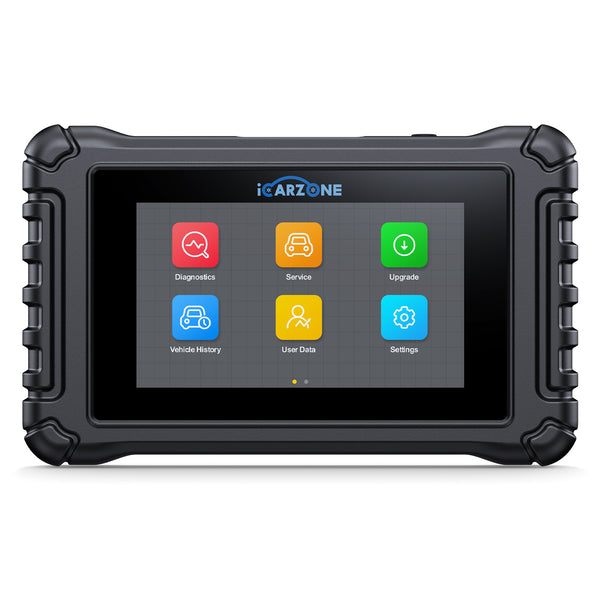
iCARZONE UR800 — 5" LCD OBD2 Scanner
Watch the O2 sensor live and use bidirectional controls to command the air pump and switching valve, so you can confirm whether air is actually reaching the exhaust before buying parts. Freeze-frame data shows whether the code set at cold start. Broad coverage including Audi/VW, Toyota/Lexus, BMW, Mercedes, GM, and most domestic and Asian platforms.
- 5" LCD 854×480 touchscreen
- Quad-Core · fast portable diagnosis
- Live O2 data graphing
- Bidirectional / active tests
- Audi/VW · Toyota · BMW · GM coverage
- 2-yr warranty + lifetime updates
How do you fix a P0410 code?
Work in order. The cold-start listen test in Step 2 is your free, decisive split — it tells you whether to chase the pump side or the valve/passage side before spending a cent.
Scan all codes and locate the SAIS components
- Record every code with freeze-frame data. P0410 often appears with P0411 (incorrect flow), P0412/P0413 (switching valve circuit), and P0418 (pump relay circuit), plus vehicle-specific air-injection codes.
- Identify your system layout: the air pump (often near the front of the engine, a fender, or under the intake), the check/combination valve at the exhaust, the switching/control valve, and the relay/fuse. Layouts vary widely by make — pull up a diagram for your vehicle.
Do the cold-start listen test — your free diagnostic split
- With the engine fully cold (sat several hours), start it and listen near the pump for a brief electric whirr/buzz that runs up to ~90 seconds.
- (A) Pump runs and sounds healthy → air is likely being produced; focus on the check/combination valve, switching valve, hoses, and passages (Steps 4–5).
- (B) Pump is silent → focus on the fuse, relay, wiring, and pump itself (Step 3).
- (C) Pump grinds, screeches, or runs rough → a failing or water-damaged pump; plan replacement and find the moisture source.
- A bidirectional scanner like the UR800 can command the pump on demand so you don't have to wait for a cold start.
Check the fuse, relay, and pump power
- Inspect the air-pump fuse. Blown? Replace it and watch — if it blows again quickly, the pump is likely seized and overloading the circuit.
- Swap-test or measure the pump relay; clean corroded contacts.
- With the pump commanded on (scanner) or at cold start, back-probe the pump connector: confirm battery voltage on the feed and a good ground. Power present but no pump movement = bad pump. No power = relay/fuse/wiring/ECM-driver side.
Inspect and test the check / combination and switching valves
- Remove the check/combination valve and look for carbon and stuck flaps. It should pass air one way (from the pump) and block exhaust backflow — not the reverse. Clean heavy carbon with carbon/throttle-body cleaner; replace if the diaphragm or flap is damaged.
- For vacuum-operated switching valves, apply vacuum with a hand pump and confirm the valve opens and holds. For electric solenoids, measure resistance against spec and command them with the scanner.
- Check for water/oil inside the valve and ducts — moisture is the root cause behind many pump failures.
Inspect hoses, passages, and exhaust backpressure
- Trace every air and vacuum hose between pump, valve, and intake source for cracks, hardening, popped-off ends, or loose clamps — a cheap, common fix.
- If pump and valve are good but flow is still wrong, suspect carbon-clogged injection passages/ports; cleaning may require removing the valve and probing the passages.
- If a clogged catalytic converter is suspected (rare), check exhaust backpressure with a gauge — high readings at idle point to a restriction feeding the fault.
Replace/clean the faulty part — final step
- Use OEM components, especially for the air pump on German platforms where aftermarket failure rates are high.
- Address the moisture source when replacing a water-damaged pump (failed check valve, missing splash shield) or the new one fails the same way.
- Clear codes and re-verify with a genuine cold-start drive cycle — the SAIS only runs cold, so a warm restart won't complete the monitor. If it returns, recheck the valve and confirm you didn't fit a marginal aftermarket pump.
How much does P0410 cost to fix?
Costs range from a couple of dollars (a fuse or hose) to around $900 for an OEM pump installed on a German platform. Many cases resolve with a valve clean or a relay/hose for under $100 DIY.
| Repair | DIY | Shop | You save | Type |
|---|---|---|---|---|
| Diagnosis (scan + cold-start listen test) | $0 (free test) | $80–$150 | Up to $150 | Free First Step |
| Air-pump fuse | $2–$8 | $40–$90 | Up to $85 | DIY Easy |
| Vacuum / air hose + clamp | $5–$30 | $60–$120 | Up to $110 | DIY Easy |
| Pump relay | $10–$40 | $60–$130 | Up to $120 | DIY Easy |
| Clean check / combination valve | $8–$20 | $100–$220 | Up to $210 | DIY Moderate |
| Check / combination valve (replace) | $30–$200 | $150–$400 | Up to $370 | DIY Moderate |
| Air switching valve / control solenoid | $40–$200 | $180–$450 | Up to $410 | DIY Moderate |
| Secondary air pump (Domestic / Asian, OEM) | $150–$400 | $350–$700 | Up to $550 | DIY Moderate |
| Secondary air pump (Audi/VW, BMW, Mercedes) | $250–$600 | $500–$900 | Up to $650 | Often Shop |
| Injection passage cleaning (labor-heavy) | $50–$150 | $250–$600 | Up to $550 | Shop Friendly |
Which vehicles are most prone to P0410?
Not every car even has a secondary air system — but among those that do, two groups dominate P0410 volume: Audi/VW (combination valve + pump) and Toyota/Lexus 5.7L V8 (air pump + switching valves, subject to extended coverage). Deep-dives below.
| Make | Model / engine | Years | Primary cause & notes | Risk |
|---|---|---|---|---|
| Audi / Volkswagen | A4, A6, Q5, Q7, Passat, Touareg (2.0T, 3.0/3.2 V6, 4.2 V8) | 2005–2018 | Combination ("combi") valve carbon + pump failure. Very common. | High |
| Toyota / Lexus | Tundra, Sequoia, LX570, Land Cruiser (5.7L 3UR-FE V8) | 2007–2014 | Air pump + switching valves; many covered by an extended warranty enhancement — check eligibility. | High |
| BMW | 3 / 5 Series, X3, X5 (M54, N52, N62 and related) | 2001–2013 | Secondary air pump and check valve; moisture-driven failures. | Medium |
| Mercedes-Benz | C / E / S-Class, ML, GL (M272 V6, M273 V8) | 2004–2015 | Air pump failure + clogged passages; sometimes addressed with a delete pipe/relay kit at dealers. | Medium |
| GM / Chevrolet / GMC | Silverado, Sierra, Tahoe, Suburban (4.8 / 5.3 / 6.0L V8) | 1999–2013 | Pump water intrusion + check valve; relocate/shield kits exist. | Medium |
| Subaru | Outback, Legacy, Forester, Impreza (2.5L) | 2006–2014 | Combination valve and pump faults at higher mileage. | Medium |
| Volvo / Porsche | Various (incl. older 911 / Cayenne, S60/XC90) | 2000–2014 | Pump and valve age-out; OEM parts strongly preferred. | Low |
P0410 on Audi / VW — the combi valve carbon problem
Audi and Volkswagen generate a large share of P0410 in North America, and the pattern is consistent enough that experienced techs check the valve before the pump:
- Combination valve first. The "combi valve" between the pump and exhaust carbons up and sticks, blocking airflow or letting exhaust flow back. The pump itself is often fine. Removing and cleaning the valve resolves a meaningful number of cases for the cost of a can of cleaner.
- Then the pump. When the pump has failed (frequently moisture-related), use OEM — aftermarket pumps on these platforms have a reputation for failing again quickly.
- Companion codes. Expect vehicle-specific air-injection / bank codes alongside P0410; read freeze-frame to confirm the fault set at cold start.
Action plan: cold-start listen → if the pump runs, pull and clean the combi valve first → re-test → only replace the pump (OEM) if it's confirmed dead. Many fixes land under $100 DIY; a full OEM pump job can reach $500–$900 at a shop.
P0410 on Toyota / Lexus 5.7L V8 — pump & switching valves
The 5.7L 3UR-FE V8 in 2007–2014 Tundra and Sequoia (and related Lexus/Land Cruiser models) is a high-volume source of air-injection faults:
- Pump and switching valves. The system uses an air pump plus air-switching valves that can stick or fail, commonly throwing P0410 along with related air-injection codes, often after exposure to moisture.
- Check for extended coverage. Toyota extended coverage for the air injection pumps and air switching valves (moisture/water intrusion) to 10 years / 150,000 miles on many of these trucks — Customer Support Program ZTQ for 2007–2010 Tundra and 2008–2010 Sequoia, and Warranty Enhancement Program ZG6 for 2011 Tundra and Sequoia. Verify your VIN's eligibility in Toyota's system before paying out of pocket (2012–2014 trucks share the failure but generally fall outside these programs).
- Verify before parts. Confirm whether the pump runs and whether the switching valves actuate (bidirectional command) so you replace only what's failed.
Check for a TSB / campaign: at NHTSA.gov enter your VIN or year/make/model and review Technical Service Bulletins and campaigns; your dealer can confirm warranty-enhancement eligibility. NHTSA recalls & TSBs ›
Should you DIY or call a mechanic?
DIY if you…
- Can do a cold-start listen test and read live O2 data
- Have a multimeter and a hand vacuum pump
- Can locate and reach the pump, valve, and relay
- Are comfortable cleaning a carbon-clogged valve
- Want to start with cheap fixes (fuse, hose, relay, valve clean)
- Want to save $150–$650 over shop diagnostic + labor
Use a mechanic if…
- The pump or valve is buried (under the intake, deep in a fender)
- Vehicle is Audi/VW/BMW/Mercedes with tight access
- Injection passages need cleaning (labor-intensive)
- You suspect a clogged catalytic converter
- You want a dealer to verify warranty-enhancement eligibility
- The fuse keeps blowing and you can't isolate the short
Frequently asked questions
Can I drive with a P0410 code?
Yes — P0410 is an emissions code and doesn't threaten the engine or leave you stranded, so it's safe to keep driving while you plan the repair. The catches: you will fail an emissions/smog inspection until it's cleared, and if your air-pump fuse keeps blowing (a seized pump), it's worth addressing sooner. Otherwise diagnose it within a few weeks.
What's the difference between P0410 and P0411?
They're close cousins. P0410 is the generic "Secondary Air Injection System Malfunction" — the catch-all. P0411 is more specific: "Incorrect Flow Detected," meaning the ECM sees the wrong amount or direction of air (often a stuck/leaking check valve, a weak pump, or a backflow problem). The diagnostic path is largely the same: confirm the pump runs, then test the valve and passages.
What's the most common cause of P0410?
A failed secondary air pump (frequently from moisture/water damage) and a carbon-clogged or stuck check/combination valve together account for most cases. That's why the free cold-start listen test is so useful: if you hear the pump running, the valve or passage is the more likely culprit; if it's silent, focus on the pump, relay, and fuse.
How much does it cost to fix P0410?
It depends on the cause. A fuse is a few dollars; a hose or relay is $5–$40; cleaning a clogged valve is the cost of a can of cleaner. Replacing the check/switching valve runs $30–$200 in parts. A secondary air pump is $150–$400 OEM on domestic/Asian platforms and $250–$600 on German ones, with shop installs reaching $700–$900. Many cases resolve under $100 DIY.
What scanner do I need to diagnose P0410?
One that shows live O2 data and offers bidirectional controls so you can command the air pump and switching valve on demand — that lets you confirm air is reaching the exhaust without waiting for a cold start. The iCARZONE UR800 is a 5-inch LCD scanner at $299.99 with live data graphing, active/bidirectional tests, freeze-frame, and broad coverage including Audi/VW, Toyota/Lexus, BMW, Mercedes, and GM.
Why does P0410 keep coming back after replacing the pump?
Two usual reasons. First, the real fault was elsewhere — a stuck check valve or clogged passage was blocking airflow, so a new pump didn't fix it. Second, the moisture source that killed the first pump (a failed check valve or missing splash shield) was never addressed, so the replacement fails the same way. Aftermarket pumps on German platforms also fail early; OEM is worth it here.
Will P0410 damage my engine?
No — the secondary air system only runs briefly at cold start and the code doesn't change how the engine runs, so P0410 won't cause engine damage. Its impact is environmental and regulatory: more cold-start emissions and a guaranteed failed inspection. Heavy carbon at the valve can be a clue to investigate a rich-running condition, but the code itself isn't an engine threat.
Quick verdict
- Step 1 — free first: scan codes, then do the cold-start listen test to split pump-side vs valve-side. $0.
- Step 2 — cheap wins ($5–$200): fuse, hose, relay, or clean the carboned valve. Many cases stop here.
- Step 3 — the pump: OEM secondary air pump ($150–$600) — only after confirming it's actually dead and fixing the moisture source.
Diagnose it right the first time
The iCARZONE UR800 lets you command the secondary air pump and watch the O2 response live — so you confirm the real fault before buying parts, across 58 vehicle makes.