P0111 Code Fix: Intake Air Temp Sensor Circuit Range/Performance

iP0111 means the intake air temperature (IAT) sensor is sending a reading the computer doesn't believe — it's connected and working electrically, but the temperature it reports is out of range or doesn't make sense. It won't hurt the engine, but it skews fueling and fails emissions. Most cases are a dirty or drifting sensor (often built into the MAF), and many are a quick DIY fix.
P0111 = "Intake Air Temperature Sensor 1 Circuit Range/Performance (Bank 1)" — the PCM sees an IAT signal that's outside the expected range or doesn't change in a logical way.
The IAT sensor is a thermistor that measures the temperature of the air entering the engine; the PCM uses it to judge air density and trim fuel and timing. P0111 is different from a wiring fault: the sensor is still connected and sending a signal, but the value is implausible — too far from what conditions suggest, or jumping around. The usual reasons are a dirty or drifting sensor (often integrated into the MAF), contamination from an over-oiled air filter, or an intermittent wiring problem.
Diagnostic priority: (1) scan codes + freeze frame; (2) on a cold engine, compare the live IAT reading to the coolant temperature — they should be close; (3) clean the IAT/MAF sensor; (4) inspect the connector, wiring, and ground; (5) measure the sensor's resistance against temperature; (6) replace the sensor or MAF only after confirming the cause.
What does P0111 actually mean?
The intake air temperature (IAT) sensor is a small thermistor — a resistor whose resistance changes with temperature. The PCM feeds it a reference voltage and reads the returning signal: cold air means high resistance and high voltage, warm air means low resistance and low voltage. From that, the PCM works out air density and fine-tunes the fuel mixture and ignition timing, which matters most on cold starts and at altitude.
P0111 sets when the IAT signal is present but doesn't add up — it's outside the expected range, or it changes too far, too fast to be a real air-temperature reading. Crucially, this is a rationality fault, not an electrical one: the difference between P0111 and P0110 is that with P0111 the sensor is still talking, it's just saying something the PCM can't believe. That points you toward contamination, sensor drift, heat soak, or an intermittent connection rather than a dead circuit.

The IAT sensor reads incoming air temperature for the PCM; P0111 means that reading no longer makes sense.
What are the symptoms of P0111?
This one is often quiet — sometimes the only sign is the light:
- Check Engine Light — frequently the only symptom, especially if the fault is intermittent
- Worse fuel economy — the PCM trims fuel from a questionable air-temp reading
- Rough idle or hesitation — when the mixture drifts off ideal
- Harder cold starts — incorrect air-density data hurts cold-start fueling
- Slightly reduced power — noticeable on some vehicles, not all
- Failed emissions test — while the code is active
- No driveability change at all — common; the light may be the only clue
Is P0111 serious?
Low severity. It's a fueling-accuracy and emissions issue, not a mechanical threat — here's the realistic picture:
- Dirty IAT / MAF sensor (cleanable)no damage · $0–$20 fix
- Faulty sensor / wiring repairno engine damage · $15–$200 fix
- Engine, brakes & transmissionunaffected by this code
- Slightly off fuelingworse economy & cold-start quality
- Failed emissions inspectionguaranteed until cleared
What causes a P0111 code? Ranked by frequency

A typical intake air temperature (IAT) sensor — drift or contamination makes it read out of range and sets P0111.
Faulty IAT Sensor (Drift / Aging Thermistor)
30% of casesThe most common cause. Over time the thermistor element drifts or ages so it no longer reports accurate temperatures, and the reading falls outside the expected range. The sensor is still electrically connected — it's just giving bad numbers. Confirm with live data and a resistance check before replacing.
Fix: $15–$300 sensor / MAFContaminated / Dirty IAT or MAF Sensor
25% of casesOil and dirt coat the sensing element and skew the reading. A very common culprit is an over-oiled aftermarket air filter, whose oil mist contaminates the MAF/IAT element. Cleaning the element with a MAF-safe sensor cleaner (never wipe it) often restores accuracy and clears the code without a new part.
Fix: $8–$20 cleanerWiring or Connector Fault
20% of casesA corroded connector, a chafed wire near the hot engine, a loose terminal, or an intermittent open/short makes the signal jump around — which the PCM flags as an implausible reading. Inspect the IAT/MAF connector for corrosion and bent pins, and check the wiring along its run for damage.
Fix: $10–$200 wiring / connectorIntake / Vacuum Air Leak or Restricted Airflow
9% of casesAn air leak between the sensor and the engine, or a clogged air filter restricting flow, can disturb the air the sensor measures and push the reading out of range. Check the intake ducting and clamps for leaks and inspect the air filter before condemning the sensor.
Fix: $10–$120 leak / filterPoor or Corroded Ground
8% of casesThe IAT sensor needs a clean ground reference; a corroded or loose ground can skew the voltage the PCM reads and trigger the code. Locate and clean the relevant ground point to bare metal and confirm a solid connection before suspecting the sensor itself.
Fix: $0–$30 clean / repair groundBad MAF (IAT Integrated) or PCM
8% of cases · RareOn many vehicles the IAT is built into the mass air flow (MAF) sensor, so a failing MAF can set P0111; rarely, a PCM fault is responsible. Clean and test the MAF first, confirm the wiring and ground, and suspect the PCM only after everything else checks out.
Fix: $50–$300 MAF (PCM rare)What you'll need
Tools
- Scanner with live IAT + coolant-temp data iCARZONE UR800 ›
- Digital multimeter (ohms vs temperature, volts)
- MAF-safe sensor cleaner
- Back-probe pins / test leads
- Electrical contact cleaner + dielectric grease
- Wiring diagram + IAT resistance/temperature spec
Parts & supplies
- IAT sensor (standalone)$15–$80
- MAF sensor (IAT integrated)$50–$300
- Connector / pigtail / terminals$10–$40
- Wiring repair supplies$10–$30
- Air filter (if clogged / over-oiled)$15–$60
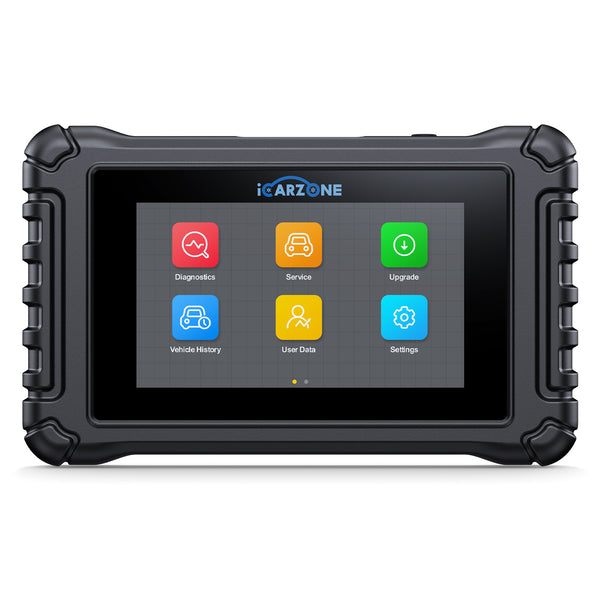
iCARZONE UR800 — 5" LCD OBD2 Scanner
P0111 is a rationality code, so the answer is in the live data. The UR800 graphs the IAT reading alongside the engine coolant temperature — so on a cold start you can see at a glance whether the IAT is plausible or reading wildly off. Live data and freeze-frame help you catch an intermittent fault, and all-system access reads the MAF data when the IAT is built into it.
- 5" LCD 854×480 touchscreen
- Live IAT + coolant-temp data
- Graphs sensor plausibility
- All-system / all-module access
- Freeze-frame + bidirectional tests
- 2-yr warranty + lifetime updates
How do you fix a P0111 code?
Start with data and a clean, not a new part. The cold-start comparison in Step 2 usually tells you whether the sensor is skewed, intermittent, or fine.
Scan all codes and note the freeze frame
- Record P0111 and any companion codes — other IAT codes (P0110/P0112/P0113), MAF codes (P0101), or lean codes (P0171/P0174) help point at a shared cause. Note the freeze frame.
- Confirm whether your vehicle has a standalone IAT or an IAT built into the MAF, so you test and clean the right part.
Compare IAT to coolant temp on a cold engine — your decisive check
- With the engine fully cold (ideally after sitting overnight), read the live IAT and engine coolant temperature. Both should sit close to ambient.
- If the IAT reads far from the coolant/ambient temperature, the sensor is skewed → clean or test it (Steps 3–5).
- If the IAT jumps around erratically, suspect a wiring or connector fault → Step 4.
Clean the IAT / MAF sensor element
- Remove the sensor (or the MAF, if the IAT is integrated) and clean the element with a MAF-safe sensor cleaner. Let it dry fully and never wipe or touch the element.
- If an over-oiled aftermarket air filter contaminated it, correct the oiling or fit a clean filter so it doesn't re-foul.
- Re-check the live reading after cleaning — many P0111 cases clear here.
Inspect the connector, wiring, and ground
- Check the connector for corrosion, water, and bent or spread pins; clean and protect with dielectric grease.
- Follow the signal and ground wires for chafing or breaks, especially near the hot engine, and back-probe for an intermittent fault.
- Confirm the sensor ground is clean and tight.
Measure the IAT resistance vs temperature
- Measure the sensor's resistance and compare it to the temperature-vs-resistance values in your vehicle's spec — resistance should be high when cold and drop as it warms.
- A reading that's off-spec, or doesn't change smoothly with temperature, confirms a faulty sensor.
Replace the sensor or MAF — final step
- If cleaning and wiring checks don't fix it, replace the IAT sensor (or the MAF, if the IAT is integrated) with the correct OEM-grade part for your vehicle.
- Clear the code and drive a warm-up cycle, then re-check that the live IAT reads plausibly against the coolant and ambient temperatures.
How much does P0111 cost to fix?
This is one of the cheaper codes to chase. A clean or a standalone sensor handles most cases for very little; only an integrated MAF or the rare PCM pushes the cost up.
| Repair | DIY | Shop | You save | Type |
|---|---|---|---|---|
| Diagnosis (scan + live IAT/coolant data) | $0 (free with tool) | $80–$150 | Up to $150 | Free First Step |
| Clean IAT / MAF sensor | $8–$20 | $50–$120 | Up to $110 | DIY Easy |
| Clean / repair ground | $0–$15 | $50–$150 | Up to $150 | DIY Easy |
| IAT sensor (standalone) | $15–$80 | $80–$200 | Up to $185 | DIY Easy |
| Connector / wiring repair | $10–$50 | $80–$200 | Up to $190 | DIY Moderate |
| MAF sensor (IAT integrated) | $50–$300 | $150–$450 | Up to $410 | DIY Moderate |
| PCM (rare) | $200–$600 | $400–$1,000 | Varies | Often Shop |
Which vehicles are most prone to P0111?
P0111 is a generic code that can appear on any OBD-II vehicle, but it's reported more on some platforms — often where the IAT is integrated into the MAF and prone to contamination. Deep-dives below.
| Make | Common models | Years | Primary cause & notes | Risk |
|---|---|---|---|---|
| Volkswagen / Audi | Jetta, Golf, Passat, A4, A3 | 2004–2019 | Sensor / MAF + wiring; a commonly reported platform. | Medium |
| Jeep / Dodge / Chrysler / RAM | Wrangler, Grand Cherokee, 1500 | 2007–2020 | Sensor / wiring; some addressed by PCM software updates. | Medium |
| Chevrolet / GM | Silverado, Cruze, Malibu, Equinox | 2005–2019 | IAT/MAF contamination; clean the element first. | Medium |
| Hyundai / Kia | Sonata, Elantra, Santa Fe, Sorento | 2007–2019 | Sensor drift; check the connector and ground. | Low |
| Ford / Lincoln | F-150, Focus, Escape, Fusion | 2004–2019 | IAT/MAF + wiring chafe near the engine. | Low |
| Nissan / Infiniti | Rogue, Altima, Sentra, Frontier | 2007–2019 | IAT sensor wear (documented Rogue cases). | Low |
| Toyota / Honda | Camry, Corolla, Civic, Accord, CR-V | 2004–2019 | Sensor / MAF; clean before replacing. | Low |
How the PCM catches P0111: the coolant-temp check
P0111 usually isn't an electrical fault — it's a plausibility (rationality) failure. Here's how the PCM decides the IAT is lying:
- The cold-start check. After the car sits overnight, the intake air, the coolant, and the engine block all settle to roughly the same ambient temperature. At the next start, the PCM compares the IAT to the engine coolant temperature (ECT). If they disagree by more than a set amount — say the IAT reads 30 °C while the coolant reads −5 °C — the IAT fails the check and P0111 sets.
- The rate check. The PCM also flags an IAT that swings too far, too fast — a larger-than-normal change in a shorter-than-expected time — which usually points to an intermittent wiring or connector fault.
- Why it matters. Because the sensor is still electrically connected (that's P0110's territory), P0111 is about a reading that doesn't make sense — so look at contamination, drift, and the live data, not just the wiring.
Action plan: read IAT and coolant temp on a fully cold engine → if they're far apart, the IAT is skewed → clean or test the sensor before replacing it.
On many cars the IAT lives inside the MAF — clean before you condemn
The single biggest time-saver on P0111 is knowing where your sensor actually is:
- Check if it's integrated. If your intake has a MAF sensor and no obvious standalone IAT, the IAT element is likely built into the MAF housing. That makes a dirty or contaminated MAF a prime P0111 suspect.
- The over-oiled filter trap. A re-oiled aftermarket air filter with too much oil can coat the MAF/IAT element and skew its reading — a very common cause. Clean the element with a MAF-safe cleaner and never touch it.
- Clean before you condemn. Cleaning the MAF/IAT often clears P0111 for the cost of a can of cleaner. Replace the MAF only if cleaning and wiring checks don't fix it.
Check for a TSB / recall: at NHTSA.gov enter your VIN or year/make/model and review bulletins related to the IAT or MAF sensor on your platform. NHTSA recalls & TSBs ›
Should you DIY or call a mechanic?
DIY if you…
- Can read live IAT and coolant-temp data on a cold start
- Can clean a sensor with MAF-safe cleaner
- Have a multimeter to check resistance and wiring
- Can reach the IAT or MAF sensor (usually easy)
- Want to clean and test before buying a part
- Want to save $80–$410 over shop diagnostic + labor
Use a mechanic if…
- The fault is intermittent and hard to catch
- You suspect a wiring fault buried in the harness
- The code returns after cleaning and a new sensor
- A PCM software update or repair is suspected
- You don't have a scanner that shows live data
- You'd rather not handle a delicate MAF element
Frequently asked questions
Is it safe to drive with a P0111 code?
Yes, in most cases — P0111 isn't an engine threat. You may notice slightly worse fuel economy, a little hesitation, or a harder cold start because the PCM is working from a questionable air-temperature reading, and you'll fail an emissions test. Fix it within a week or two, sooner if you have an inspection due or notice rough running.
What's the difference between P0111 and P0110?
P0110 is an electrical circuit malfunction — an open, short, or lost signal, so the sensor isn't sending usable data. P0111 means the sensor is still connected and sending a signal, but the reading is out of range or doesn't change logically — usually contamination, drift, or heat soak. Different faults, different fixes: P0110 points to wiring or a failed sensor, P0111 to a skewed reading.
Can a dirty MAF cause P0111?
Yes. On many vehicles the IAT sensor is built into the MAF, so a dirty or oil-contaminated MAF — often from an over-oiled aftermarket air filter — skews the air-temperature reading and sets P0111. Cleaning the MAF/IAT element with a MAF-safe cleaner often clears the code without a new part.
How much does it cost to fix P0111?
Often very little. Cleaning the IAT/MAF sensor is under $20 DIY. A standalone IAT sensor is roughly $15–$80 in parts; a MAF with an integrated IAT is $50–$300. Wiring or connector repairs run $10–$50. Shop labor adds $80–$150+. Many cases land under $100 once you've found the cause.
What scanner do I need to diagnose P0111?
One that shows live data so you can compare the IAT reading to the engine coolant temperature on a cold start — the quickest way to spot a skewed sensor. The iCARZONE UR800 ($299.99) is a 5-inch all-system scanner with live data graphing, freeze-frame, and bidirectional tests, plus the MAF data access you need when the IAT is integrated.
Why does P0111 keep coming back?
Usually because the root cause is still there. Re-check the IAT/MAF for contamination, inspect the connector and wiring for an intermittent fault, and confirm the ground is clean. If the sensor is integrated in the MAF, make sure you cleaned or replaced the right part — and that an over-oiled air filter isn't re-contaminating it.
Quick verdict
- Step 1 — free first: scan codes and read the live IAT and coolant temperature on a fully cold engine. If they're far apart, the IAT is skewed. $0 with a capable scanner.
- Step 2 — clean & check: clean the IAT/MAF element with sensor-safe cleaner, inspect the connector, wiring, and ground, and measure the sensor's resistance against spec.
- Step 3 — fix only what's proven: replace the IAT sensor (or the MAF if the IAT is integrated) with the correct part, then clear and verify the reading is plausible.
Compare the readings, find the fault
The iCARZONE UR800 graphs your intake-air temperature next to the coolant reading — so you can spot a skewed IAT sensor before buying parts, across 58 vehicle makes.