
P0134 Code: O2 Sensor No Activity (Bank 1, Sensor 1) — Fix & Cost

P0134 means your engine's upstream (bank 1) oxygen sensor has gone quiet — the computer expects a rapidly switching signal but sees a flat, dead line instead. It's an emissions and fuel-economy code, rarely an immediate engine threat, and most cases come down to a worn-out sensor or a failed sensor heater — often a DIY fix.
P0134 = "O2 Sensor Circuit No Activity Detected (Bank 1, Sensor 1)" — the PCM is watching the upstream oxygen sensor on bank 1 and sees a flat, unchanging signal instead of the rapid switching a healthy sensor produces.
A working oxygen sensor's voltage swings quickly between about 0.1V and 0.9V as the mixture shifts. With P0134 the signal sits still — often parked near the 0.45V bias voltage — telling the PCM the sensor is effectively dead. Because the sensor has to reach about 600°F to generate a signal, a failed internal heater is one of the most common reasons it never "wakes up." The PCM then runs open-loop on default fuel maps, which is why fuel economy drops.
Diagnostic priority: (1) read all codes + freeze frame (note any P0135); (2) graph the bank 1 sensor 1 voltage — flat vs switching is the answer; (3) check the heater circuit resistance, power, ground, and fuse; (4) inspect the connector and wiring; (5) check for an exhaust leak near the sensor; (6) replace the sensor with the correct part only after confirming the cause.
What does P0134 actually mean?
The upstream (pre-catalyst) oxygen sensor measures how much oxygen is left in the exhaust and reports it to the PCM as a constantly changing voltage. The PCM uses that switching signal to fine-tune fuel delivery in "closed loop." Bank 1 is the side of the engine that contains cylinder #1; Sensor 1 is the upstream sensor, before the catalytic converter.
P0134 sets when that signal shows no activity — it stops switching and sits flat. To the PCM, a sensor that never changes is a sensor it can't trust, so it stores the code, lights the Check Engine Light, and falls back to open-loop fueling. The usual physical reasons are a worn-out sensor element, a failed sensor heater (the sensor must hit ~600°F to work), or an open/corroded wire or connector that cuts the signal off. An exhaust leak near the sensor can mimic the same thing — which is why a quick live-data check beats simply bolting on a new sensor.
What are the symptoms of P0134?
Often the light is the main clue, but the open-loop fueling behind it can show up at the pump:
- Check Engine Light — steady; frequently the only obvious symptom
- Poor fuel economy — the PCM runs open-loop on default maps instead of trimming live
- Rough idle, hesitation, or low power — when fueling drifts off ideal
- Failed emissions / smog inspection — guaranteed while the code is active
- Fuel smell, black smoke, or fouled plugs — if open-loop fueling runs rich
- A faint rotten-egg (sulfur) smell — from incomplete combustion in some cases
- No driveability change at all — common; the code and the light may be the only signs
Is P0134 serious?
Low-to-moderate. The code doesn't threaten the engine, but it isn't "ignore it forever" either — here's the realistic picture:
- Failed O2 sensor or heaterno engine damage · $35–$350 fix
- Blown heater fuse / wiringno engine damage · $5–$200 fix
- Corroded connectorno engine damage · $10–$60 fix
- Failed emissions inspectionguaranteed until cleared
- Long-term open-loop runningworse MPG; can foul plugs / the cat over time
What causes a P0134 code? Ranked by frequency

A typical upstream oxygen sensor — when its signal goes flat instead of switching, the PCM sets P0134.
Failed Upstream O2 Sensor (Worn / Dead Element)
35% of casesThe most common cause. Oxygen sensors are a wear item — the sensing element ages, gets contaminated (oil, coolant, or silicone), or simply dies, and stops producing the switching signal the PCM expects. The voltage flatlines and the PCM logs "no activity." Most modern sensors have a built-in heater, so replacing the sensor usually cures both the signal and heater sides at once.
Fix: $35–$300 sensor + laborO2 Sensor Heater Failure (or Blown Heater Fuse)
25% of casesThe sensor only works once it reaches about 600°F, so it relies on an internal heater. If that heater fails — or its fuse blows — the sensor never warms up and stays inactive, setting P0134 (very often alongside P0135). Measure the heater circuit resistance against spec, confirm the heater has power and ground, and check the O2-heater fuse on vehicles that have one.
Fix: $2–$300 fuse or sensorWiring or Connector Fault
18% of casesAn open or shorted signal/heater wire, a corroded connector, or a chafed harness near the hot exhaust can cut the sensor off so the PCM sees nothing. Inspect the connector for green corrosion, melted plastic, and bent or spread pins, and check the wiring along its run — especially where it passes near the exhaust.
Fix: $10–$200 wiring / connectorExhaust Leak Near the Sensor
10% of casesA crack or leak in the manifold or pipe ahead of the sensor pulls in outside air and can skew or flatten the reading, imitating a dead sensor. A cracked exhaust manifold is a classic cause of a "sensor" code that a new sensor won't fix. Inspect for leaks and listen for ticking near the manifold before condemning the sensor.
Fix: $20–$600 leak repairRich / Lean Fuel Condition Confusing the PCM
7% of casesSometimes the sensor is fine but a fuel problem upsets it. Leaking injectors — a known issue on some Honda hybrids — flood the exhaust and can confuse the PCM into setting sensor codes; a large vacuum or exhaust leak can do the same. Check the spark plugs for fouling and read fuel trims before replacing an expensive sensor.
Fix: varies with the fuel repairPower / Ground Loss or PCM Fault
5% of cases · RareA loss of reference voltage or ground to the sensor, or — rarely — a PCM fault, can produce no activity. Confirm the sensor has clean power and ground first. Suspect the PCM only after the sensor, heater, wiring, connector, and exhaust have all checked out.
Fix: varies — diagnose power/ground firstWhat you'll need
Tools
- OBD2 scanner with live O2 data graphing iCARZONE UR800 ›
- Digital multimeter (ohms for heater, volts for signal)
- O2 sensor socket (22 mm / 7⁄8")
- Back-probe pins / test leads
- Anti-seize compound for the new sensor threads
- Wiring diagram + O2-heater spec for your vehicle
Parts & supplies
- Upstream O2 sensor (B1S1, OEM-grade)$35–$300
- Air/Fuel ratio sensor (some Japanese models)$80–$400
- O2 heater fuse$2–$8
- Connector / pigtail$10–$50
- Wiring repair supplies$10–$30
- Exhaust gasket / leak repair (if needed)$10–$60
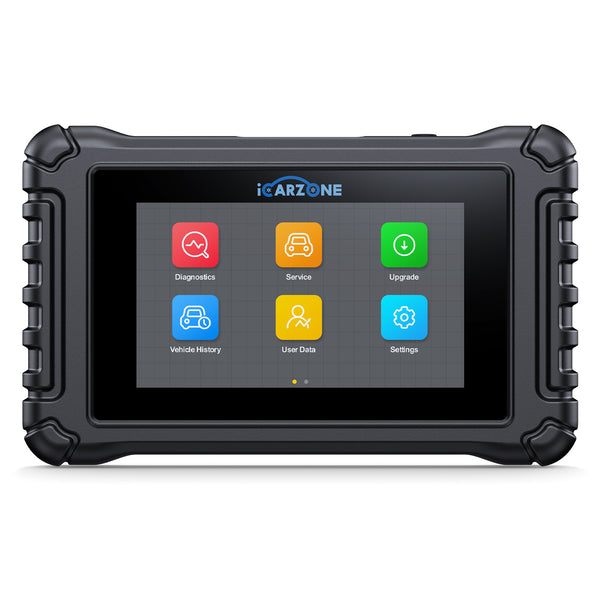
iCARZONE UR800 — 5" LCD OBD2 Scanner
P0134 is all about whether the sensor signal moves. The UR800 graphs the upstream O2 voltage live, so you can see at a glance whether it's switching like a healthy sensor or sitting flat — the fastest way to confirm a dead sensor or heater. Freeze-frame shows the conditions when the code set, and all-system access lets you read companion codes like P0135 across most domestic, Asian, and European platforms.
- 5" LCD 854×480 touchscreen
- Live O2 data graphing
- Reads heater / companion codes
- Freeze-frame + I/M readiness
- Bidirectional / active tests
- 2-yr warranty + lifetime updates
How do you fix a P0134 code?
Work in order. The live-graph in Step 2 is your free, decisive check — it tells you immediately whether the sensor is dead, starved by an exhaust leak, or simply intermittent.
Scan all codes and note the freeze frame
- Record every code with freeze-frame data. P0134 very often appears with P0135 (heater circuit), and sometimes P0154 (no activity, bank 2) — seeing both banks at once points to a shared fuse or ground.
- Confirm bank 1, sensor 1 is the upstream sensor on the side with cylinder #1, so you test and replace the right one.
Graph the upstream O2 voltage — your free, decisive check
- With the engine warm and running, graph the bank 1 sensor 1 voltage. Healthy = rapid swings between ~0.1V and ~0.9V. A flat line is the fault.
- Flat near 0.45V (the bias voltage) → a dead sensor or a non-working heater.
- Stuck low/lean → suspect an exhaust leak near the sensor or a wiring problem.
- If it actually switches normally, the fault may be intermittent or a stored history code — recheck wiring and connectors.
Check the heater circuit, power, ground, and fuse
- Unplug the sensor and measure the heater element's resistance against your vehicle's spec (commonly a few up to ~15 ohms — verify the figure for your car). An open reading means a dead heater.
- Confirm the heater has battery voltage on the feed and a good ground with the key on.
- Check the O2-heater fuse on vehicles that use one; a blown fuse takes the sensor offline.
Inspect the connector and wiring
- Look at the sensor connector for corrosion, water, melted plastic, and bent or spread pins; clean or repair as needed.
- Follow the signal and heater wires along their run for chafing or breaks, especially where the harness passes near the hot exhaust.
- Back-probe the signal wire with the engine running to see whether the fault follows the sensor or the wiring.
Check for an exhaust leak near the sensor
- Inspect the exhaust manifold and pipe ahead of the sensor for cracks, leaking gaskets, or a telltale ticking on cold start.
- A leak upstream of the sensor lets in outside air and can flatten or skew the reading — fix the leak before replacing the sensor.
Replace the O2 sensor — final step
- Fit the correct OEM-grade sensor for your vehicle — note that some Japanese models use an Air/Fuel ratio sensor, which is not interchangeable with a conventional O2 sensor.
- Use anti-seize on the threads (if not pre-applied) and torque to spec.
- Clear the code and drive a full warm-up cycle, then re-graph the signal to confirm it switches normally. If it returns, recheck wiring, the heater fuse, and the exhaust.
How much does P0134 cost to fix?
Costs run from a couple of dollars for a heater fuse to a few hundred for an Air/Fuel ratio sensor — and more only if an exhaust leak needs repair. Many cases resolve with a sensor or wiring fix for under $200 DIY.
| Repair | DIY | Shop | You save | Type |
|---|---|---|---|---|
| Diagnosis (scan + live O2 graph) | $0 (free with tool) | $80–$150 | Up to $150 | Free First Step |
| O2 heater fuse | $2–$8 | $40–$90 | Up to $85 | DIY Easy |
| O2 connector / pigtail repair | $10–$50 | $80–$200 | Up to $190 | DIY Moderate |
| Signal / heater wiring repair | $10–$40 | $90–$250 | Up to $220 | DIY Moderate |
| Upstream O2 sensor (Bank 1, Sensor 1) | $35–$300 | $150–$450 | Up to $410 | DIY Moderate |
| Air/Fuel ratio sensor (some Japanese) | $80–$400 | $200–$550 | Up to $470 | DIY Moderate |
| Exhaust leak repair near the sensor | $20–$300 | $150–$600 | Up to $580 | Often Shop |
Which vehicles are most prone to P0134?
P0134 is a generic code, and because bank 1, sensor 1 exists on every OBD-II vehicle — four-cylinder and V-engine alike — it can appear on almost any make. A few patterns are worth knowing, especially the Air/Fuel ratio sensor used by many Japanese models. Deep-dives below.
| Make | Model / engine | Years | Primary cause & notes | Risk |
|---|---|---|---|---|
| Toyota / Lexus | Camry, Corolla, RAV4, Tacoma, Tundra | 2000–2020 | Often an Air/Fuel ratio sensor (not a plain O2); heater/element aging. | Medium |
| Honda / Acura | Civic, Accord, CR-V, Pilot, Odyssey | 2000–2020 | A/F sensor; on some, rich from leaking injectors sets false codes — check plugs. | Medium |
| Ford / Lincoln | F-150, Focus, Escape, Explorer, Fusion | 2002–2019 | Sensor / heater aging; wiring chafe near the manifold. | Medium |
| GM / Chevrolet / GMC | Silverado, Malibu, Equinox, Tahoe, Cruze | 2000–2019 | Heater circuit + connector corrosion. | Medium |
| Nissan / Infiniti | Altima, Sentra, Rogue, Frontier | 2002–2019 | Sensor aging; check the O2-heater fuse. | Low |
| Volkswagen / Audi | Jetta, Golf, Passat, A3, A4 | 2004–2018 | Faulty sensor plus wiring and exhaust-leak cases. | Medium |
| BMW / Mercedes-Benz | 3 / 5 Series, C / E-Class | 2004–2018 | Sensor aging; cracked exhaust manifolds cause false readings. | Low |
Is it the sensor, or the heater?
P0134 and a dead heater are so closely linked that it's worth separating them before you spend:
- Why the heater matters. The sensor can't produce a signal until it reaches about 600°F. Modern sensors carry a built-in heater to get there quickly; if that heater dies, the sensor stays cold and inactive — setting P0134, very often alongside P0135 (heater circuit).
- How to tell them apart. Measure the heater circuit resistance against spec and confirm it has power and ground. An open heater (or a blown O2-heater fuse) points to the heater side; a flat signal with a good heater points to a dead sensing element.
- One part, usually. Because the heater is built into the sensor, replacing the upstream sensor typically fixes both — so confirm the heater and signal first, then replace once with the correct OEM-grade part.
Action plan: graph the signal → if flat, measure heater resistance + check the O2-heater fuse → replace the sensor (heater integral) with OEM-grade → verify it switches after a full warm-up.
P0134 by platform — and the A/F sensor catch
The single biggest buying mistake on this code is fitting the wrong type of sensor:
- Air/Fuel ratio sensors. Many Japanese vehicles (Toyota, Honda) use an A/F ratio sensor in the sensor-1 position instead of a conventional narrowband O2 sensor. It reads differently, costs more, and is not interchangeable — order the correct part for your VIN.
- Honda injector trap. On some Honda models, leaking fuel injectors flood the exhaust and trick the PCM into setting sensor codes. Check the spark plugs for fouling before replacing an expensive A/F sensor.
- European exhaust leaks. On VW/Audi and BMW/Mercedes, a cracked exhaust manifold or damaged wiring is a common cause of a "sensor" code that a new sensor won't fix — inspect the manifold and harness first.
Check for a TSB / recall: at NHTSA.gov enter your VIN or year/make/model and review bulletins related to O2 or A/F sensors on your platform. NHTSA recalls & TSBs ›
Should you DIY or call a mechanic?
DIY if you…
- Can graph live O2 voltage and read freeze-frame
- Have a multimeter and an O2 sensor socket
- Can measure heater resistance and check a fuse
- Can reach the upstream sensor (before the cat)
- Want to confirm sensor-vs-heater-vs-wiring before buying
- Want to save $100–$450 over shop diagnostic + labor
Use a mechanic if…
- The sensor is seized into a rusty manifold
- You suspect a cracked exhaust manifold
- The vehicle uses a pricey A/F sensor you want diagnosed first
- Wiring damage is buried or hard to trace
- The code persists after a new sensor (deeper fault)
- You don't have a scanner that graphs live O2 data
Frequently asked questions
Can I drive with a P0134 code?
Short-term, yes — it usually won't strand you. But with the upstream sensor inactive the PCM runs open-loop on default fuel maps, so you'll burn more fuel, may run a little rough, and will fail an emissions test. Prolonged open-loop running can foul plugs and stress the catalytic converter, so plan to fix it within a week or two.
What's the difference between P0134 and P0135?
P0134 means the O2 sensor shows no signal activity — a flat, dead reading. P0135 means a fault in that sensor's heater circuit. They're closely linked: the sensor needs about 600°F to work, so a failed heater (P0135) commonly causes the inactivity (P0134). You'll often see both together, and replacing the sensor — which contains the heater — usually clears both.
Is P0134 always a bad oxygen sensor?
No. A failed sensor or heater is most common, but an open or corroded wire or connector, a blown O2-heater fuse, or an exhaust leak near the sensor can all produce "no activity" with a perfectly good sensor. Graph the live signal and check the heater circuit and wiring before buying a sensor.
How much does it cost to fix P0134?
Often modest. An O2-heater fuse is a few dollars; a connector or wiring repair is $10–$50 DIY. An upstream O2 sensor is roughly $35–$300 in parts, and an Air/Fuel ratio sensor (some Japanese models) $80–$400. Shop labor adds $80–$200+. Many cases land under $200 DIY once you've confirmed the cause.
What scanner do I need to diagnose P0134?
One that graphs live O2 sensor voltage, so you can see whether the upstream signal is switching or sitting flat — the quickest confirmation of a dead sensor or heater. The iCARZONE UR800 ($299.99) is a 5-inch scanner with live data graphing, freeze-frame, I/M readiness, and bidirectional tests, plus all-system access to read companion codes like P0135.
Why does P0134 come back after I replaced the O2 sensor?
Usually because the sensor wasn't the root cause. Check for an open or corroded heater/signal wire, a blown O2-heater fuse, or an exhaust leak near the sensor that's skewing the reading. On some Honda models, leaking injectors fouling the plugs can set sensor codes — and make sure you fitted the correct part, since a conventional O2 sensor and an Air/Fuel ratio sensor are not interchangeable.
Quick verdict
- Step 1 — free first: scan codes (note any P0135) and graph the upstream O2 voltage. Flat = the fault; switching = likely intermittent. $0 with a capable scanner.
- Step 2 — confirm the cause: measure heater resistance and power, check the O2-heater fuse and connector/wiring, and look for an exhaust leak near the sensor.
- Step 3 — fix only what's proven: replace the upstream sensor (heater integral) with the correct OEM-grade part, then clear and drive-cycle verify it switches.
See whether the signal is alive
The iCARZONE UR800 graphs your upstream O2 voltage live — so you can tell a dead sensor from a wiring or heater fault before buying parts, across 58 vehicle makes.
0 comments