
P01F0 Code Fix: Coolant Temp Below Diagnostic Monitoring Threshold

P01F0 means your engine's coolant temperature fell back below the level the computer needs to run its self-tests — in plain terms, the engine isn't holding normal operating temperature. It's almost always a thermostat stuck open or a faulty coolant temperature sensor. It won't strand you, but it wastes fuel, slows warm-up, and over time raises wear and emissions.
P01F0 = "Coolant Temperature Relapsed Below Diagnostic Monitoring Temperature" — the engine control module (ECM) saw the coolant temperature fall back below the threshold it needs to run its emission self-tests.
To run its diagnostic monitors and switch to closed-loop fuel control, the ECM needs the engine at a minimum temperature. With P01F0, the coolant reached that point but then dropped back below it — it "relapsed." That almost always means the engine can't hold heat: a thermostat that's stuck open or opens too early, or a coolant temperature (ECT) sensor reading falsely low. It's a cooling-system and emissions code, not an engine-failure one.
Diagnostic priority: (1) scan codes + freeze frame; (2) graph the live coolant temperature through a full warm-up — does it reach and hold ~90 °C?; (3) test the thermostat; (4) test the ECT sensor and wiring; (5) check coolant level and fan operation; (6) replace the thermostat or sensor, then bleed, clear, and verify.
What does P01F0 actually mean?
Your engine runs best — and cleanest — at a normal operating temperature of roughly 90 °C (195 °F). Two parts keep it there: the thermostat, which blocks coolant flow to the radiator until the engine warms up and then regulates it to hold temperature, and the coolant temperature (ECT) sensor, which reports that temperature to the ECM. The ECM needs the engine warm before it will run its emission self-tests and move into closed-loop fuel control.
P01F0 sets when the coolant temperature relapses below the diagnostic monitoring temperature — the engine warmed up, but then the coolant fell back below the minimum the ECM requires. Unlike a code for an engine that never warms up, P01F0 is specifically about an engine that can't hold its heat. The usual reasons are a thermostat stuck open (or opening too early) letting the engine shed heat, or an ECT sensor reading lower than the real temperature. Exact trigger thresholds vary by make, but the core issue is the same across vehicles.

Graphing live coolant temperature: a healthy engine reaches and holds ~90 °C; with P01F0 it relapses below the threshold.
What are the symptoms of P01F0?
The clues point at an engine that won't get — or stay — warm:
- Check Engine Light — often the main indicator
- Slow engine warm-up — takes much longer than normal to reach temperature
- Weak or cool heater — cabin heat is lukewarm, worst in cold weather
- Temperature gauge stays low — sits below normal or fluctuates
- Worse fuel economy — the ECM runs warm-up enrichment / open-loop longer
- Rough or higher cold idle — in some cases, until the engine warms
- Few other symptoms — sometimes just slow warm-up and the light
Is P01F0 serious?
Low to moderate. It's a fuel-economy, comfort, and emissions issue rather than a mechanical danger — here's the realistic picture:
- Thermostat replacementno engine damage · $15–$350 fix
- ECT sensor / wiringno engine damage · $15–$200 fix
- Engine itselfnot at risk from this code
- Running cool long-termworse MPG, more wear & emissions
- Weak winter heatcabin heater underperforms
What causes a P01F0 code? Ranked by frequency

The leading P01F0 causes: a thermostat stuck open and a faulty coolant temperature sensor.
Thermostat Stuck Open (or Opening Too Early)
45% of casesBy far the most common cause. A thermostat stuck open — or one that opens earlier than it should — lets coolant circulate to the radiator constantly, so the engine sheds heat faster than it makes it and can't hold operating temperature. The coolant reaches the diagnostic temperature briefly, then falls back below it, especially in cold weather or at highway speed. A new thermostat is usually the fix.
Fix: $15–$80 thermostat + laborFaulty Coolant Temperature (ECT) Sensor
25% of casesThe ECT sensor reports coolant temperature to the ECM. A drifting or failing sensor can read falsely low — telling the ECM the engine is cooler than it really is — and set P01F0 even when the engine is at temperature. Confirm with a second reading (an infrared thermometer or scan-tool comparison) before replacing the sensor.
Fix: $15–$80 sensorLow Coolant Level or Air in the System
10% of casesLow coolant or a trapped air pocket disrupts heat transfer and can leave the ECT sensor reading inaccurately or the engine slow to warm. Check the coolant level and condition, top up as needed, and bleed the system of air before chasing parts.
Fix: $10–$40 coolant / bleedCooling Fan Running Too Much / Stuck On
8% of casesA cooling fan that runs constantly — from a stuck relay, a faulty fan switch, or a wiring fault — over-cools the engine so it can't reach or hold temperature. Confirm the fan cycles on and off normally rather than running all the time.
Fix: $50–$300 fan / relayECT Wiring or Connector Fault
7% of casesA corroded connector, high resistance, or a chafed wire in the ECT circuit can skew the temperature signal low and trigger the code with a good sensor. Inspect and clean the connector and check the wiring for damage before condemning the sensor.
Fix: $10–$50 wiring / connectorWrong Thermostat or Cold-Climate Factors
5% of cases · RareA previously fitted wrong-temperature thermostat, a stuck-open heater control valve, or sustained driving in extreme cold can all keep coolant below the diagnostic threshold. Verify the correct thermostat is installed for your vehicle before looking further.
Fix: varies — verify the correct partsWhat you'll need
Tools
- Scanner with live coolant-temp graphing iCARZONE UR1000 ›
- Infrared thermometer (to verify real coolant temp)
- Digital multimeter (ohms vs temperature)
- Basic hand tools for the thermostat housing
- Coolant + funnel (and a bleeding kit if needed)
- Wiring diagram + ECT resistance/temperature spec
Parts & supplies
- Thermostat (correct temperature rating)$15–$80
- Coolant temperature (ECT) sensor$15–$80
- Thermostat gasket / housing$10–$60
- Coolant (correct spec)$15–$40
- ECT connector / pigtail$10–$30
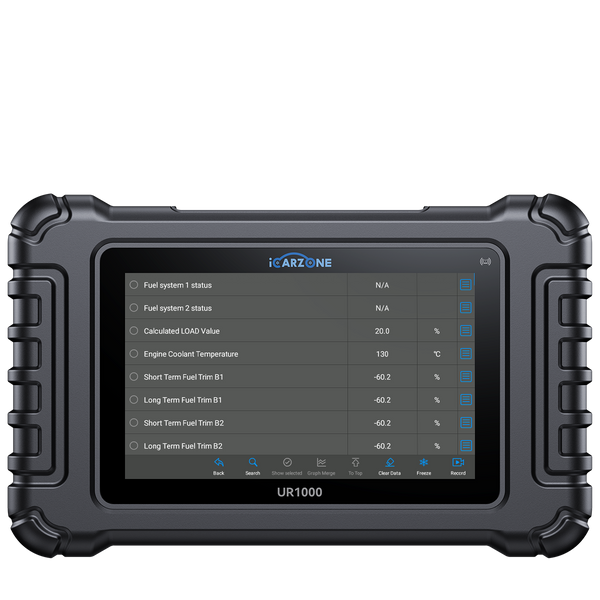
iCARZONE UR1000 — 7" Wireless All-System Scanner
P01F0 is solved by watching the coolant warm up. The UR1000 graphs the live coolant temperature over a full drive, so you can see at a glance whether the engine reaches and holds ~90 °C or keeps falling back — the fastest way to pin a stuck-open thermostat versus a false sensor reading. Its bidirectional tests can command the cooling fan, and all-system access reads the data a basic reader can't.
- 7" wireless touchscreen (33 ft range)
- Live coolant-temperature graphing
- All-system OE-level diagnostics
- 40,000+ bidirectional / active tests
- 49 services + CAN FD
- 100+ brands · lifetime free updates
How do you fix a P01F0 code?
Let the live data lead. Graphing the coolant warm-up tells you in one drive whether you're chasing the thermostat, the sensor, or the wiring.
Scan all codes and note the freeze frame
- Record P01F0 and any companion codes — related coolant codes (P0128, P0125) or ECT sensor codes (P0116–P0119) help point at the cause. Note the freeze-frame conditions.
- Confirm your engine's normal operating temperature and the ECT location so you know what "normal" looks like on the live data.
Graph the live coolant temperature — your decisive check
- Watch the coolant temperature on the scanner from a cold start through a full warm-up and a highway run.
- If it never reaches ~90 °C, the thermostat is likely stuck open. If it reaches temperature but falls back below the threshold (often on the highway in cold weather), the thermostat is weak or opening too early.
- If it climbs and holds normally but the ECT reading is erratic or implausible, suspect the sensor or its wiring.
Test the thermostat
- With the engine warming, feel (carefully) or measure the upper radiator hose — it should stay cool until the thermostat opens, then warm up. A hose that's warm almost immediately suggests a thermostat stuck open.
- If in doubt, remove the thermostat and test it in hot water to confirm it opens at the rated temperature; replace if it's stuck or wrong-rated.
Test the ECT sensor and wiring
- Compare the scan-tool coolant temperature to an infrared thermometer reading at the sensor — a big gap means the sensor (or its wiring) is reading wrong.
- Measure the ECT sensor resistance against the temperature-vs-resistance spec, and check the connector and wiring for corrosion or high resistance.
Check coolant level and fan operation
- Verify the coolant level and condition, and bleed any trapped air, which can skew readings and heat-up.
- Confirm the cooling fan cycles on and off normally rather than running constantly and over-cooling the engine.
Replace the thermostat or sensor — final step
- Fit the correct-temperature thermostat (or the ECT sensor) for your vehicle, refill with the right coolant, and bleed the system properly.
- Clear the code and drive a full warm-up cycle, then confirm on the live data that the coolant reaches and holds normal operating temperature.
How much does P01F0 cost to fix?
This is an inexpensive code in most cases. A thermostat or a coolant sensor handles the vast majority of repairs; only a cooling-fan or wiring fault pushes the cost up.
| Repair | DIY | Shop | You save | Type |
|---|---|---|---|---|
| Diagnosis (scan + live temp graph) | $0 (free with tool) | $80–$150 | Up to $150 | Free First Step |
| Coolant top-up / bleed | $10–$40 | $50–$120 | Up to $110 | DIY Easy |
| Coolant temperature (ECT) sensor | $15–$80 | $80–$200 | Up to $185 | DIY Easy |
| ECT connector / wiring repair | $10–$50 | $80–$200 | Up to $190 | DIY Moderate |
| Thermostat | $15–$80 | $150–$350 | Up to $335 | DIY Moderate |
| Cooling fan / fan relay | $50–$300 | $200–$500 | Up to $450 | Often Shop |
Which vehicles are most prone to P01F0?
P01F0 is a generic powertrain code that can appear on any vehicle — wherever a thermostat sticks open or a coolant sensor drifts. It's reported across makes; the exact threshold varies, but the cause is usually the same. Deep-dives below.
| Make | Common models | Years | Primary cause & notes | Risk |
|---|---|---|---|---|
| BMW / Mini | 3 / 5 Series, X3, X5, Mini Cooper | 2007–2019 | Thermostat (often electronically controlled) & ECT; a commonly reported platform. | Medium |
| Volkswagen / Audi | Jetta, Golf, Passat, A4, Q5 | 2006–2019 | Thermostat housing / ECT; check the live warm-up. | Medium |
| Ford / Lincoln | F-150, Focus, Escape, Fusion | 2005–2019 | Stuck-open thermostat; usually a cheap fix. | Medium |
| Chevrolet / GM | Silverado, Cruze, Equinox, Malibu | 2005–2019 | Thermostat & ECT sensor. | Medium |
| Chrysler / Dodge / Jeep / RAM | 1500, Grand Cherokee, Wrangler | 2007–2019 | Thermostat / coolant sensor; verify the rating. | Low |
| Toyota / Honda | Camry, Corolla, Civic, Accord, CR-V | 2005–2019 | Thermostat (less common); check the ECT first. | Low |
| Hyundai / Kia / Nissan | Sonata, Elantra, Altima, Rogue | 2007–2019 | Thermostat / ECT wiring. | Low |
The usual culprit: a thermostat stuck open
Before testing sensors or wiring, rule out the cheapest and most common cause:

The cooling system: a thermostat stuck open keeps coolant flowing so the engine can't hold temperature — the usual P01F0 cause.
- How it causes P01F0. A thermostat stuck open (or opening too early) keeps coolant flowing to the radiator all the time, so the engine sheds heat faster than it builds it. It can't hold the temperature the ECM needs, the reading falls below the diagnostic threshold, and P01F0 sets.
- The tell-tale signs. Slow warm-up, a heater that blows cool, and a temperature gauge that stays low — especially in cold weather or on the highway — all point to the thermostat.
- Confirm with data. Graph the live coolant temperature: a healthy system climbs to ~90 °C and holds; a stuck-open thermostat never gets there or drops back down. Replacing the thermostat — a cheap part — fixes most cases.
Action plan: graph the warm-up → if the coolant won't reach or hold ~90 °C, suspect the thermostat → confirm the ECT reads accurately before replacing it.
What "relapsed below" actually means
P01F0's full name — "Coolant Temperature Relapsed Below Diagnostic Monitoring Temperature" — is a mouthful, so here's what it describes:
- The ECM needs heat. To run its emission self-tests and switch to closed-loop fuel control, the ECM needs the engine at a minimum coolant temperature — the "diagnostic monitoring temperature," often around 50 °C / 122 °F or higher depending on the vehicle.
- "Relapsed" = warmed, then cooled. Unlike P0128 (which sets when the engine never reaches temperature), P01F0 means the coolant did reach the monitoring temperature but then fell back below it. That points to an engine that can't hold heat — a thermostat opening too early or stuck open, or losing temperature under load on a cold highway.
- What it points to. A thermostat that won't keep the engine at temperature is the leading cause; a falsely-low ECT reading is the other. Either way, the live coolant-temperature graph tells the story.
Check for a TSB / recall: at NHTSA.gov enter your VIN or year/make/model for bulletins related to the thermostat or coolant temperature sensor on your platform. NHTSA recalls & TSBs ›
Should you DIY or call a mechanic?
DIY if you…
- Can read and graph live coolant-temperature data
- Can compare it to an infrared thermometer reading
- Are comfortable replacing a thermostat and bleeding coolant
- Have a multimeter to test the ECT sensor
- Want to confirm thermostat-vs-sensor before buying parts
- Want to save $80–$450 over shop diagnostic + labor
Use a mechanic if…
- The thermostat is buried or hard to access
- The cooling system is awkward to bleed on your vehicle
- You suspect a cooling-fan or wiring fault
- The code returns after a thermostat and sensor
- You don't have a scanner that graphs live data
- You'd rather not work with hot coolant
Frequently asked questions
Is it safe to drive with a P01F0 code?
Yes — P01F0 doesn't put the engine at risk, so the car is safe to drive. The downsides are everyday ones: worse fuel economy, a weak cabin heater (especially in winter), and more wear and emissions from running cool, plus a permanent Check Engine Light. Fix it within a few weeks, sooner if you rely on the heater in cold weather.
What's the difference between P01F0 and P0128?
Both are coolant-temperature codes about an engine that won't hold heat, and a stuck-open thermostat is the usual cause of each. P0128 sets when the coolant doesn't reach the thermostat's regulating temperature in the expected time. P01F0 is about the coolant falling back below the temperature the ECM needs for its diagnostics — it "relapsed" below the monitoring threshold. The fix is usually the same: the thermostat, or the coolant sensor.
Can a stuck thermostat really cause P01F0?
Yes — it's the leading cause. A thermostat stuck open keeps coolant flowing to the radiator constantly, so the engine can't build and hold operating temperature. The coolant drops below the diagnostic threshold and P01F0 sets. Watching the live coolant temperature fail to reach or hold ~90 °C is the classic confirmation, and a new thermostat usually fixes it.
How much does it cost to fix P01F0?
Usually modest. A thermostat is roughly $15–$80 in parts (DIY) or $150–$350 at a shop; a coolant temperature sensor is $15–$80 in parts. Coolant and a bleed add a little, and a cooling-fan or wiring fault costs more. Many cases land under $200 DIY once the live data shows whether it's the thermostat or the sensor.
What scanner do I need to diagnose P01F0?
One that graphs live coolant temperature so you can watch the engine warm up and see whether it reaches and holds normal temperature — the quickest way to separate a thermostat from a sensor fault. The iCARZONE UR1000 ($499.99) offers all-system access, live data graphing, 40,000+ bidirectional tests, and CAN FD support.
Why does P01F0 come back after I replaced the thermostat?
Usually because the thermostat wasn't the only issue — or the replacement is the wrong temperature rating or was installed with trapped air. Re-bleed the cooling system, verify the correct thermostat, and check the coolant temperature sensor and its wiring, since a falsely-low ECT reading will keep setting the code with a good thermostat.
Quick verdict
- Step 1 — free first: scan codes + freeze frame, then graph the live coolant temperature through a full warm-up. $0 with a capable scanner.
- Step 2 — read the warm-up: coolant that won't reach or hold ~90 °C points to the thermostat; a holding temperature with an erratic ECT reading points to the sensor or wiring.
- Step 3 — fix only what's proven: replace the correct-rated thermostat (or the ECT sensor), bleed the system, then clear and verify the coolant reaches and holds temperature.
Watch the warm-up, find the fault
The iCARZONE UR1000 graphs your live coolant temperature over a full drive — so you can see whether the engine holds heat and pinpoint a P01F0 thermostat or sensor before buying parts, across 100+ brands.
0 comments