
P0462 Code: Fuel Level Sensor Circuit Low Input — Symptoms & Fix

P0462 means the fuel-level sensor in your tank is sending a signal that's too low for the computer to trust — so your fuel gauge can't be relied on. It won't hurt the engine, but it can leave you guessing how much fuel you really have. The cause is usually a worn sender, a short to ground, or a wiring fault, and many cases are a DIY fix.
P0462 = "Fuel Level Sensor Circuit Low Input" — the computer (often the PCM, body module, or instrument cluster) is reading a fuel-level signal voltage below the normal range, typically under about 0.5V.
The fuel-level sender is a float on an arm that moves a variable resistor inside the tank; its changing resistance becomes a voltage that drives your gauge. P0462 means that voltage is stuck too low — pointing to a shorted or worn sender, a signal wire shorted to ground, or a wiring/connector fault. It's an electrical fault, not a mechanical one: a stuck float alone usually just gives a wrong gauge reading without setting this code.
Diagnostic priority: (1) scan codes and read the live fuel-level value; (2) compare it to the actual fuel and check the signal at the tank connector; (3) inspect the connector and ground at the fuel-pump module; (4) measure the sender's resistance across its range; (5) repair the wiring or replace the sender, then clear and verify the gauge.
What does P0462 actually mean?
Your fuel gauge doesn't measure fuel directly — it reads a fuel-level sender inside the tank. The sender is a float on a moveable arm; as the fuel level rises and falls, the arm sweeps across a variable resistor, changing the resistance. That resistance turns into a voltage signal that the computer (PCM, body control module, or instrument cluster, depending on the vehicle) uses to drive the gauge and the distance-to-empty estimate.
P0462 sets when that signal voltage falls below the calibrated minimum — typically under about 0.5V. The key word is circuit: this is an electrical low-voltage condition, not simply a stuck float. A worn resistor track, a signal wire shorted to ground (often from water in the connector), or a high-resistance/open wiring fault can all pull the reading low. Because it's a circuit fault, the diagnosis lives in the live data and the wiring — not in shaking the tank.
What are the symptoms of P0462?
The clues almost all point at the fuel gauge:
- Check Engine Light — often alongside a fuel-gauge problem
- Fuel gauge stuck on empty (or full) — the classic P0462 symptom
- Gauge reads erratically — jumps between E and F or sits at a fixed point
- "Low fuel" warning light on — even when the tank has plenty of fuel
- No change after refueling — the gauge doesn't move when you add fuel
- Wrong distance-to-empty — the trip computer's range is off
- EVAP monitor won't complete — readiness stays incomplete, blocking emissions testing
Is P0462 serious?
Low severity. It's an inconvenience-and-emissions issue, not a mechanical threat — here's the realistic picture:
- Wiring / connector or ground repairno engine damage · $5–$200 fix
- Fuel-level sender replacementno engine damage · $30–$500 fix
- Untrustworthy fuel gaugerisk of running out of fuel unexpectedly
- EVAP monitor won't setcan block an emissions inspection
- Engine, brakes & transmissioncompletely unaffected
What causes a P0462 code? Ranked by frequency

A fuel-level sender — its float and variable resistor set the gauge signal; a worn track makes it read low and sets P0462.
Faulty Fuel-Level Sender (Worn Resistor Track)
35% of casesThe most common cause. The sender's variable resistor wears a dead spot or open into its track over time, so it outputs a constant low (or zero) voltage regardless of float position. The sender is part of the fuel-pump module inside the tank, and on many vehicles it's replaced as an assembly.
Fix: $30–$400 sender / moduleSignal Wire Shorted to Ground
25% of casesIf the sender's signal wire shorts to ground — often from water ingress at the tank connector or chafed insulation — the computer reads a voltage near zero and sets P0462. Inspect the connector for moisture and corrosion and check the wire's routing for damage; a short to ground is a leading cause of a "low" reading.
Fix: $10–$200 wiring repairWiring / Connector Fault (Corrosion, High Resistance)
20% of casesCorroded pins, a loose connector, or a chafed harness between the sender and the module can drop or distort the signal. The connector usually sits on top of the fuel-pump module, exposed to dirt and moisture. Clean or repair the connector and check the wiring for continuity and resistance.
Fix: $10–$150 connector / pinsPoor or Corroded Ground
10% of casesA bad ground reference in the sender circuit can skew the voltage the computer sees and trigger the code. Locate and clean the relevant ground point to bare metal and confirm a solid connection before suspecting the sender itself.
Fix: $0–$30 clean / repair groundFaulty PCM / Body Module / Instrument Cluster
6% of cases · RareRarely, the input stage of the module that reads the fuel-level signal develops an internal fault, so it logs a low reading even with a healthy sender and clean wiring. Confirm the sender, wiring, connector, and ground are all good before suspecting the module — it's the last and most expensive answer.
Fix: varies — diagnose everything else firstWrong or Aftermarket Sender / Fuel-Pump Module
4% of cases · RareA previously installed sender or fuel-pump assembly that's the wrong part or a low-quality unit can read out of range from the start. If the code appeared right after a recent fuel-pump or sender replacement, verify the part is correct for your vehicle.
Fix: $30–$400 correct partWhat you'll need
Tools
- All-system scanner with live fuel-level data iCARZONE UR800 ›
- Digital multimeter (volts, ohms, continuity)
- Back-probe pins / test leads
- Fuel-pump module lock-ring tool (for tank access)
- Electrical contact cleaner + dielectric grease
- Wiring diagram + sender resistance spec for your vehicle
Parts & supplies
- Fuel-level sensor / sending unit$30–$200
- Fuel-pump module (sender integral)$100–$400
- Connector / pigtail / terminals$10–$40
- Wiring repair supplies$10–$30
- Tank lock-ring seal / gasket$5–$20
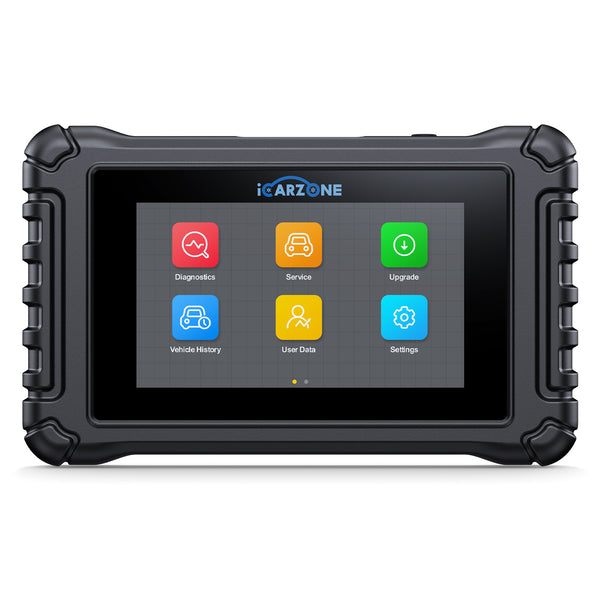
iCARZONE UR800 — 5" LCD OBD2 Scanner
P0462 is a circuit code, so the answer is in the live data. The UR800 shows the fuel-level sensor's live reading — voltage or percentage — so you can compare it against the fuel that's actually in the tank and confirm the signal really is reading low. All-system access matters here, because the fuel-level input is often handled by the body module or instrument cluster, not just the engine ECU.
- 5" LCD 854×480 touchscreen
- Live fuel-level data (voltage / %)
- All-system / all-module access
- Reads BCM, cluster, engine & more
- Freeze-frame + bidirectional tests
- 2-yr warranty + lifetime updates
How do you fix a P0462 code?
Work the circuit before the tank. The live-data check and a quick wiring inspection often pinpoint the fault without the labor of dropping the fuel tank.
Scan codes and read the live fuel-level value
- Record P0462 and any companion codes (other fuel-level codes like P0460/P0461/P0463, or EVAP readiness flags). Note the freeze frame.
- Read the live fuel-level reading (percentage or voltage) and compare it to how much fuel is actually in the tank — a pinned-low value with a non-empty tank confirms the fault.
Check the signal at the tank connector — your decisive split
- Locate the fuel-pump module connector (usually under the rear seat or trunk access panel, or atop the tank). Back-probe the sender signal wire with the key on.
- A signal near 0V points to a short to ground or a dead sender; an open or very high reading points to a broken wire or bad connector.
- If the value reads correctly when you wiggle the connector, you've found an intermittent connection.
Inspect the connector and ground
- Unplug the module connector and check for water, corrosion, and bent or spread pins; clean and protect with dielectric grease.
- Confirm the sender's ground is clean and tight — a poor ground can mimic a low-signal fault.
- Follow the signal wire for chafing or a short to ground along its run.
Measure the sender resistance across its range
- With access to the sender, measure its resistance while moving the float from empty to full. It should sweep smoothly between the spec values — a jump to zero or an open spot is a worn resistor track.
- Compare against your vehicle's spec (GM-style systems often read lower resistance at low fuel; others vary), so check the manual before condemning it.
Repair the wiring or replace the sender — final step
- Repair the short/open/connector, or replace the sender (or fuel-pump module if the sender is integral) with the correct part for your vehicle.
- Use a new lock-ring seal when reinstalling the module, and observe fuel-safety precautions.
- Clear the code, refuel if needed, and confirm the gauge tracks correctly and the live value matches the tank.
How much does P0462 cost to fix?
The fix can be nearly free if it's a ground or connector, but climbs if the sender is inside the tank and the tank has to come down. Many electrical cases are inexpensive once the live data points you to the fault.
| Repair | DIY | Shop | You save | Type |
|---|---|---|---|---|
| Diagnosis (scan + live fuel-level data) | $0 (free with tool) | $80–$150 | Up to $150 | Free First Step |
| Clean / repair ground | $0–$15 | $50–$150 | Up to $150 | DIY Easy |
| Connector / terminal repair | $10–$40 | $80–$200 | Up to $190 | DIY Moderate |
| Signal wiring repair (short to ground) | $10–$50 | $90–$300 | Up to $290 | DIY Moderate |
| Fuel-level sender / sending unit | $30–$200 | $200–$500 | Up to $470 | Often Shop |
| Fuel-pump module (sender integral) | $100–$400 | $300–$800 | Up to $700 | Often Shop |
| Module / cluster repair (rare) | $100–$500 | $250–$800 | Varies | Shop Friendly |
Which vehicles are most prone to P0462?
P0462 is a generic code that can appear on virtually any vehicle with an electronic fuel gauge. A worn sender resistor and a corroded tank-top connector are the recurring culprits across makes; the access method and resistance spec are what differ. Deep-dives below.
| Make | Common models | Years | Primary cause & notes | Risk |
|---|---|---|---|---|
| GM / Chevrolet / GMC | Silverado, Tahoe, Malibu, Impala, Equinox | 2000–2019 | Worn sender resistor; module often accessed by dropping the tank. | Medium |
| Ford / Lincoln | F-150, Focus, Escape, Explorer, Fusion | 2002–2019 | Sender + tank-top connector corrosion. | Medium |
| Toyota / Lexus | Corolla, Camry, RAV4, Tacoma | 2003–2020 | Worn resistor track on the sender (documented Corolla cases). | Low |
| Chrysler / Dodge / Jeep / RAM | Caravan, 1500, Liberty, Grand Cherokee | 2003–2019 | Water ingress / short to ground; often paired with P0463. | Medium |
| Honda / Acura | Civic, Accord, CR-V, Pilot | 2003–2019 | Sender unit + connector; check the wiring first. | Low |
| Nissan / Infiniti | Altima, Sentra, Rogue, Frontier | 2004–2019 | Sender wear; inspect ground and connector. | Low |
| VW / Audi / BMW | Jetta, Golf, A4, 3-Series | 2004–2018 | Sender / wiring; some use dual senders in saddle tanks. | Low |
Why the computer cares about fuel level (it's not just the gauge)
It's easy to think a fuel-gauge code is harmless, but the computer uses fuel level for more than the dash:
- EVAP leak monitoring. The OBD-II evaporative-leak test usually only runs when the tank is within a set range (often around 15–85% full) and the fuel-level signal is valid. A faulty signal can stop the EVAP monitor from completing — which keeps your readiness "not ready" and can block an emissions pass.
- Distance-to-empty & warnings. The trip computer's range estimate and the low-fuel light both depend on this signal, so a low-input fault makes them unreliable.
- Misfire logic. Some systems suppress misfire reporting when fuel is very low (to avoid false misfire codes on an empty tank), so a bad fuel-level reading can interact with other diagnostics.
Takeaway: P0462 is "just the gauge" in terms of driving, but fixing it also restores the EVAP monitor and accurate range — worth doing before an inspection or a long trip.
Most P0462 fixes live on top of the fuel tank
The sender is part of the fuel-pump module, so the repair usually points there — but check the easy stuff first:
- Access. Many vehicles have an access panel under the rear seat or in the trunk floor that reaches the module without dropping the tank; others require lowering the tank. Check yours before quoting the job.
- Connector first. The tank-top connector is exposed to dirt and moisture — corrosion and water-induced shorts to ground are common and cheap to fix. Inspect it before condemning the sender.
- Sender test. With the module accessible, sweep the float and watch the resistance change smoothly; a dead spot or open confirms a worn sender. Use a new lock-ring seal on reassembly.
Check for a TSB / recall: at NHTSA.gov enter your VIN or year/make/model and review bulletins related to the fuel-level sender or fuel-pump module on your platform. NHTSA recalls & TSBs ›
Should you DIY or call a mechanic?
DIY if you…
- Can read live fuel-level data with a scanner
- Have a multimeter and can back-probe a connector
- Can reach the fuel-pump module via an access panel
- Are comfortable working safely around fuel
- Want to rule out wiring/ground before pulling the module
- Want to save $80–$700 over shop diagnostic + labor
Use a mechanic if…
- The tank must be dropped to reach the sender
- You'd rather not work around fuel vapors
- The short to ground is buried in the harness
- The fault is intermittent and hard to catch
- A module or cluster is suspected (rare)
- You don't have a scanner that shows live fuel-level data
Frequently asked questions
Is it safe to drive with a P0462 code?
Mechanically, yes — P0462 doesn't affect the engine, transmission, or brakes. The real risk is that your fuel gauge can't be trusted, so you could run out of fuel without warning. Track your mileage between fill-ups until it's repaired, and fix it before an emissions test, since it can stop the EVAP readiness monitor from completing.
Why is my fuel gauge stuck on empty with P0462?
Because the computer is reading a fuel-level voltage below the normal range — so it shows the lowest reading. That low signal usually comes from a worn sender resistor, a signal wire shorted to ground, or a corroded connector. The gauge will stay wrong until the circuit fault is repaired, not just after refueling.
What's the difference between P0462 and P0463?
They're mirror images on the same circuit. P0462 means the fuel-level signal is too low (often a short to ground or a worn sender), while P0463 means it's too high (often an open circuit or a disconnected sender). Seeing both at once — common after water damage — points to a wiring or connector problem affecting the whole circuit.
How much does it cost to fix P0462?
It depends on where the fault is. A ground clean or connector repair is $0–$40 DIY; a wiring repair $10–$50. A fuel-level sender is roughly $30–$200 in parts, or $100–$400 if it's part of the fuel-pump module — and labor climbs if the tank must be dropped. Many electrical cases are inexpensive once live data points to the fault.
What scanner do I need to diagnose P0462?
One that shows live fuel-level data and reads all modules, since the fuel-level input often lives in the body module or instrument cluster rather than the engine ECU. The iCARZONE UR800 ($299.99) is a 5-inch all-system scanner with live data, freeze-frame, and bidirectional tests, so you can compare the live reading to the actual tank level.
Will P0462 clear itself after I add fuel?
No. Refueling changes the actual fuel level, but P0462 is set by a low signal voltage in the circuit — adding fuel doesn't repair a shorted wire, a corroded connector, or a worn sender. The code (and the light) will stay until the underlying electrical fault is fixed and you clear it.
Quick verdict
- Step 1 — free first: scan codes and read the live fuel-level value, then compare it to the actual fuel in the tank. $0 with a capable scanner.
- Step 2 — check the circuit: back-probe the signal at the tank connector, inspect for a short to ground, corrosion, and a bad ground before pulling anything.
- Step 3 — fix only what's proven: repair the wiring/connector or replace the sender (or fuel-pump module) with the correct part, then clear and confirm the gauge tracks.
See the gauge signal, skip the guesswork
The iCARZONE UR800 reads live fuel-level data across all your vehicle's modules — so you can confirm a low signal and find the real P0462 cause before dropping the tank, across 58 vehicle makes.
0 comments