
P0634 Code: Control Module Internal Temperature Too High

P0634: Prove the Thermal Event
Identify the reporting module, preserve conditions and separate heat exposure from internal sensing or power faults.
DIAGNOSTIC FOCUS
The DTC alone does not prove a failed component.
P0634 means PCM/ECM/TCM Internal Temperature Too High. Preserve the complete event and identify the reporting module before clearing it.
The DTC describes a controller observation, not a guaranteed failed part. Compare command, circuit and physical response using the exact vehicle procedure.
What Does the P0634 Code Mean?
P0634 is reported when the controller detects the code-specific condition: PCM/ECM/TCM Internal Temperature Too High. The exact monitor, circuit and enable conditions depend on the vehicle and reporting module.
This label describes a controller observation, not a parts verdict. Separate command, electrical evidence and physical response using the exact OEM procedure.
Component location, thresholds, cylinder or solenoid mapping and repair steps vary by application. Do not transfer one OEM’s value or bulletin to another vehicle. The word internal is important: this code refers to a temperature or thermal-check result generated inside the reporting module. It is not a direct coolant, transmission-fluid or ambient-temperature code. Ford’s document describes its own TCM monitoring and protection behavior; another vehicle may use different packaging, sensing and shutdown logic. Record whether the event occurred during a cold start, prolonged load, heat soak, charging event or after work near the module. Inspect heat shields, mounting, enclosure seals and airflow before touching the module. A supply or ground problem can create stress or corrupt an internal check, while a genuine hot module can shut down and create secondary communication or drivability codes. Avoid substituting an infrared case reading for the controller’s internal test, and do not use a generic temperature limit. Module replacement, programming or configuration belongs only after the external thermal and electrical branches pass. Verification must reproduce the documented operating condition safely and confirm that protection or shutdown does not recur.
Read the full OEM text and module address; do not assume a generic PCM when the TCM or an integrated controller may be reporting.
Record ambient conditions, coolant or fluid temperature, load, fan state, charging voltage and when the warning appeared.
Compare the module’s reported value with the application procedure and inspect mounting, shields, airflow, supplies and grounds before replacement.
P0634 Symptoms, Severity, and Driving Safety
The MIL can be the only immediate sign of a module thermal monitor event.
A controller may enter protection or reduced operation when its internal power stage is hot.
Heat-related stalling or no-start can occur if the reporting module shuts down.
A TCM architecture may change shift strategy or communication when protection activates.
Fans or cooling requests may accompany the event, but they do not prove module temperature.
A stored event may remain after the module has cooled and the vehicle appears normal.
Treat repeated thermal warnings, loss of power, stalling or erratic transmission control as a prompt safety issue. Do not continue a trip based on the code alone.
P0634 Causes and the Evidence That Separates Them
These are code-specific diagnostic branches, not a ranking of failure rates.
External heat exposure
Exhaust, turbocharger or transmission heat can raise the module environment without an internal electronics failure.
How to prove it: Inspect shields, mounting distance and airflow against the installation information.
Check firstSupply or ground stress
Poor grounds, charging transients or a loose supply can increase power-stage stress or corrupt the internal check.
How to prove it: Measure supply and ground behavior under load and compare with the Ford-specific strategy.
Check firstCooling or airflow fault
A duct, enclosure seal or fan condition can change the local thermal environment.
How to prove it: Verify the actual cooling path and fan request; do not infer module heat from coolant temperature.
Verify directlyConnector or mounting problem
A poor terminal or mounting interface can create localized heating or intermittent loss of module data.
How to prove it: Inspect retention, corrosion and fasteners, then perform the specified loaded circuit check.
Verify directlyInternal temperature sensor or power stage
After environmental and power causes pass, the module’s internal sensor or power stage may be the remaining branch.
How to prove it: Use the OEM internal check or replacement criteria; do not jump from code to module replacement.
Verify directlyCalibration/application mismatch
An incorrect module, calibration or configuration can make the thermal monitor inapplicable or implausible.
How to prove it: Confirm part number, calibration and programming state for the exact vehicle.
Final branchOrder these branches by evidence. Recent work identifies an inspection area, not a failed part; document the test that supports any repair.
Using JU2000 MAX During P0634 Diagnosis
On a supported vehicle, iCARZONE JU2000 MAX can preserve accessible fault status, freeze frame and supported data before clearing P0634. Coverage and available PIDs remain VIN-dependent.
Use the scanner to organize ECU evidence and compare supported command/response data. It cannot directly prove wiring, terminal tension, waveform, pressure, flow, injector current, fan current or mechanical wear.
Pair scan data with the current OEM procedure and appropriate physical tools. Confirm the exact vehicle, controller and requested function before purchase.
iCARZONE JU2000 MAX All-in-One Diagnostic & TPMS Kit
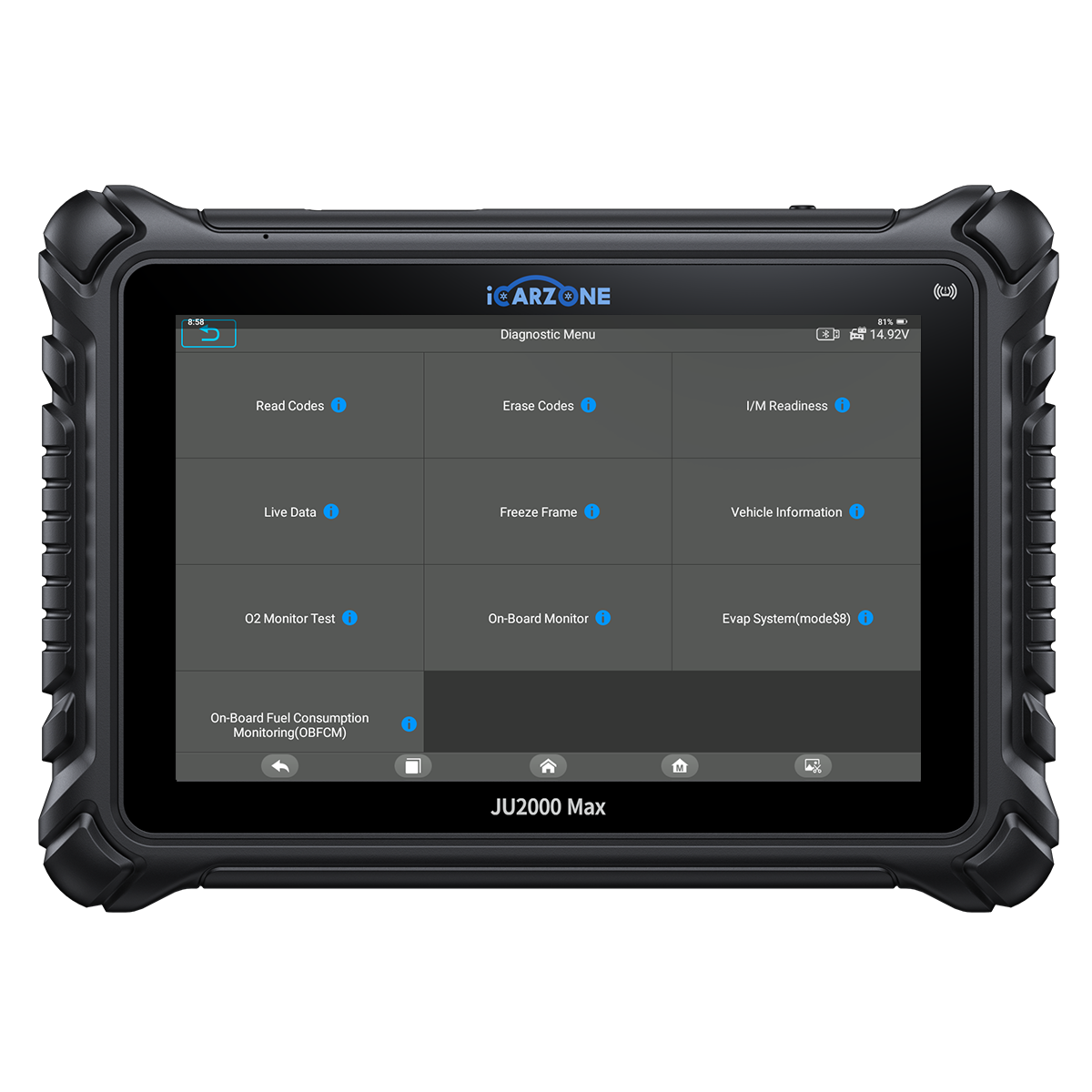
Preserve P0634 evidence and compare supported data before authorizing parts or module work.
Use only supported functions for the identified VIN and controller. ECU coding or an active test is never universal, and a scan result does not replace physical proof.
How to Diagnose P0634 in 6 Steps
Use these six decisions with the VIN-specific procedure for P0634. Record conditions, measurements and comparison limits; do not substitute another vehicle's specification.
P0634 Quick Diagnostic Path
-
1
Record the reporting module, temperature data, load, ambient and companion codes.
- Record the exact condition and measurement required by the OEM procedure.
- Do not replace a component until the failed branch is documented.
-
2
Compare the reported value with the exact OEM strategy and confirm which module generated the thermal event.
- Record the exact condition and measurement required by the OEM procedure.
- Do not replace a component until the failed branch is documented.
-
3
Inspect heat shields, mounting, airflow, connectors and grounds.
- Record the exact condition and measurement required by the OEM procedure.
- Do not replace a component until the failed branch is documented.
-
4
Check battery/charging and module supply behavior under load.
- Record the exact condition and measurement required by the OEM procedure.
- Do not replace a component until the failed branch is documented.
-
5
Only after external causes pass, evaluate internal sensing or calibration.
- Record the exact condition and measurement required by the OEM procedure.
- Do not replace a component until the failed branch is documented.
-
6
Repeat the thermal and supply checks under the same conditions and verify no recurrence.
- Record the exact condition and measurement required by the OEM procedure.
- Do not replace a component until the failed branch is documented.
How to Fix P0634 and Verify the Repair
Restore the thermal environment
Correct shielding, mounting, airflow or heat exposure demonstrated by inspection.
Restore power integrity
Repair proven supply, ground or charging faults under load.
Evaluate the module branch
Only after external heat and power causes pass, follow the module-specific internal test.
Verify protection behavior
Repeat the same thermal/load conditions and confirm no shutdown or code return.
Diagnostic time
VIN-specific quoteRequest a quote that separates scan review from the test needed to identify the failed branch. A code read alone is not completed diagnosis.
Wiring and access
VIN-specific quoteQuote proven terminal, harness and access work separately, including the cause of heat, abrasion, contamination or water entry.
Proven component repair
VIN-specific quoteAsk for the exact part, failed test and supporting installation items. The correct service unit depends on the vehicle.
Setup and final verification
VIN-specific quoteInclude programming, relearn or calibration only when required. These are alternative paths, not four automatic charges.
Connect each proposed repair to a documented finding and retain the original and final reports.
If the code returns, compare the new event with the baseline and reopen the correct diagnostic branch.
P0634 OEM Differences and DIY Limits
Ford’s 2006 model-year OBD System Operation Summary describes internal TCM over-temperature monitoring and shutdown/MIL behavior for its specified applications. Internal controller temperature is distinct from engine coolant and transmission fluid temperature; the document is not a universal test limit for another module.
It is not the coolant or ambient-temperature sensor by definition.
Ford describes internal TCM over-temperature shutdown and immediate MIL. This is separate from engine coolant temperature; use the applicable module monitor limits.
A protection event changes safety priority and should not be recreated casually.
For the exact VIN, identify the reporting controller and supported internal-temperature data, then verify sensor plausibility, cooling provisions, electrical supply and the required thermal-protection procedure.
- Save the complete scan and warning text without clearing it.
- Record conditions, recent work and symptoms accurately.
- Inspect only safely accessible areas with the specified power state.
- Follow the owner manual response to every active warning.
- Use qualified assistance when symptoms make operation unsafe.
- Do not jump, backfeed or force an unidentified circuit or actuator.
- Use the exact isolation and measurement procedure.
- Leave pressurized, high-current, internal, programming or disassembly work to equipped personnel.
Frequently Asked Questions About P0634
What does P0634 mean?
Does P0634 mean the ECU is bad?
Can low battery voltage cause P0634?
Should I replace the module?
Can a scanner measure module temperature?
Is P0634 safe to drive?
Will clearing the code fix it?
What confirms repair?
Sources and Technical Review Notes
- Ford 2006 MY OBD System Operation Summary (OBDSM608, revision November 12, 2007), P0634 at PDF pages 141 and 148 — Ford-specific internal TCM over-temperature monitoring and shutdown/MIL behavior; this is not a coolant-temperature definition and provides no universal numeric threshold.
x
- Tags: DTC iCARZONE JU2000 MAX OBD-II P0634
0 comments