
P073E Code: Unable to Engage Reverse — Diagnose the Cause

P073E: Trace the Reverse Request
Separate selection, actuator position and actual engagement before choosing a repair.
DIAGNOSTIC FOCUS
- FAULT TYPE
- Unable to Engage Reverse
- FIRST CHECKS
- Reporting module, transmission identity, range request and position feedback
The code does not by itself prove a failed reverse clutch or complete transmission.
P073E means Unable to Engage Reverse. The code does not by itself prove a failed reverse clutch or complete transmission. Save the full fault record, identify the reporting controller and use the current vehicle-specific procedure.
Secure the vehicle and save all module faults. Identify how this vehicle requests and selects reverse, then compare the request with the actuator or range feedback and the actual transmission response.
What Does the P073E Code Mean?
P073E means Unable to Engage Reverse. It describes an unsuccessful reverse-engagement result, not a universal failed component. The controller and conditions that recognize the failure vary by vehicle, so retain the exact OEM wording and reporting module.
The driver’s selection, the control system’s requested range and the transmission’s actual state are different pieces of evidence. A display showing R does not establish that a mechanical range mechanism reached reverse, or that the internal elements transmitted torque.
The first useful question is where the sequence stops. A selection or range-control fault requires a different path from a transmission that reaches the requested range but cannot produce the expected response. Hydraulic and internal mechanical tests come from the installed transmission’s procedure.
Record the complete code, suffix, reporting module and status. A short description does not establish a common circuit layout.
Compare requested range, actual or learned position and available transmission response. Do not use a dashboard indicator as a substitute for range-position or engagement evidence.
Save available freeze frame and note requested range, displayed gear, delay, vehicle movement, temperature and recent range-control work. A reset or disconnected connector can change the evidence before the cause is found.
P073E Symptoms, Severity, and Driving Safety
The vehicle may not move backward when reverse is selected; keep the surrounding area clear.
A gear-selection or transmission message may appear. Preserve its exact wording.
Delayed engagement may occur, but repeated throttle input is not a diagnostic method.
Requested, indicated and actual range can disagree on some systems. Treat unexpected movement as unsafe.
Temperature, vibration or a range-control condition may make the complaint occasional.
Power, communication, position or transmission faults may help identify which stage failed.
A vehicle without dependable range selection is not suitable for normal maneuvering. Assess whether forward operation, Park retention or other ranges are also affected; do not assume the problem is confined to backing up.
P073E Causes and the Evidence That Separates Them
The following are possible diagnostic branches, not a ranking of failure rates. Their relevance depends on the installed range-selection and transmission architecture. Begin with the branch identified by the OEM decision tree and the complete code pattern.
Request or communication problem
The intended reverse request may not reach the responsible controller correctly.
How to prove it: Compare the selection input and supported module data while resolving relevant communication faults.
Check firstActuator supply or control defect
A powered range actuator may fail to reach its requested position because of an electrical or control problem.
How to prove it: Test the specified feeds, returns and command path using the correct diagram.
Check firstLinkage or coupler alignment
Where a mechanical connection exists, misalignment or poor attachment can separate actuator movement from transmission selection.
How to prove it: Inspect alignment and engagement by the exact service procedure before replacing internal transmission parts.
Verify directlyPosition feedback or learning issue
Incorrect position information or an incomplete required learn can affect range control on applicable systems.
How to prove it: Compare feedback with physical state and complete a learn only when the OEM diagnostic branch calls for it.
Verify directlyHydraulic engagement fault
If the selected mechanical range is correct, a pressure or valve-control defect may prevent engagement.
How to prove it: Follow the installed unit’s fluid, pressure and control tests; a no-reverse complaint alone does not prove this branch.
Verify directlyInternal mechanical defect
A damaged engagement element or other internal fault may prevent reverse after external selection and control checks pass.
How to prove it: Require the prescribed evidence before teardown or a complete transmission recommendation.
Final branchIf the warning followed range actuator, transmission, linkage or battery work, compare the timing with the original complaint. Recheck disturbed connections and part compatibility, but do not treat recent work alone as proof of causation. A component should earn replacement through a failed test.
Using JU2000 MAX During P073E Diagnosis
On a supported vehicle, iCARZONE JU2000 MAX can retrieve accessible module faults, available freeze frame and live data. Preserve the P073E record before erasing anything. A saved report gives the technician a baseline instead of relying on a remembered warning message.
The official product page describes system diagnostics and bidirectional control. Confirm the exact VIN, controller, software and requested function before purchase. A product feature list does not guarantee every PID, active test, reset or adaptation on every vehicle.
When the vehicle supports them, save requested range, actuator position, transmission status and companion-module data. JU2000 MAX cannot physically confirm coupler alignment or measure clutch holding capacity. A supported range learn is not permission to run it before prerequisites are satisfied.
iCARZONE JU2000 MAX All-in-One Diagnostic & TPMS Kit
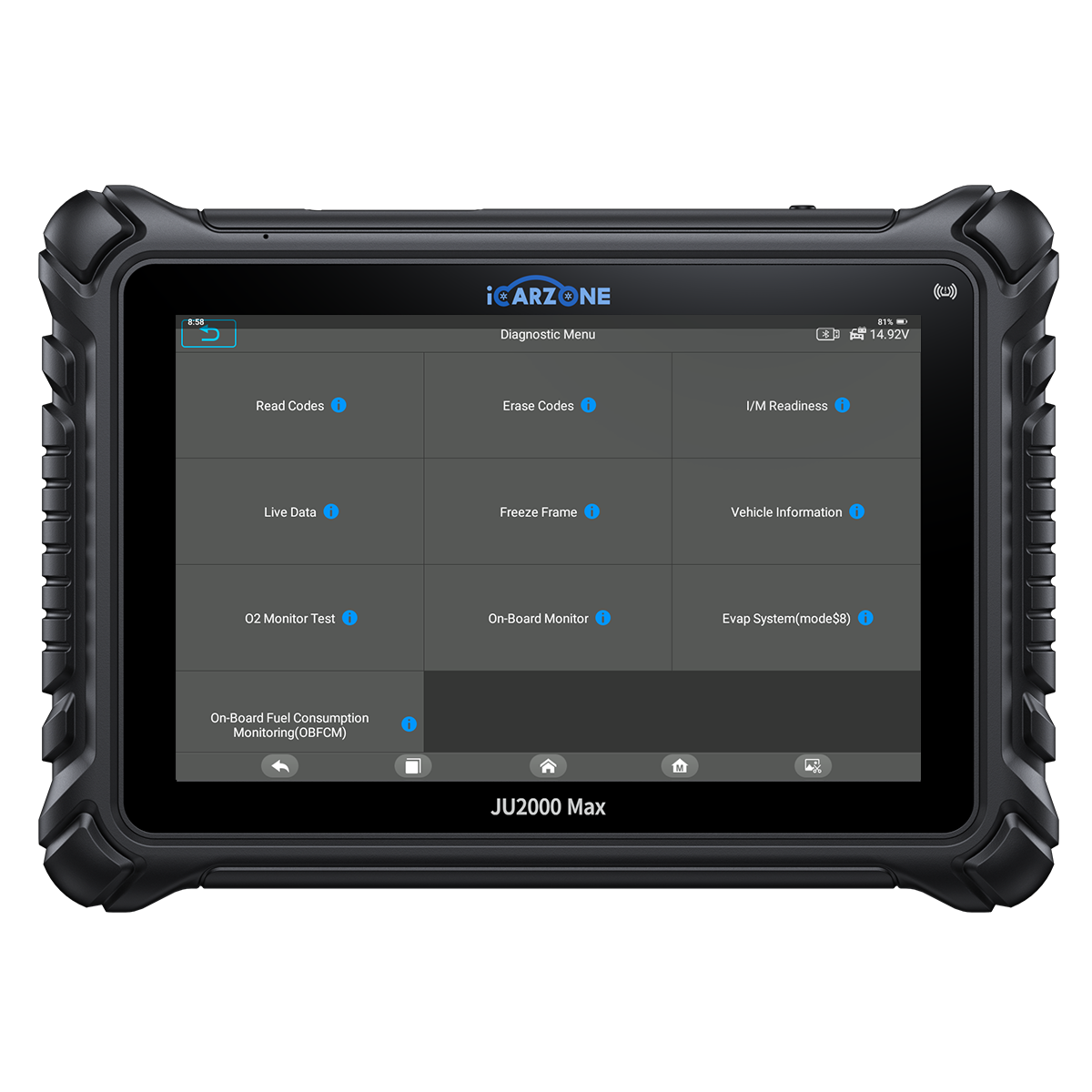
Preserve the requested-versus-actual range evidence before a reset, learn or transmission repair.
Use the scanner alongside the prescribed external test equipment and current service information. An unavailable menu is a coverage or access question, not proof that a component failed. Price checked October 8, 2026; confirm the current offer and vehicle coverage on the product page.
How to Diagnose P073E in 6 Steps
This six-step sequence explains the decisions a diagnosis needs to resolve. It is not a substitute for the VIN-specific service procedure. Keep a record of the test conditions, measured results and comparison limits; do not fill a missing specification with a number from another vehicle.
P073E Quick Diagnostic Path
-
1
Save the complete original event
- Record all modules' faults, full descriptions, suffixes, status and available freeze frame before clearing P073E. Save companion codes even when they seem unrelated; their timing may identify a shared supply, communication or operating-condition problem.
- Document requested range, displayed gear, delay, vehicle movement, temperature and recent range-control work. Ask when the warning first appeared and whether it preceded range actuator, transmission, linkage or battery work. Do not recreate an unsafe symptom merely to collect a better graph.
-
2
Identify the reverse-selection architecture
- Confirm transmission type, responsible module and whether range is selected by cable, linkage or an electronic actuator.
- Obtain the current selection, recovery and diagnostic procedures. Do not assume a selector design from another model year applies.
-
3
Compare request and position evidence
- Read supported selector request and actual-position data alongside range-related codes. Distinguish an unavailable data item from a failed component.
- Inspect supply and communication prerequisites. If position data conflicts with vehicle movement, stop dynamic testing until the vehicle is safely secured.
-
4
Check the external selection path
- Follow the OEM tests for actuator, linkage, connector or coupler faults where those parts are fitted.
- Document whether the transmission mechanism reaches the commanded position. Do not adjust an unidentified linkage by trial and error or force reverse engagement.
-
5
Evaluate transmission response
- When the selected range is proven correct, use the applicable hydraulic, clutch-control and internal-mechanical decision tree.
- Record fluid condition or pressure only by the prescribed method. Never hold the throttle against a failure to engage to try to force a result.
-
6
Verify the repair under the right conditions
- Repeat the failed measurement or functional check. Complete only required setup or learning, then compare the result with the saved baseline.
- Follow OEM verification, retain the final scan and disclose incomplete tests. Diagnose any new symptom or code separately.
How to Fix P073E and Verify the Repair
Restore request and control integrity
Repair proven input, communication, power or actuator-control defects.
Correct the selection mechanism
Repair verified linkage or coupler problems using specified alignment and fastening procedures.
Perform required setup
Complete the applicable range learn or calibration after its mechanical and electrical prerequisites pass.
Repair the proven internal branch
Authorize valve, clutch or internal transmission work only when the unit-specific tests identify the defect.
Diagnostic time
VIN-specific quoteRequest a quote distinguishing range-control, linkage and internal engagement problems. A code read alone does not identify the replacement part.
Wiring and access
VIN-specific quoteQuote proven terminal, harness and access work separately. Correct the source of heat, abrasion or contamination.
Proven component repair
VIN-specific quoteAsk for the exact part, failed test and required supporting items. The correct service unit depends on the vehicle and defect.
Setup and final verification
VIN-specific quoteInclude learning, calibration or programming only when required. Labor, parts and access differ; these are alternative paths, not four automatic charges.
Ask the shop to connect each proposed repair to a finding and separate confirmed defects from conditional work. Keep the original and final reports.
A reset that temporarily restores reverse does not identify the cause. Keep the original selection and response records, and check the repaired stage under the approved conditions.
P073E OEM Differences and DIY Limits
GM bulletin 18-NA-083 covers certain 2017 Buick LaCrosse and 2017–2018 Cadillac XT5 applications with the listed transmission. It associates P073E in the Chassis Control Module with a possible misaligned coupler between the transmission range control module and transmission.
Confirm the reporting module and installed selection mechanism before interpreting a generic transmission label.
Keep driver request, actuator feedback, actual mechanical range and transmitted torque as separate observations.
Confirm correct selection and engagement under OEM conditions, complete any required learn and rescan all affected modules.
The bulletin specifies an application-dependent alignment and learning procedure. This example demonstrates why a no-reverse code can need external range-control diagnosis; it is not a universal coupler repair for every P073E vehicle.
- Save the complete scan and warning text without clearing it.
- Record the conditions and service history accurately.
- Inspect only safely accessible areas under the specified power state.
- Follow the owner manual response to every active warning.
- Use qualified assistance when symptoms make operation unsafe.
- Do not jump, backfeed or force an unidentified circuit or actuator.
- Use the exact isolation procedure and specified test equipment.
- Leave required disassembly, learning or programming to equipped personnel.
Frequently Asked Questions About P073E
What does P073E mean?
Does P073E mean the reverse clutch is broken?
Can the display show R without actual reverse engagement?
Will a range relearn always fix it?
Is it safe to use forward gears only?
Should I clear P073E before diagnosis?
Can JU2000 MAX help diagnose P073E?
What confirms a successful P073E repair?
Sources and Technical Review Notes
- GM Bulletin 18-NA-083: Transmission Range Control Coupler — Narrowly scoped P073E range-control example for listed LaCrosse and XT5 vehicles.
- Tags: DTC iCARZONE JU2000 MAX OBD-II P073E
0 comments