
P0768 Code: Shift solenoid D electrical

P0768: Prove Solenoid D
Identify the transmission-specific solenoid D circuit and separate wiring, driver and internal hydraulic branches.
DIAGNOSTIC FOCUS
The DTC alone does not prove a failed component.
P0768 means Shift Solenoid D Electrical. Preserve the complete event and identify the reporting module before clearing it.
The DTC describes a controller observation, not a guaranteed failed part. Compare command, circuit and physical response using the exact vehicle procedure.
What Does the P0768 Code Mean?
P0768 is reported when the controller detects the code-specific condition: Shift Solenoid D Electrical. The exact monitor, circuit and enable conditions depend on the vehicle and reporting module.
This label describes a controller observation, not a parts verdict. Separate command, electrical evidence and physical response using the exact OEM procedure.
Component location, thresholds, cylinder or solenoid mapping and repair steps vary by application. Do not transfer one OEM’s value or bulletin to another vehicle. P0768 identifies an electrical fault for Shift Solenoid D, but the letter D and the gear or clutch it controls are transmission-specific. The Hyundai bulletin cited for one application maps D to an overdrive function; that mapping cannot be transferred to another transmission. Preserve gear, fluid temperature, shift command, freeze frame and companion ratio codes. Start with the external connector, shared feed and harness, then test the current or control waveform with the circuit isolated as directed. An internal transmission harness can fail in fluid or heat while the external connector appears sound. If the electrical path passes, compare pressure and ratio response; a hydraulic or valve-body fault is a different branch from an electrical solenoid code. Do not run a commanded test with the vehicle unsecured or infer a failed solenoid from a harsh shift alone. A successful repair repeats the original electrical test and the specified shift verification at the relevant temperature, with no related ratio or communication code returning.
Record complete code text, suffix, reporting module and status before deciding what hardware is named.
Compare command, scan interpretation and physical response with the prescribed test.
Save freeze frame and note temperature, load, operating mode, recent work and companion codes.
P0768 Symptoms, Severity, and Driving Safety
The transmission warning may appear before the driver notices a shift change.
Harsh, delayed or missing shifts can follow a Solenoid D electrical fault.
The controller may hold a gear or enter a protection strategy.
Heat can expose an internal harness or coil fault.
Slip/ratio codes may indicate a hydraulic consequence rather than the original electrical cause.
A stored fault can exist with normal shifts when the event was brief.
Assess the actual warning and system behavior. A stored code with normal operation still deserves diagnosis, and the code alone cannot establish a safe remaining distance.
P0768 Causes and the Evidence That Separates Them
These are code-specific diagnostic branches, not a ranking of failure rates.
External connector or harness
Heat, fluid intrusion and terminal tension can interrupt the Solenoid D circuit.
How to prove it: Inspect the external connector and perform the specified loaded test.
Check firstShared feed/ground
A common actuator supply fault can affect Solenoid D and other solenoids.
How to prove it: Compare feed and ground with companion actuator circuits.
Check firstSolenoid coil/internal connection
The coil or internal transmission harness can fail intermittently or open.
How to prove it: Test current and isolate the internal harness only as directed.
Verify directlyValve-body/hydraulic response
A valid electrical command may still produce the wrong pressure or gear response.
How to prove it: Use pressure/ratio evidence after electrical proof.
Verify directlyInternal transmission harness
An external connector can pass while an internal harness has a fluid/heat defect.
How to prove it: Follow the exact pan/valve-body inspection procedure before disassembly.
Verify directlyTCM driver/software
The driver or calibration is a later branch after the load and wiring pass.
How to prove it: Verify command at the controller and applicability of updates.
Final branchRecent work can identify a disturbed area to inspect, but it does not prove causation. A component should earn replacement through a failed test.
Using JU2000 MAX During P0768 Diagnosis
On a supported vehicle, iCARZONE JU2000 MAX can preserve accessible fault status, freeze frame and supported data before clearing P0768. Coverage and available PIDs remain VIN-dependent.
Use the scanner to organize ECU evidence and compare supported command/response data. It cannot directly prove wiring, terminal tension, waveform, pressure, flow, injector current, fan current or mechanical wear.
Pair scan data with the current OEM procedure and appropriate physical tools. Confirm the exact vehicle, controller and requested function before purchase.
iCARZONE JU2000 MAX All-in-One Diagnostic & TPMS Kit
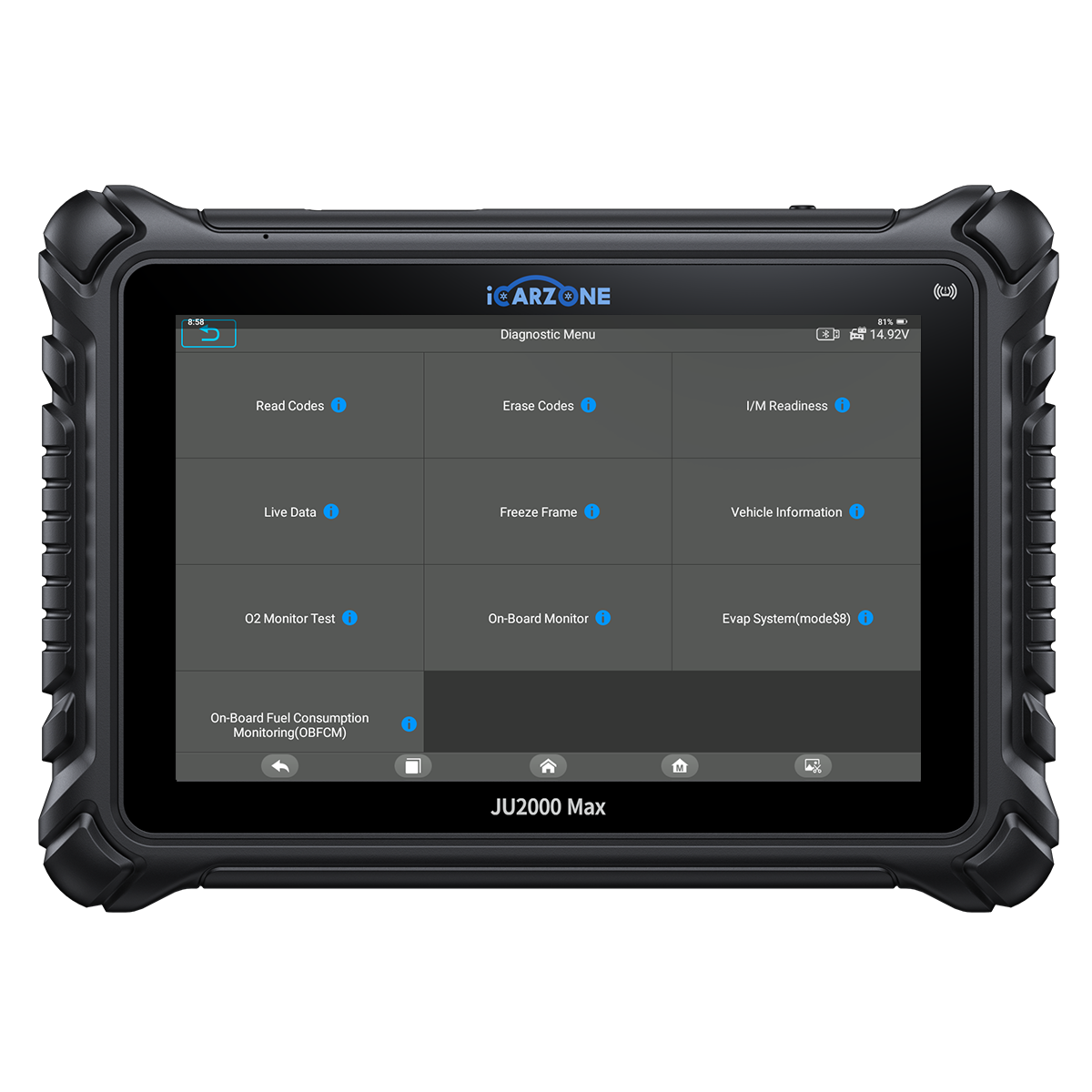
Preserve the P0768 fault event and compare supported data before authorizing parts or module work.
Use only supported functions for the identified VIN and controller. ECU coding or an active test is never universal, and a scan result does not replace physical proof.
How to Diagnose P0768 in 6 Steps
Use this six-step sequence with the VIN-specific procedure. Record conditions, measurements and comparison limits; never substitute another vehicle's specification.
P0768 Quick Diagnostic Path
-
1
Save TCM codes, gear, temperature, freeze frame and subcodes.
- Record the exact condition and measurement required by the OEM procedure.
- Do not replace a component until the failed branch is documented.
-
2
Identify Solenoid D and gear mapping for the exact transmission.
- Record the exact condition and measurement required by the OEM procedure.
- Do not replace a component until the failed branch is documented.
-
3
Inspect external and internal harness paths per the service procedure.
- Record the exact condition and measurement required by the OEM procedure.
- Do not replace a component until the failed branch is documented.
-
4
Test command/current and isolate the solenoid circuit correctly.
- Record the exact condition and measurement required by the OEM procedure.
- Do not replace a component until the failed branch is documented.
-
5
If electrical tests pass, follow pressure/ratio and valve-body checks.
- Record the exact condition and measurement required by the OEM procedure.
- Do not replace a component until the failed branch is documented.
-
6
Repair the proven branch and complete the required shift verification.
- Record the exact condition and measurement required by the OEM procedure.
- Do not replace a component until the failed branch is documented.
How to Fix P0768 and Verify the Repair
Restore Solenoid D circuit
Repair the proven external/internal harness, terminal, supply or driver fault.
Test Solenoid D
Replace the solenoid only after the exact electrical test fails.
Check hydraulic response
Use pressure/ratio evidence only after the electrical branch passes.
Verify gear response
Repeat the specified shift and temperature monitor.
Diagnostic time
VIN-specific quoteRequest a quote that separates scan review from the test needed to identify the failed branch. A code read alone is not completed diagnosis.
Wiring and access
VIN-specific quoteQuote proven terminal, harness and access work separately, including the cause of heat, abrasion, contamination or water entry.
Proven component repair
VIN-specific quoteAsk for the exact part, failed test and supporting installation items. The correct service unit depends on the vehicle.
Setup and final verification
VIN-specific quoteInclude programming, relearn or calibration only when required. These are alternative paths, not four automatic charges.
Ask the shop to connect each proposed repair to a finding and preserve the original and final reports. Separate confirmed defects from conditional work. The Hyundai example illustrates why an electrical fault should start outside the transmission. Its procedure checks the PCM-to-transmission harness and connector terminals before taking the solenoid repair branch. A replacement solenoid will not repair a damaged external lead or a pushed-out terminal. Conversely, a mechanically sticky valve cannot be diagnosed from an electrical code label alone. Match the actual transmission and service publication, preserve the failed circuit test, and request a quote that separates harness work, internal access, the documented solenoid and post-repair fluid-level verification.
If the code returns, compare the new event with the baseline and reopen the correct branch. Another replacement part or a reset is not a substitute for a failed test.
P0768 OEM Differences and DIY Limits
Hyundai TSB 16-AT-014, p.6: Maps P076800 to OD shift solenoid D in the listed transmission; application-limited mapping.
Hyundai’s cited OD mapping is application-limited.
A circuit DTC cannot prove valve-body wear.
Active tests depend on VIN and controller support.
No universal threshold, location or repair outcome is claimed. Use the current OEM manual for the exact VIN.
- Save the complete scan and warning text without clearing it.
- Record conditions, recent work and symptoms accurately.
- Inspect only safely accessible areas with the specified power state.
- Follow the owner manual response to every active warning.
- Use qualified assistance when symptoms make operation unsafe.
- Do not jump, backfeed or force an unidentified circuit or actuator.
- Use the exact isolation and measurement procedure.
- Leave pressurized, high-current, internal, programming or disassembly work to equipped personnel.
Frequently Asked Questions About P0768
What does P0768 mean?
Does P0768 prove a failed part?
Can I keep driving with P0768?
Should I clear P0768 first?
Can JU2000 MAX diagnose P0768?
Will replacing the named component fix P0768?
Is the definition identical on every vehicle?
What confirms a repair?
Sources and Technical Review Notes
- Hyundai TSB 16-AT-014, p.6 — Maps P076800 to OD shift solenoid D in the listed transmission; application-limited mapping.
- Tags: DTC iCARZONE JU2000 MAX OBD-II P0768
0 comments