
P076F Code: Gear 7 Incorrect Ratio Diagnosis

P076F: Verify the Ratio Evidence
Confirm the transmission and speed inputs before deciding what actually slipped.
DIAGNOSTIC FOCUS
- FAULT TYPE
- Gear 7 Incorrect Ratio
- FIRST CHECKS
- Transmission identity, complete code set and input/output speed evidence
A ratio code alone does not prove which solenoid, clutch or transmission assembly failed.
P076F means Gear 7 Incorrect Ratio. A ratio code alone does not prove which solenoid, clutch or transmission assembly failed. Save the full fault record, identify the reporting controller and use the current vehicle-specific procedure.
Preserve the shift event, confirm the transmission has the relevant gear, and check companion speed-sensor or solenoid faults before drawing a mechanical conclusion.
What Does the P076F Code Mean?
P076F means gear 7 incorrect ratio. The transmission controller has identified a speed relationship that does not fit the expected seventh-gear operating condition. Before interpreting it, establish the installed transmission, the reporting module and the complete manufacturer description.
The ratio calculation depends on the relevant speed information. A physical slip condition and an unreliable speed input can lead to very different repair paths. Do not assume that a displayed mismatch proves a worn clutch until the procedure has addressed the input data and associated faults.
This is not a universal seventh-gear solenoid code. Automatic transmissions use different arrangements of clutches, valves and control devices. A component letter, gear number or repair from another gearbox cannot identify the failed part in the vehicle being diagnosed.
Record the complete code, any suffix, reporting module and current/history status. The same short description does not establish a common circuit layout across vehicles.
Compare the commanded gear with the prescribed input/output speed relationship. Engine RPM, torque-converter slip and a calculated gear display are not interchangeable measurements.
Save available freeze frame and note commanded gear, input/output speeds, fluid temperature and whether the driver felt slipping or a harsh shift. A reset or disconnected connector can change the evidence before the cause is found.
P076F Symptoms, Severity, and Driving Safety
Save the full record and any speed or solenoid faults before erasing codes.
An increase in engine speed without the expected acceleration needs diagnosis; do not repeatedly reproduce it.
Document when it occurs and whether the controller is already operating in a restricted mode.
The available gears depend on the transmission strategy; do not assume one universal limp gear.
The original fluid temperature may matter to verification. A cold stationary scan cannot reproduce every shift condition.
A history fault may reflect an earlier event. Review its status and context before authorizing mechanical work.
Treat slipping or unreliable gear engagement seriously and arrange prompt transmission diagnosis. Avoid towing, heavy load and repeated attempts to reproduce a slipping shift. The stored code does not establish how far the vehicle can be driven safely.
P076F Causes and the Evidence That Separates Them
The following are possible diagnostic branches, not a ranking of failure rates. Their relevance depends on the installed automatic transmission. Begin with the branch identified by the OEM decision tree and the complete code pattern.
Unreliable speed input
An incorrect or interrupted speed signal can undermine the ratio calculation.
How to prove it: Diagnose applicable speed-sensor codes and verify the required speed data first.
Check firstFluid condition or level issue
Incorrect fluid, leakage or an improperly checked level can affect operation.
How to prove it: Use the specified fluid and temperature-dependent checking method; do not add fluid by guesswork.
Check firstHydraulic control fault
A valve or pressure-control problem may prevent the commanded clutch state.
How to prove it: Use the gearbox-specific pressure and control tests after the prerequisite checks.
Verify directlySolenoid performance issue
A control device may not produce the required hydraulic response despite a displayed command.
How to prove it: Compare command, electrical and hydraulic evidence under the exact procedure.
Verify directlyInternal slip or damage
A clutch or other internal element may fail to hold the required relationship.
How to prove it: Require the manufacturer’s supporting tests and condition evidence before disassembly.
Verify directlySetup or application problem
An incompatible part or incomplete required setup can affect shift operation.
How to prove it: Verify the repair history, calibration applicability and specified adaptation requirements.
Final branchIf the warning followed transmission service, fluid replacement, speed-sensor work or control-unit work, compare the timing with the original complaint. Recheck disturbed connections and part compatibility, but do not treat recent work alone as proof of causation. A component should earn replacement through a failed test.
Using UR1000 During P076F Diagnosis
On supported vehicles, iCARZONE UR1000 retrieves accessible faults, available freeze frame and live data. Save the P076F event before clearing it so the technician has the original evidence.
The official product page describes system diagnostics and bidirectional control. Confirm the exact VIN, controller, software and requested function before purchase. Every PID, active test or adaptation is not guaranteed on every vehicle.
Use supported transmission data to save commanded gear, available input/output speeds and fluid temperature. UR1000 cannot establish clutch holding capacity merely by displaying a gear PID. Pressure testing and internal diagnosis need the manufacturer’s equipment and procedure.
iCARZONE UR1000 Bidirectional Scan Tool with ECU Coding
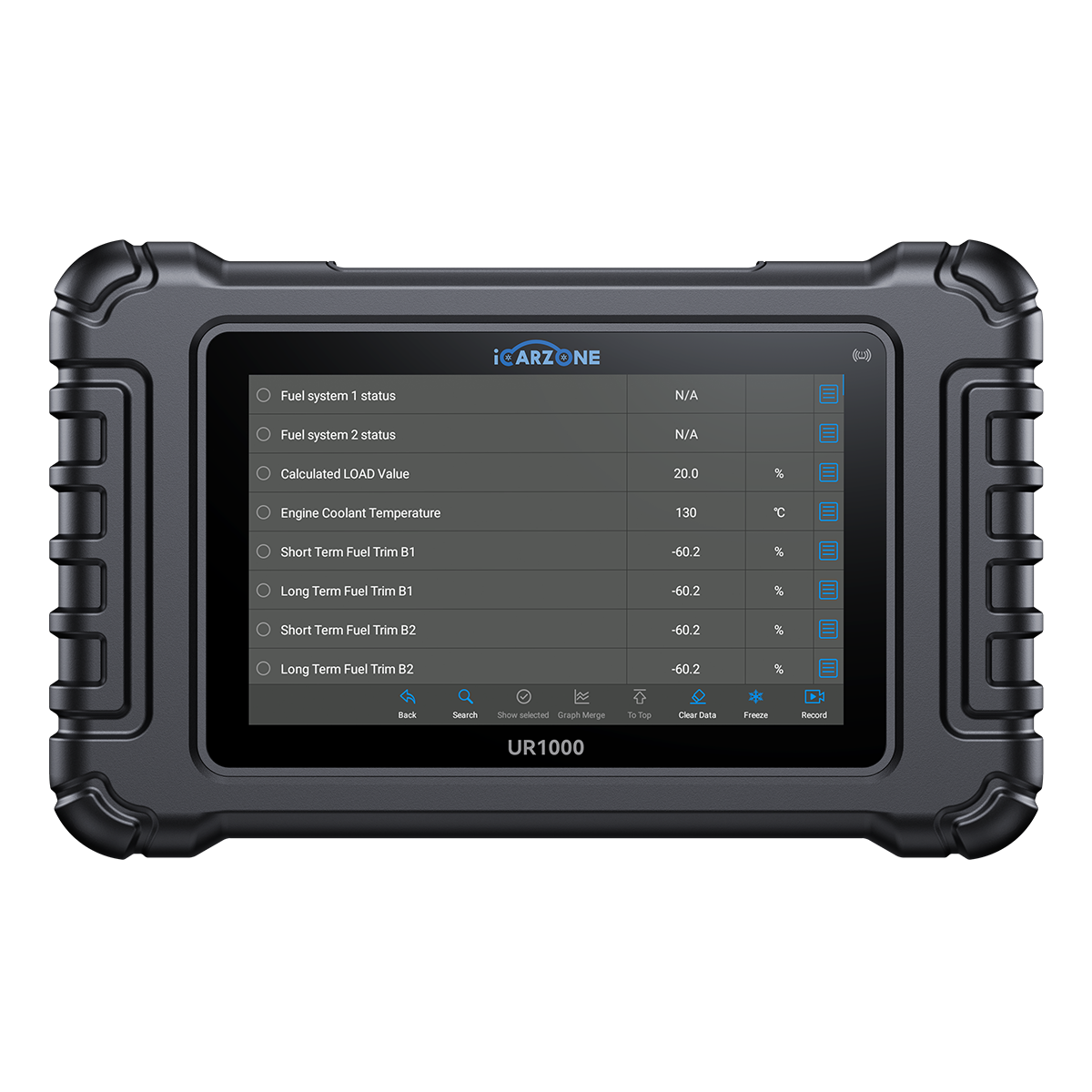
Preserve the ratio event and companion faults so a bad speed input is not confused with proven internal transmission slip.
Use the prescribed external equipment and current service information. A missing menu is a coverage question, not proof of failure. Price checked September 27, 2026; confirm the current offer on the product page.
How to Diagnose P076F in 6 Steps
Use these six decisions alongside the VIN-specific procedure. Record conditions, measurements and comparison limits; never substitute another vehicle’s specification.
P076F Quick Diagnostic Path
-
1
Save the complete original event
- Save all module faults, descriptions, suffixes, status and available freeze frame before clearing P076F. Preserve companion-code timing when investigating a shared condition.
- Document commanded gear, input/output speeds, fluid temperature and whether the driver felt slipping or a harsh shift. Note whether the warning preceded transmission service, fluid replacement, speed-sensor work or control-unit work. Do not reproduce an unsafe symptom.
-
2
Confirm the transmission and code scope
- Identify the transmission model and full OEM fault description. Verify the actual gear and data definitions.
- Do not apply a seventh-gear test to a gearbox that does not have that operating state.
-
3
Resolve relevant companion faults
- Review input/output speed, supply, communication and solenoid records with their status and timing.
- A ratio calculation based on invalid data should not become immediate evidence for mechanical replacement.
-
4
Check fluid and control conditions
- Inspect for leakage and check level and condition only by the exact method and required temperature.
- Use the specified fluid; an additive or flush is not a substitute for identifying a failed test.
-
5
Follow the hydraulic or mechanical branch
- Compare command and response, and perform pressure or internal checks only when the service procedure calls for them.
- Do not repeatedly force a slipping shift or perform an improvised stall test. Apply a bulletin only when the transmission and fault conditions match.
-
6
Verify the repair under the right conditions
- Repeat the failed check, complete any required setup and compare the result with the original evidence. An extinguished lamp alone is not verification.
- Follow the OEM verification process and retain the final scan. Explain incomplete checks or remaining faults before releasing the vehicle.
How to Fix P076F and Verify the Repair
Repair proven speed-signal faults
Restore the affected circuit or sensor and reevaluate the ratio using valid information.
Correct verified fluid or leak issues
Use the correct service procedure and investigate the reason for fluid loss or contamination.
Repair a demonstrated control fault
Select the solenoid, valve or control repair supported by electrical and hydraulic evidence.
Complete justified internal repair
Use the correct service path for demonstrated internal slip or damage, with required setup and final verification.
Diagnostic time
VIN-specific quoteRequest a quote that identifies the test needed to distinguish a speed-input or service issue from hydraulic control or internal slip. A code scan alone is not completed diagnosis.
Wiring and access
VIN-specific quoteQuote proven terminal, harness and access work separately. Correct the cause of heat, abrasion or contamination to reduce repeat damage.
Proven component repair
VIN-specific quoteRequest the exact part, its failed test and required installation items. The correct service unit depends on the vehicle and demonstrated defect.
Setup and final verification
VIN-specific quoteInclude setup only when required, plus final verification. Local rates and taxes vary; these are alternative paths, not four automatic charges.
Ask which finding supports each proposed P076F repair. Separate confirmed defects from conditional work and retain the original and final reports.
A code that returns after fluid or solenoid work needs comparison with the original speed and temperature evidence. Do not treat a temporary improvement as proof that the original failure mechanism was identified.
P076F OEM Differences and DIY Limits
Hyundai bulletin 24-AT-002H lists P076F/P076F00 for seventh-gear ratio diagnosis in the relevant eight-speed columns. It separates companion speed-sensor and solenoid faults from an isolated ratio condition. Its model and transmission applicability must be checked before using its repair path.
Match the transmission and the controller’s gear and speed definitions before calculating or comparing a ratio.
Distinguish trustworthy speed inputs from a real failure to achieve or hold the commanded transmission state.
The original failed ratio check must pass with valid speed data, correct service conditions and no unresolved relevant companion fault.
The bulletin also includes other transmission types and ratio codes; that does not mean every listed code applies to every listed gearbox. Follow the exact vehicle’s current instructions rather than transferring a replacement conclusion across models.
- Save the complete scan and warning text without clearing it.
- Record the conditions and service history accurately.
- Inspect only safely accessible areas under the specified power state.
- Follow the owner manual response to every active warning.
- Use qualified assistance when symptoms make operation unsafe.
- Do not jump, backfeed or force an unidentified circuit or actuator.
- Use the exact isolation procedure and specified test equipment.
- Leave required disassembly, learning or programming to equipped personnel.
Frequently Asked Questions About P076F
What does P076F mean?
Does P076F mean a seventh-gear solenoid is bad?
Can a speed-sensor problem trigger ratio concerns?
Will changing transmission fluid fix P076F?
Can I continue driving while it slips?
Should I clear P076F before diagnosis?
Can UR1000 help diagnose P076F?
What confirms a successful P076F repair?
Sources and Technical Review Notes
- Hyundai TSB 24-AT-002H, April 2024 — Gear 7 ratio wording and transmission-specific handling of companion faults; exact applicability required.
0 comments