
P1681 Code: Identify the Manufacturer-Specific Fault

P1681: Confirm the OEM Meaning
The right vehicle and controller definition must come before a parts recommendation.
DIAGNOSTIC FOCUS
- FAULT TYPE
- a manufacturer-specific powertrain fault requiring the exact OEM definition
- FIRST CHECKS
- VIN, engine, controller identity, complete fault text and applicable service information
The code is not a universal throttle-sensor or PCM replacement instruction.
P1681 means a manufacturer-specific powertrain fault requiring the exact OEM definition. The code is not a universal throttle-sensor or PCM replacement instruction. Save the full fault record, identify the reporting controller and use the current vehicle-specific procedure.
Save the complete fault text and reporting-module identity. Match the VIN and powertrain to current OEM information; use the GM throttle example below only when that application is actually confirmed.
What Does the P1681 Code Mean?
P1681 is in a manufacturer-controlled powertrain code range. It does not establish a common component or repair across brands. Verify a generic database label against the vehicle’s actual diagnostic definition.
Collect the make, model, year, VIN, engine and controller identification. Engine or module changes and incorrect scan-tool selection can misidentify the application. Resolve any mismatch before following a component-specific procedure.
An archived GM example uses P1681 for a control-module throttle-position diagnostic performance monitor. That is a scoped example, not the definition for every P1681 vehicle. It also concerns the diagnostic function, so the familiar word throttle does not by itself condemn the throttle-position sensor.
Record the complete code, suffix, reporting module and status. A short description does not establish a common circuit layout.
Separate code identity from component measurements. First establish what the actual controller is monitoring; only then choose the data, circuit tests and acceptance criteria that can evaluate it.
Save available freeze frame and note full fault text, module name, engine identity, software identification and any driveability complaint. A reset or disconnected connector can change the evidence before the cause is found.
P1681 Symptoms, Severity, and Driving Safety
A lamp may be the only reported change. Record its timing and the actual controller fault text.
A throttle-related symptom is relevant only after the application and monitor have been confirmed.
Preserve the event and companion codes; these symptoms do not establish a universal P1681 mechanism.
A shared supply or communication event may need assessment before an isolated component conclusion.
Recent replacement, programming or engine changes make identification and compatibility checks particularly important.
Different database wording is a reason to verify OEM information, not a reason to choose the most convenient repair.
No single driving-risk rating applies across all P1681 definitions. Use the actual warning and vehicle behavior while the correct meaning is established; apparently normal operation does not confirm a harmless fault.
P1681 Causes and the Evidence That Separates Them
The following are possible diagnostic branches, not a ranking of failure rates. Their relevance depends on the installed vehicle-specific monitor and controller. Begin with the branch identified by the OEM decision tree and the complete code pattern.
Incorrect code interpretation
A generic list or a different manufacturer’s description may point the diagnosis at the wrong system.
How to prove it: Match complete fault text and controller identification to current information for the exact vehicle.
Check firstWrong application or configuration
Incorrect scanner selection or incompatible replacement hardware can undermine the assumed test path.
How to prove it: Verify VIN, engine, module part number and applicable software before testing components.
Check firstSupply or ground defect, when supported
A controller’s electrical baseline may matter to the confirmed monitor, but it is not automatically the cause.
How to prove it: Use that monitor’s prerequisite power and ground checks rather than a universal voltage rule.
Verify directlyExternal circuit or input fault, when supported
On a confirmed application, wiring or input defects may need exclusion before internal control-module diagnosis.
How to prove it: Follow the designated circuit and sensor checks with the correct connector views and test conditions.
Verify directlyCalibration or setup issue, when documented
Relevant service guidance may prescribe software or setup after identification and physical checks.
How to prove it: Confirm an applicable bulletin and its prerequisites; do not reflash solely because the code is manufacturer-specific.
Verify directlyInternal monitor or controller fault, if proven
Some OEM definitions concern internal diagnostic performance, including the scoped GM example.
How to prove it: Complete the applicable decision tree and exclude required external conditions before authorizing a controller.
Final branchIf the warning followed module replacement, programming, engine conversion or battery work, compare the timing with the original complaint. Recheck disturbed connections and part compatibility, but do not treat recent work alone as proof of causation. A component should earn replacement through a failed test.
Using JU2000 MAX During P1681 Diagnosis
On a supported vehicle, iCARZONE JU2000 MAX can retrieve accessible module faults, available freeze frame and live data. Preserve the P1681 record before erasing anything. A saved report gives the technician a baseline instead of relying on a remembered warning message.
The official product page describes system diagnostics and bidirectional control. Confirm the exact VIN, controller, software and requested function before purchase. A product feature list does not guarantee every PID, active test, reset or adaptation on every vehicle.
JU2000 MAX can help preserve supported fault descriptions, ECU identification and live data. Coverage and wording vary, so confirm the correct vehicle profile and requested controller access. A scanner label or menu cannot replace the OEM definition or prove an internal self-test has failed.
iCARZONE JU2000 MAX All-in-One Diagnostic & TPMS Kit
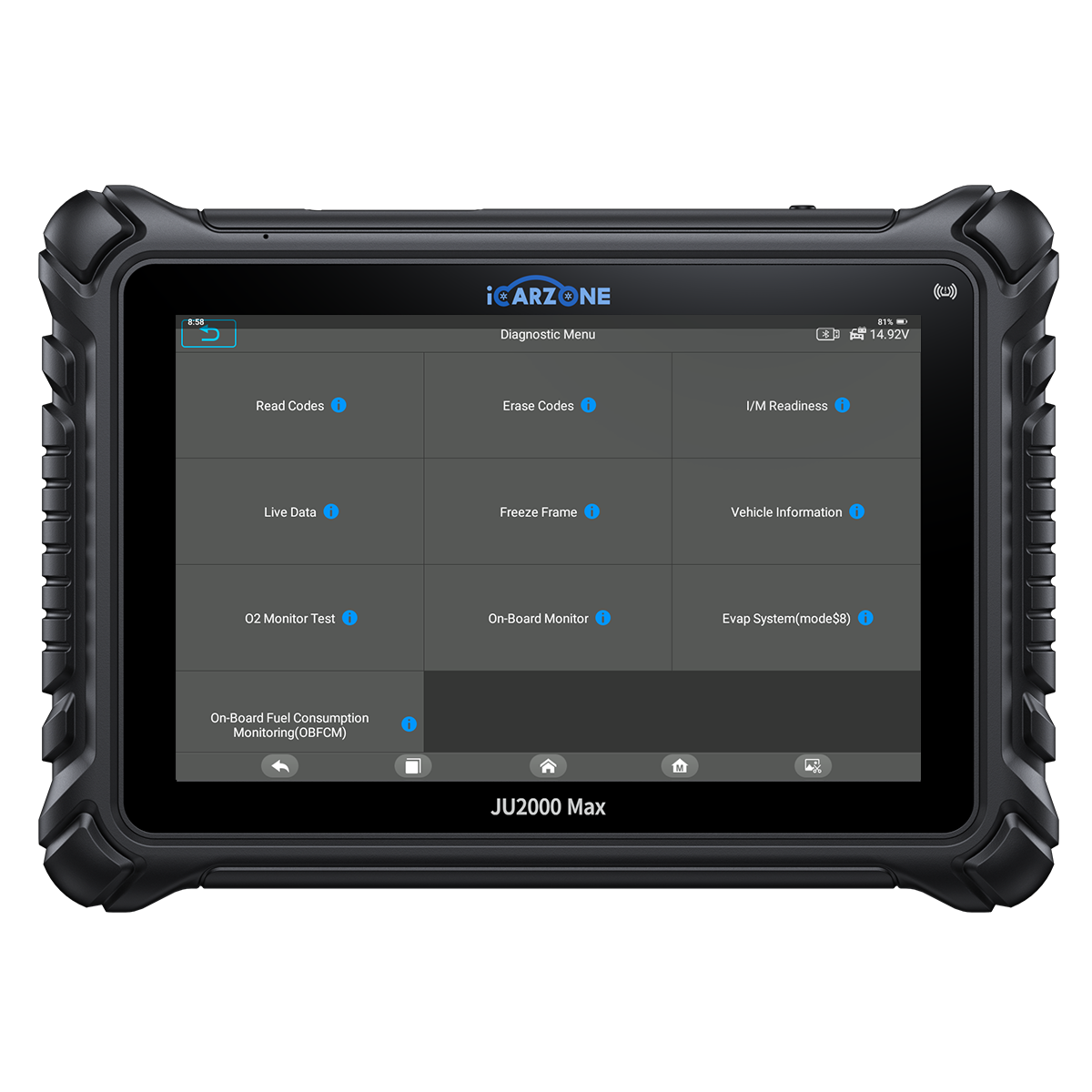
Save the exact module description and identification so the test path matches the vehicle.
Use the scanner alongside the prescribed external test equipment and current service information. An unavailable menu is a coverage or access question, not proof that a component failed. Price checked October 8, 2026; confirm the current offer and vehicle coverage on the product page.
How to Diagnose P1681 in 6 Steps
This six-step sequence explains the decisions a diagnosis needs to resolve. It is not a substitute for the VIN-specific service procedure. Keep a record of the test conditions, measured results and comparison limits; do not fill a missing specification with a number from another vehicle.
P1681 Quick Diagnostic Path
-
1
Save the complete original event
- Record all modules' faults, full descriptions, suffixes, status and available freeze frame before clearing P1681. Save companion codes even when they seem unrelated; their timing may identify a shared supply, communication or operating-condition problem.
- Document full fault text, module name, engine identity, software identification and any driveability complaint. Ask when the warning first appeared and whether it preceded module replacement, programming, engine conversion or battery work. Do not recreate an unsafe symptom merely to collect a better graph.
-
2
Establish the vehicle and controller identity
- Record VIN, engine designation, module identification and complete code text. Check whether the scan used the correct vehicle profile.
- Compare those details with the vehicle record and any replacement-module or engine-work history. Do not apply a diagram until the application is resolved.
-
3
Retrieve the applicable OEM definition
- Find the current diagnostic procedure for that controller and exact code, including any suffix or failure-type information.
- If two descriptions conflict, stop the component-specific diagnosis and resolve the mismatch. Do not select a definition just because it matches a symptom.
-
4
Follow prerequisites and external checks
- Use the confirmed procedure to choose supply, ground, network or input tests. Save relevant companion codes and the conditions required by the monitor.
- For a throttle-related application, distinguish external position signals from the controller’s ability to run its diagnostic checks. Never create a sensor short to imitate an internal monitor.
-
5
Evaluate the demonstrated failure
- Record which prescribed check fails and what evidence excludes other branches. Confirm relevant calibration or service guidance before a module recommendation.
- Do not replace a throttle body, sensor or PCM merely because one appears in an online P1681 description. If the procedure is unavailable, obtain qualified OEM-level diagnosis.
-
6
Verify the repair under the right conditions
- Repeat the failed measurement or functional check. Complete only required setup or learning, then compare the result with the saved baseline.
- Follow OEM verification, retain the final scan and disclose incomplete tests. Diagnose any new symptom or code separately.
How to Fix P1681 and Verify the Repair
Correct identification first
Resolve an incorrect vehicle profile, incompatible part or misunderstood code definition before performing a repair.
Repair proven external faults
Fix the circuit, connection or supply issue established by the applicable OEM procedure.
Apply documented setup or software
Use an applicable, verified procedure when calibration or setup is the demonstrated branch.
Replace a controller only with evidence
Follow the OEM decision and required programming when the internal fault is confirmed, then verify the original monitor.
Diagnostic time
VIN-specific quoteRequest a quote distinguishing identification, external circuit testing and any confirmed controller-monitor issue. A code read alone does not identify the replacement part.
Wiring and access
VIN-specific quoteQuote proven terminal, harness and access work separately. Correct the source of heat, abrasion or contamination.
Proven component repair
VIN-specific quoteAsk for the exact part, failed test and required supporting items. The correct service unit depends on the vehicle and defect.
Setup and final verification
VIN-specific quoteInclude learning, calibration or programming only when required. Labor, parts and access differ; these are alternative paths, not four automatic charges.
Ask the shop to connect each proposed repair to a finding and separate confirmed defects from conditional work. Keep the original and final reports.
Ask the shop to put the OEM definition and failed test on the estimate. A parts quote based only on P1681, without vehicle and module identity, is not a complete diagnosis.
P1681 OEM Differences and DIY Limits
GM’s archived 2004 document for the 2.8L LK5 and 3.5L L52 provides a throttle-position diagnostic-performance example for P1681. Its monitor concerns the controller’s diagnostic ability; it must not be generalized to all GM engines or to another manufacturer.
Require the exact vehicle, engine, controller and code wording before applying a component-specific label.
Use only evidence relevant to the confirmed monitor; a plausible external sensor value may not prove an internal diagnostic function.
Repeat the applicable failed test and OEM monitor-verification conditions after the identified repair, with the correct vehicle configuration.
The archived OEM excerpt is a historical reference, not a current repair procedure. Access to the full service path may require the manufacturer’s service system. Verify present applicability and do not translate the description of an internal diagnostic test into instructions to short external sensor pins.
- Save the complete scan and warning text without clearing it.
- Record the conditions and service history accurately.
- Inspect only safely accessible areas under the specified power state.
- Follow the owner manual response to every active warning.
- Use qualified assistance when symptoms make operation unsafe.
- Do not jump, backfeed or force an unidentified circuit or actuator.
- Use the exact isolation procedure and specified test equipment.
- Leave required disassembly, learning or programming to equipped personnel.
Frequently Asked Questions About P1681
What does P1681 mean?
Does P1681 always mean a bad throttle sensor?
Can I use another brand’s P1681 repair?
What should I give the repair shop?
Can this code justify replacing the PCM?
Should I clear P1681 before diagnosis?
Can JU2000 MAX help diagnose P1681?
What confirms a successful P1681 repair?
Sources and Technical Review Notes
- GM 2004 OBD Documentation: 2.8L LK5 and 3.5L L52 — Historical P1681 throttle-position diagnostic-performance example; indexed OEM excerpt, full-document access may require GM login.
- Tags: DTC iCARZONE JU2000 MAX OBD-II P1681
0 comments