P2005 Code Fix: Intake Manifold Runner Control Stuck Open (Bank 2)

P2005 means the intake manifold runner flaps on bank 2 are stuck open — the computer commands them to close at low RPM but they won't move. You'll usually feel it as a rough idle or soft low-end power, and it fails emissions. Most cases are carbon buildup or a failed actuator, but a physically broken flap can be drawn into the engine, so it's worth fixing soon.
P2005 = "Intake Manifold Runner Control Stuck Open (Bank 2)" — the PCM commanded the bank 2 intake runner flaps to close but detected they stayed open.
Many engines use small butterfly flaps (tumble/swirl flaps) inside the intake runners. They close at idle and low RPM to speed up and swirl the incoming air — improving idle quality, low-end torque, and emissions — and open at high RPM for maximum airflow. P2005 means the bank 2 flaps are stuck open and the actuator can't move them, usually from carbon buildup, a failed actuator/motor, or a broken flap or linkage. Bank 2 is the side of the engine without cylinder #1, so this appears on V6, V8, and boxer engines.
Diagnostic priority: (1) scan all codes + freeze frame; (2) bidirectionally command the runner control and watch the live position respond; (3) inspect the actuator, linkage, flaps, and (on vacuum systems) the vacuum supply; (4) resistance-test the actuator and position sensor; (5) try cleaning a carbon-bound flap before buying parts; (6) replace the actuator — or the manifold if a flap is broken.
What does P2005 actually mean?
Inside the intake manifold, many engines fit a set of runner control flaps — butterfly plates that partially close the intake passages at idle and low RPM. Closing them speeds up and swirls the incoming air, which improves idle stability, low-end torque, and cold-start emissions; at higher RPM they open fully for maximum power. The flaps are moved by an IMRC actuator — an electric motor/solenoid (PWM-controlled) or a vacuum actuator — and a position feedback sensor tells the PCM where they are.
P2005 sets when the PCM commands the bank 2 runners to a position (typically closed) but the feedback says they're still open. The flaps are physically stuck, the actuator can't drive them, or the position signal doesn't match the command. Bank 2 is the cylinder bank that doesn't contain cylinder #1 — so P2005 only appears on engines with two banks (V6, V8, V10, and flat/boxer engines). Bank 1's version of the same fault is P2004.

How the intake runner control works: the flaps close at low RPM for torque and open at high RPM for power — P2005 means the bank 2 flaps are stuck open.
What are the symptoms of P2005?
The flaps matter most at low RPM, so that's where you'll feel it:
- Check Engine Light — often the first sign
- Rough or uneven idle — idle speed can wander or feel lumpy
- Soft low-end power / hesitation — a flat spot or lag when accelerating from low RPM
- Reduced fuel economy — typically a few MPG
- Failed emissions test — uncontrolled intake airflow shifts the air-fuel balance
- A rattle from the intake (sometimes) — a loose flap or linkage can rattle
- Little to no change in some cases — the light may be the only clue
Is P2005 serious?
Moderate — higher than a typical emissions code because of one failure mode. Here's the realistic picture:
- Carbon-bound flap freed by cleaningno damage · $10–$200 fix
- IMRC actuator / wiring faultno engine damage · $40–$450 fix
- Reduced low-end power & economydriveable, but noticeable
- Failed emissions inspectionguaranteed until cleared
- Broken flap drawn into the enginecan cause serious internal damage
What causes a P2005 code? Ranked by frequency

The intake manifold and its runner flaps — carbon buildup, a failed actuator, or a broken flap is the usual P2005 cause.
Carbon Buildup / Binding Flaps
30% of casesThe most common cause. Carbon coking inside the intake manifold builds up around the runner flaps and their shaft until they bind and can't close, so the actuator pushes against a stuck flap. Cleaning the runners (intake cleaner, or walnut blasting on direct-injection engines) often frees the flap and clears the code without new parts.
Fix: $10–$200 cleaningFailed IMRC Actuator / Solenoid / Motor
28% of casesThe actuator that drives the flaps can fail internally — worn brushes, damaged windings, a seized gear, or a dead solenoid — so it can no longer move the runners. On vacuum-operated systems, a failed vacuum actuator does the same thing. Resistance-test the actuator and confirm it physically moves when commanded.
Fix: $40–$300 actuatorBroken or Loose Flaps / Linkage
16% of casesThe screws or rivets that secure the flaps to the shaft can loosen or fall out, and plastic flaps or linkage can crack, leaving the runners stuck and rattling. This is the failure mode that makes P2005 worth taking seriously — a broken flap can be drawn into the engine. Inspect the linkage and flaps for play, breakage, and missing hardware.
Fix: $150–$600 manifold (if broken)Wiring / Connector Fault
12% of casesAn open or shorted actuator circuit, a corroded connector, or a poor electrical connection stops the PCM from driving or reading the runner control. Inspect the actuator/solenoid connector for corrosion and bent pins, and check the wiring for opens, shorts, and high resistance.
Fix: $10–$150 wiring / connectorVacuum Leak / Failed Vacuum Actuator
8% of casesOn vacuum-operated runner systems, a cracked or disconnected vacuum line, a leaking diaphragm, or a faulty vacuum solenoid leaves the flaps unable to move. Inspect the vacuum lines and test the actuator with a hand vacuum pump to see whether the runners respond.
Fix: $10–$200 vacuum line / actuatorFaulty Position Sensor or PCM
6% of cases · RareA faulty runner-position sensor can report "open" even when the flaps move correctly, and — rarely — a PCM fault can mis-drive the circuit. Confirm the flaps actually move and the actuator and wiring are good before replacing the sensor, and suspect the PCM only as a last resort.
Fix: $30–$150 sensor (PCM rare)What you'll need
Tools
- All-system scanner with live data + bidirectional IMRC test iCARZONE UR1000 ›
- Digital multimeter (resistance, continuity)
- Intake / throttle-body cleaner (to free a sticky flap)
- Hand vacuum pump (for vacuum-operated systems)
- Back-probe pins / test leads
- Wiring diagram + actuator/sensor resistance spec
Parts & supplies
- IMRC actuator / solenoid / motor$40–$300
- Runner-position sensor$30–$150
- Intake manifold (if flaps broken)$150–$600
- Connector / pigtail / terminals$10–$40
- Vacuum lines (vacuum systems)$5–$30
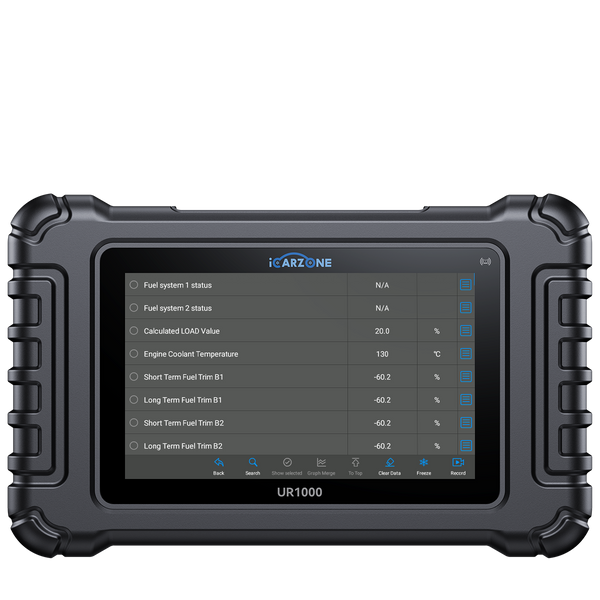
iCARZONE UR1000 — 7" Wireless All-System Scanner
P2005 is confirmed with an active test, not a guess. The UR1000 commands the intake runner control and graphs the live runner-position feedback as it responds — so you can tell a stuck or carbon-bound flap from a dead actuator or a wiring fault before pulling the manifold. All-system, OE-level access reads the intake and engine data a basic code reader can't.
- 7" wireless touchscreen (33 ft range)
- All-system OE-level diagnostics
- 40,000+ bidirectional / active tests
- Live runner-position & solenoid data
- 49 services + CAN FD
- 100+ brands · lifetime free updates
How do you fix a P2005 code?
Confirm movement first, then work cheap-to-expensive. A bidirectional test tells you in seconds whether the flaps move — which decides everything that follows.
Scan all codes and note the freeze frame
- Record P2005 and any companion codes — P2004 (stuck open, bank 1), P2006/P2007 (stuck closed), or runner-control circuit codes (P2008+). Freeze-frame shows the conditions when it set.
- Confirm which physical side is bank 2 (the side without cylinder #1) so you test and, if needed, replace the right bank's actuator and runners.
Bidirectionally command the runner control — your decisive test
- With a capable scanner, command the runner control open and closed and watch the live position feedback. Flaps that track the command are healthy; flaps that don't move are the fault.
- If the actuator is clearly trying but the flaps don't move, suspect carbon/binding or a broken linkage; if the actuator does nothing, suspect the actuator or its wiring.
Inspect the actuator, linkage, flaps, and vacuum
- Visually check the actuator and external linkage for play, breakage, or missing screws/rivets, and look/listen for a loose flap.
- On vacuum systems, inspect the vacuum lines for cracks and test the actuator diaphragm with a hand vacuum pump.
- Check the connector for corrosion and the wiring for damage.
Resistance-test the actuator and position sensor
- Measure the actuator/solenoid and the position sensor resistance against your vehicle's spec — an open or out-of-range reading condemns the part.
- To avoid module damage, disconnect related controllers before testing circuits, then check continuity on the harness.
Clean the carbon / free a sticky flap
- If the flaps bind on carbon, clean the runners with intake cleaner (or walnut-blast on direct-injection engines) and work the flaps free by hand or with the bidirectional test.
- Re-test movement after cleaning — many P2005 cases clear here without replacing parts.
Replace the actuator — or the manifold — final step
- If the actuator or position sensor is confirmed faulty, replace it with the correct part. If a flap, shaft, or runner is physically broken, the intake manifold is usually replaced as an assembly.
- Clear the code, re-run the bidirectional test, and confirm the runners now track the command and the idle and power are restored.
How much does P2005 cost to fix?
A carbon clean or an actuator handles most cases at modest cost. The bill only climbs if a flap or the manifold itself is broken and the manifold has to be replaced.
| Repair | DIY | Shop | You save | Type |
|---|---|---|---|---|
| Diagnosis (scan + live data + bidirectional) | $0 (free with tool) | $90–$160 | Up to $160 | Free First Step |
| Intake cleaning (free a sticky flap) | $10–$30 | $80–$200 | Up to $190 | DIY Easy |
| Vacuum line / connector repair | $10–$50 | $80–$200 | Up to $190 | DIY Moderate |
| Runner-position sensor | $30–$150 | $120–$350 | Up to $320 | DIY Moderate |
| IMRC actuator / solenoid / motor | $40–$300 | $150–$450 | Up to $410 | DIY Moderate |
| Intake manifold (broken flaps/runner) | $150–$600 | $400–$1,200 | Up to $1,050 | Often Shop |
Which vehicles are most prone to P2005?
P2005 only appears on engines with two cylinder banks — V6, V8, and boxer layouts — that use intake runner control. European makes are especially well-represented, but it shows up across brands. Deep-dives below.
| Make | Common models | Years | Primary cause & notes | Risk |
|---|---|---|---|---|
| Mercedes-Benz | C / E / CLK / ML (V6 & V8) | 2004–2018 | Tumble/swirl flaps & intake manifold issues; a known problem area. | High |
| Audi / Volkswagen | A4, A6, A8, Q7, Touareg (V6 & V8) | 2004–2018 | Intake flap / runner failures; carbon binding common. | High |
| Hyundai / Kia | Sonata, Santa Fe, Sorento (V6) | 2006–2019 | IMRC actuator motor failure; check actuator first. | Medium |
| Ford / Lincoln | Mustang, F-150, Explorer (V6 & V8) | 2004–2019 | IMRC actuator & carbon; inspect linkage. | Medium |
| Subaru | WRX, Legacy, Outback (boxer) | 2005–2019 | Tumble generator valve / runner; bank 2 is a boxer side. | Medium |
| Nissan / Infiniti | Maxima, Murano, 350Z, G35 (VQ V6) | 2004–2018 | Runner control actuator / wiring; less common. | Low |
| GM / Chevrolet | Various V6 / V8 | 2004–2018 | Actuator / carbon; verify with a bidirectional test. | Low |
Carbon and sticky flaps — try cleaning before parts
Before spending on an actuator or a manifold, rule out the cheapest and most common cause:
- How carbon causes it. Oil vapor and combustion byproducts coke up inside the intake over time. The deposits build around the runner flaps and their shaft until the flaps bind and won't close — so the actuator is working against a stuck flap, and the PCM sees "stuck open."
- What to do. Clean the runners and flaps with an intake/throttle cleaner, or walnut-blast the intake on direct-injection engines where carbon is worst. Work the flaps free and re-run the bidirectional test to confirm they move.
- Why it's worth trying. Freeing a carbon-bound flap can clear P2005 for the cost of a can of cleaner — far less than a new actuator or manifold.
Action plan: bidirectional-test the flaps → if they bind, clean the runners → free the flaps → re-test movement before ordering any parts.
The risk worth respecting: a broken flap
This is why P2005 sits above a routine emissions code on the priority list:
- The failure. The screws or rivets that hold the flaps to the shaft can loosen, and plastic flaps or linkage can crack. A flap that breaks free can be drawn down an intake runner and into a cylinder — risking valve, piston, and cylinder damage.
- The warning signs. A rattle from the intake, a sudden change in idle, or visible play in the linkage all point to mechanical breakage rather than a sticky flap or bad actuator.
- What to do. If you find broken or loose flaps, don't keep driving — the manifold is usually replaced as an assembly, and that's cheaper than the engine damage a swallowed flap can cause.
Check for a TSB / recall: at NHTSA.gov enter your VIN or year/make/model for bulletins related to the intake manifold or runner control on your platform. NHTSA recalls & TSBs ›
Should you DIY or call a mechanic?
DIY if you…
- Have a scanner that runs bidirectional IMRC tests and live data
- Can identify bank 2 and reach the actuator
- Have a multimeter to resistance-test the actuator and sensor
- Are comfortable cleaning the intake / runners
- Want to rule out carbon and wiring before buying parts
- Want to save $90–$1,000 over shop diagnostic + labor
Use a mechanic if…
- A flap, shaft, or runner is physically broken
- The intake manifold must come off to access the runners
- You don't have a bidirectional scanner
- The fault is intermittent and hard to catch
- You suspect a swallowed flap or internal damage
- The code returns after cleaning and a new actuator
Frequently asked questions
Is it safe to drive with a P2005 code?
You can usually drive short distances, but it's not a "leave it for months" code. A stuck-open runner costs you low-end power and fuel economy and fails emissions — and if a runner flap or its linkage has physically broken, a piece can be drawn into the engine and cause real damage. Get it diagnosed soon, sooner if the idle is rough or you hear a rattle from the intake.
What does "Bank 2" mean on P2005?
Bank 2 is the side of the engine that doesn't contain cylinder #1 — so P2005 appears on V6, V8, and boxer engines that have two cylinder banks, each with its own intake runner control. Bank 1's version of the same fault is P2004. Confirm which physical side is bank 2 before testing or replacing parts.
Can carbon buildup cause P2005?
Yes — it's one of the most common causes. Carbon coking inside the intake manifold makes the runner flaps bind or stick open so the actuator can't close them. Cleaning the runners with a suitable intake cleaner (or walnut blasting on direct-injection engines) often frees a sticky flap and clears the code without new parts.
How much does it cost to fix P2005?
It depends on the cause. Cleaning a sticky flap can be $10–$30 DIY. An IMRC actuator or solenoid is roughly $40–$300 in parts, a position sensor $30–$150. If a flap or the manifold is physically broken, a replacement intake manifold can run $150–$600 in parts plus labor. Shop labor adds $90–$200+.
What scanner do I need to diagnose P2005?
One that can run a bidirectional (active) test of the intake runner control and show the live runner-position data, so you can command the flaps and watch them respond. The iCARZONE UR1000 ($499.99) offers all-system access, live data, and 40,000+ bidirectional tests, which makes confirming a stuck runner straightforward.
Why does P2005 come back after I replaced the actuator?
Usually because the flaps themselves are still binding — carbon buildup or a broken/loose flap will defeat a new actuator. Re-check the runners for carbon and mechanical damage, inspect the linkage and position sensor, and confirm the wiring and (on vacuum systems) the vacuum supply. Make sure the replacement actuator is the correct part for your engine.
Quick verdict
- Step 1 — free first: scan codes + freeze frame, then bidirectionally command the runner control and watch the live position. $0 with a capable scanner.
- Step 2 — find the cause: a flap that won't move means carbon/binding or a dead actuator; resistance-test the actuator and sensor, and inspect the linkage and flaps for breakage.
- Step 3 — fix in order: try cleaning a sticky flap first, then replace the actuator or sensor, and replace the manifold only if a flap or runner is physically broken.
Command the runners, confirm the fault
The iCARZONE UR1000 runs 40,000+ bidirectional tests and live data — so you can actuate the intake manifold runner control and watch it respond to pinpoint P2005 before removing the manifold, across 100+ brands.