
P200E Code: Catalyst System Over Temperature, Bank 1

P200E: Establish Thermal Safety
Verify the temperature evidence and its cause before choosing a catalyst repair.
DIAGNOSTIC FOCUS
- FAULT TYPE
- Catalyst System Over Temperature, Bank 1
- FIRST CHECKS
- Active warnings, full engine scan and measured versus modeled temperature
This code is not a Bank 2 catalyst-efficiency code and does not by itself prove the catalyst must be replaced.
P200E means Catalyst System Over Temperature, Bank 1. P200E is not a Bank 2 catalyst-efficiency code and does not by itself prove the catalyst must be replaced. Save the full fault record, identify the reporting controller and use the current vehicle-specific procedure.
Treat signs of extreme exhaust heat as a safety issue. Let the system cool, preserve the scan and identify how the vehicle monitors catalyst temperature before testing.
What Does the P200E Code Mean?
P200E means catalyst system over temperature on Bank 1. This distinction matters: a thermal event is a different diagnostic problem from low conversion efficiency. The code is also distinct from a diesel particulate filter over-temperature label and does not justify applying a generic regeneration procedure.
A controller may use temperature sensors, modeled temperature information or an application-specific combination of inputs. Establish what the displayed value actually represents before treating a scan PID as a direct thermometer reading. The fault description alone does not supply a universal temperature limit or identify a failed sensor.
The cause and the condition of the catalyst are separate questions. A real thermal problem can require investigation of engine operation and the exhaust system, while inaccurate temperature evidence requires its own circuit or plausibility checks. Replacing a catalyst without addressing the demonstrated cause can leave the original problem unresolved.
Record the complete code, any suffix, reporting module and current/history status. The same short description does not establish a common circuit layout across vehicles.
Distinguish sensor measurements, calculated catalyst temperature and actual physical symptoms. A modeled value cannot be validated simply by comparing it with a surface reading at an unrelated location.
Save available freeze frame and note engine load, temperature data, misfire or mixture faults and any smoke, odor or visible overheating. A reset or disconnected connector can change the evidence before the cause is found.
P200E Symptoms, Severity, and Driving Safety
Record the exact warning and complete fault set; do not assume every warning is an ordinary efficiency issue.
Document reduced performance and follow the owner manual response rather than using heavy acceleration to test it.
Investigate concurrent engine faults independently. They can change the thermal-risk assessment.
Treat visible smoke or strong abnormal heat signs seriously. Do not work underneath a hot exhaust.
Identify whether the value is sensed or calculated and preserve the operating conditions.
A historical event may no longer be present. Its absence now does not establish what occurred under the original load.
Prompt diagnosis is required because abnormal exhaust heat can damage components and create a fire hazard. Avoid heavy load and towing until the cause is understood. Do not use an assumed driving distance or a cleared warning as proof that the thermal risk has ended.
P200E Causes and the Evidence That Separates Them
The following are possible diagnostic branches, not a ranking of failure rates. Their relevance depends on the installed catalyst-temperature monitoring. Begin with the branch identified by the OEM decision tree and the complete code pattern.
Unreliable temperature input
A temperature sensor or its circuit may supply implausible information.
How to prove it: Identify the actual sensor architecture and perform the prescribed plausibility and circuit checks.
Check firstModeled-temperature input problem
A calculated value depends on the controller’s input data and strategy.
How to prove it: Validate relevant inputs and the OEM monitor conditions rather than replacing a sensor that may not exist.
Check firstAbnormal engine operation
Misfire or fueling problems may be relevant to excessive exhaust heat.
How to prove it: Diagnose companion engine faults and verify the actual condition before assigning a root cause.
Verify directlyExhaust restriction or damage
A demonstrated exhaust condition may affect operation or require repair after a thermal event.
How to prove it: Use the specified safe inspection and restriction tests after cooling.
Verify directlyApplication-specific thermal control issue
An installed aftertreatment strategy may have control conditions relevant to the event.
How to prove it: Follow the exact system procedure; do not apply an unrelated forced-regeneration routine.
Verify directlyIncorrect component or calibration
Recent work may have introduced incompatible parts or an unsupported setup.
How to prove it: Verify application and service history, then confirm any bulletin or calibration instruction by VIN.
Final branchIf the warning followed exhaust, oxygen-sensor, fuel-system or engine-control work, compare the timing with the original complaint. Recheck disturbed connections and part compatibility, but do not treat recent work alone as proof of causation. A component should earn replacement through a failed test.
Using JU2000 MAX During P200E Diagnosis
On supported vehicles, iCARZONE JU2000 MAX retrieves accessible faults, available freeze frame and live data. Save the P200E event before clearing it so the technician has the original evidence.
The official product page describes system diagnostics and bidirectional control. Confirm the exact VIN, controller, software and requested function before purchase. Every PID, active test or adaptation is not guaranteed on every vehicle.
Use JU2000 MAX to save supported temperature data, engine faults and the operating context. Label each PID as measured or calculated when the service information identifies it. The scanner does not prove internal catalyst condition or make an unsafe exhaust-temperature test safe.
iCARZONE JU2000 MAX All-in-One Diagnostic & TPMS Kit
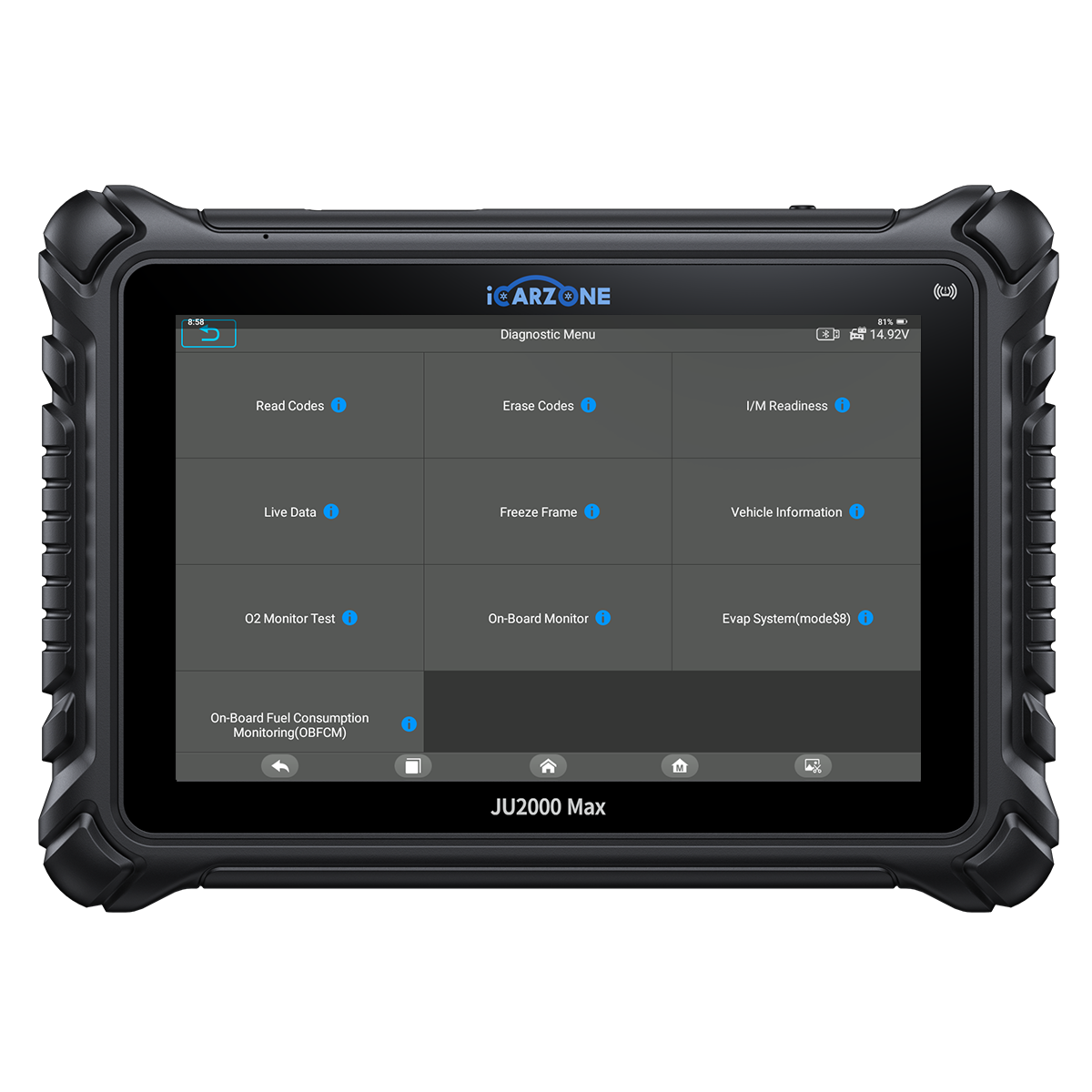
Keep the original thermal event and engine data together so temperature risk is not reduced to an unsupported catalyst replacement guess.
Use the prescribed external equipment and current service information. A missing menu is a coverage question, not proof of failure. Price checked October 8, 2026; confirm the current offer on the product page.
How to Diagnose P200E in 6 Steps
Use these six decisions alongside the VIN-specific procedure. Record conditions, measurements and comparison limits; never substitute another vehicle’s specification.
P200E Quick Diagnostic Path
-
1
Save the complete original event
- Save all module faults, descriptions, suffixes, status and available freeze frame before clearing P200E. Preserve companion-code timing when investigating a shared condition.
- Document engine load, temperature data, misfire or mixture faults and any smoke, odor or visible overheating. Note whether the warning preceded exhaust, oxygen-sensor, fuel-system or engine-control work. Do not reproduce an unsafe symptom.
-
2
Establish safety and let the system cool
- Follow warning instructions, keep the vehicle away from combustible material and do not touch hot exhaust components.
- Do not continue a road test to make an over-temperature warning recur. Escalate visible fire or smoke appropriately.
-
3
Identify the temperature-monitor method
- Use current service information to locate the relevant sensors or modeled values and Bank 1 exhaust path.
- Check the complete code set, operating conditions and data units before deciding what a high value means.
-
4
Separate input faults from a real heat source
- Perform the specified sensor, circuit and plausibility checks. Investigate concurrent misfire or fueling faults on their own evidence.
- Do not treat invalid oxygen or temperature feedback as proof of a rich engine without the required confirming tests.
-
5
Assess exhaust condition and select the repair
- Once cool and safe, follow the prescribed inspection for restriction or thermal damage and review applicable control-system instructions.
- A catalyst replacement needs demonstrated damage or a failed test; any proven upstream cause must be corrected as part of the repair.
-
6
Verify the repair under the right conditions
- Repeat the failed check, complete any required setup and compare the result with the original evidence. An extinguished lamp alone is not verification.
- Follow the OEM verification process and retain the final scan. Explain incomplete checks or remaining faults before releasing the vehicle.
How to Fix P200E and Verify the Repair
Repair a proven temperature-input defect
Restore the sensor circuit or correct input problem identified by the procedure, then verify plausibility.
Correct the demonstrated engine fault
Repair supported misfire or fueling defects and reevaluate the thermal event under safe conditions.
Repair verified exhaust damage
Replace damaged or restricted service parts only after the cause and required scope are established.
Complete applicable control or setup work
Use the current VIN-specific service instruction and confirm normal thermal behavior after the repair.
Diagnostic time
VIN-specific quoteRequest a quote that identifies the test needed to distinguish a temperature-input problem from an engine fault or damaged exhaust component. A code scan alone is not completed diagnosis.
Wiring and access
VIN-specific quoteQuote proven terminal, harness and access work separately. Correct the cause of heat, abrasion or contamination to reduce repeat damage.
Proven component repair
VIN-specific quoteRequest the exact part, its failed test and required installation items. The correct service unit depends on the vehicle and demonstrated defect.
Setup and final verification
VIN-specific quoteInclude setup only when required, plus final verification. Local rates and taxes vary; these are alternative paths, not four automatic charges.
Ask which finding supports each proposed P200E repair. Separate confirmed defects from conditional work and retain the original and final reports.
A replacement catalyst does not resolve an uncorrected upstream cause. Request a repair record that identifies both why the thermal event occurred and how the final verification addresses it.
P200E OEM Differences and DIY Limits
The official Autel code reference distinguishes P200E as catalyst over temperature on Bank 1 from P200F on Bank 2 and from P200C/P200D DPF temperature codes. It does not provide a universal temperature threshold or vehicle-specific repair.
Trace the Bank 1 catalyst path and determine whether its relevant temperature data are sensed, calculated or combined.
Validate the meaning and location of the temperature evidence before comparing values from different instruments.
The identified cause must be corrected and the specified thermal verification must pass without recreating an unsafe heat condition.
Ford owner guidance reinforces that exhaust components can remain hot after shutdown and must be kept away from combustible ground cover. For diagnostic limits, sensor locations and verification conditions, use the exact vehicle’s current service information.
- Save the complete scan and warning text without clearing it.
- Record the conditions and service history accurately.
- Inspect only safely accessible areas under the specified power state.
- Follow the owner manual response to every active warning.
- Use qualified assistance when symptoms make operation unsafe.
- Do not jump, backfeed or force an unidentified circuit or actuator.
- Use the exact isolation procedure and specified test equipment.
- Leave required disassembly, learning or programming to equipped personnel.
Frequently Asked Questions About P200E
What does P200E mean?
Is P200E Bank 2 catalyst efficiency below threshold?
Should I force a DPF regeneration?
Does a high scan-tool temperature prove a bad sensor?
Must the catalyst be replaced immediately?
Should I clear P200E before diagnosis?
Can JU2000 MAX help diagnose P200E?
What confirms a successful P200E repair?
Sources and Technical Review Notes
- Autel official diagnostic code reference — P200E Bank 1 over-temperature wording and neighboring catalyst/DPF distinctions.
- Ford owner information — Catalytic Converter — Hot-exhaust, combustible-ground and prompt-inspection safety guidance; not a P200E threshold or repair specification.
- Tags: DTC iCARZONE JU2000 MAX OBD-II P200E
0 comments