
P2159 Code: Vehicle Speed Sensor B Range and Performance

P2159: Trace the Speed Signal
Identify sensor B and test the signal path before choosing a replacement.
DIAGNOSTIC FOCUS
- FAULT TYPE
- Vehicle Speed Sensor B Range/Performance
- FIRST CHECKS
- Full module record, signal identity and companion speed faults
The code does not identify a universal sensor location or prove a transmission assembly has failed.
P2159 means Vehicle Speed Sensor B Range/Performance. The code does not identify a universal sensor location or prove a transmission assembly has failed. Save the full fault record, identify the reporting controller and use the current vehicle-specific procedure.
Compare the relevant speed signals under the specified conditions. Do not assume the dashboard speedometer and the reporting controller use the same source.
What Does the P2159 Code Mean?
P2159 identifies a range or performance concern involving vehicle speed sensor B. The controller has detected behavior that does not fit its expected operating relationship. That description is a starting point: it does not specify whether the useful next test is electrical, a signal comparison or an inspection of the speed target.
The letter B is a circuit designation, not an instruction to replace the second sensor you can see. A vehicle may distribute speed information among transmission, brake and engine controllers. Identify the source and destination on the wiring diagram and service procedure before deciding which physical component belongs to the stored fault.
A steady dashboard reading does not disprove a fault in another speed channel. Equally, a strange speed reading in one controller does not prove the sensor is defective. Compare the original fault timing, the relevant PIDs and any physical waveform or target inspection directed by the manufacturer. Keep wheel speed, shaft speed and calculated vehicle speed distinct.
Record the complete code, any suffix, reporting module and current/history status. The same short description does not establish a common circuit layout across vehicles.
A scan PID is the controller’s interpretation of a signal. A prescribed waveform test at the correct point can answer a different question about what actually reaches the controller.
Save available freeze frame and note vehicle speed, selected gear, warning messages and whether the event occurred during a shift. A reset or disconnected connector can change the evidence before the cause is found.
P2159 Symptoms, Severity, and Driving Safety
Save the exact message and all related module records before clearing. A warning can appear before the driver notices a shift problem.
Poor speed information can accompany altered shifting. A shift complaint also needs fluid, hydraulic and mechanical context.
Record an erratic or missing display, but do not assume that its input is identical to the signal named by the stored code.
Note whether cruise becomes unavailable alongside the speed fault. Do not test cruise while other vehicle behavior is unsafe.
A group of speed or communication faults may identify a shared path. Compare their status and order instead of replacing every named sensor.
Heat, vibration or recent work may help define when the event occurs. A normal parked snapshot cannot rule out an intermittent signal.
Arrange diagnosis promptly, particularly when gear changes or speed indications are unreliable. The code cannot establish a safe remaining distance. Follow the owner manual warning instructions and avoid towing or high-load use while a transmission complaint remains unresolved.
P2159 Causes and the Evidence That Separates Them
The following are possible diagnostic branches, not a ranking of failure rates. Their relevance depends on the installed speed-signal architecture. Begin with the branch identified by the OEM decision tree and the complete code pattern.
Connector or terminal defect
A loose, contaminated or damaged connection may disturb a speed signal without leaving an obvious broken wire.
How to prove it: Inspect the identified circuit and use approved terminal and loaded-circuit checks.
Check firstHarness damage
Abrasion, heat or a stretched lead can produce an intermittent or incorrect signal.
How to prove it: Trace the actual route and compare measurements across the suspected section.
Check firstSensor response
The correct sensor may fail to generate the expected response under prescribed conditions.
How to prove it: Prove its supplies and test it using the specified sensor technology and method.
Verify directlyTarget or installation issue
A damaged target, incorrect installation or relevant mechanical condition can affect the information the sensor reads.
How to prove it: Inspect the matching target and mounting arrangement, not an assumed universal air gap.
Verify directlyShared power or network condition
Companion faults may show that multiple signals were affected by a common event.
How to prove it: Compare code timing, controller supplies and the vehicle’s actual signal routing.
Verify directlyApplication-specific controller issue
A particular transmission may have a documented internal sensor or controller service path.
How to prove it: Match the complete OEM code and bulletin conditions before authorizing that work.
Final branchIf the warning followed transmission, wheel-bearing, sensor or harness work, compare the timing with the original complaint. Recheck disturbed connections and part compatibility, but do not treat recent work alone as proof of causation. A component should earn replacement through a failed test.
Using UR1000 During P2159 Diagnosis
On supported vehicles, iCARZONE UR1000 retrieves accessible faults, available freeze frame and live data. Save the P2159 event before clearing it so the technician has the original evidence.
The official product page describes system diagnostics and bidirectional control. Confirm the exact VIN, controller, software and requested function before purchase. Every PID, active test or adaptation is not guaranteed on every vehicle.
For this fault, compare available transmission and vehicle-speed data with the complete controller scan. UR1000 does not physically measure a tone target or guarantee that the speed-B channel appears as a separate PID; the exact ECU determines what can be displayed.
iCARZONE UR1000 Bidirectional Scan Tool with ECU Coding
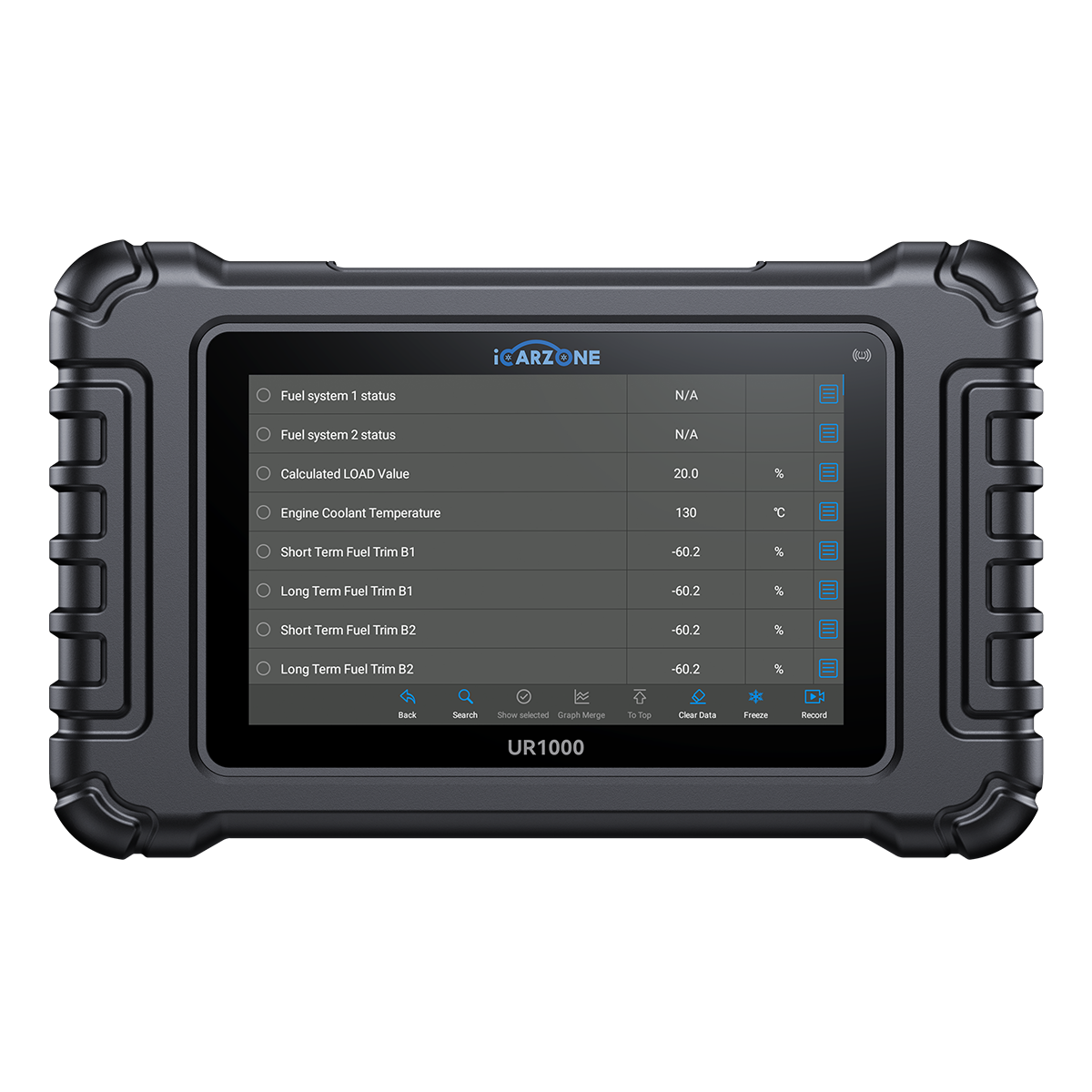
Preserve the speed fault and compare supported signals before deciding whether sensor, wiring or transmission work is justified.
Use the prescribed external equipment and current service information. A missing menu is a coverage question, not proof of failure. Price checked September 27, 2026; confirm the current offer on the product page.
How to Diagnose P2159 in 6 Steps
Use these six decisions alongside the VIN-specific procedure. Record conditions, measurements and comparison limits; never substitute another vehicle’s specification.
P2159 Quick Diagnostic Path
-
1
Save the complete original event
- Save all module faults, descriptions, suffixes, status and available freeze frame before clearing P2159. Preserve companion-code timing when investigating a shared condition.
- Document vehicle speed, selected gear, warning messages and whether the event occurred during a shift. Note whether the warning preceded transmission, wheel-bearing, sensor or harness work. Do not reproduce an unsafe symptom.
-
2
Identify the reporting controller and signal
- Read the full OEM description, suffix and any manufacturer subcode. Use current service information to locate the B signal source.
- Confirm whether the information is directly wired, processed or shared between modules before disconnecting anything.
-
3
Compare data without assuming equal values
- Review relevant vehicle, wheel and shaft speeds at the conditions allowed by the procedure. Record units and expected relationships.
- Do not expect engine, turbine and output speeds to be numerically equal; transmission operation changes those relationships.
-
4
Inspect and test the identified path
- Check connector retention, wiring route and the specified supplies. Use a suitable waveform or electrical test where directed.
- A continuity result alone cannot establish good signal quality under operating conditions. Do not use a generic resistance specification for an unidentified sensor.
-
5
Separate target and internal transmission evidence
- If the electrical path is sound, follow the prescribed target, mounting or internal sensor checks. Review applicable service information.
- Stop before disassembly unless the evidence and correct service procedure support it. Do not substitute a reset for a proven repair.
-
6
Verify the repair under the right conditions
- Repeat the failed check, complete any required setup and compare the result with the original evidence. An extinguished lamp alone is not verification.
- Follow the OEM verification process and retain the final scan. Explain incomplete checks or remaining faults before releasing the vehicle.
How to Fix P2159 and Verify the Repair
Repair a proven connection
Restore the correct terminals, seals or harness section and protect its route from repeat damage.
Replace a tested sensor
Confirm exact fitment and installation requirements after its supply and signal tests identify the defect.
Correct target or installation
Repair the demonstrated target or mounting problem using the matching service procedure.
Follow an applicable internal repair
Internal transmission or controller work requires the exact fault evidence and service path, not the short generic code alone.
Diagnostic time
VIN-specific quoteRequest a quote that identifies the test needed to distinguish a signal-path defect from a target or internal transmission condition. A code scan alone is not completed diagnosis.
Wiring and access
VIN-specific quoteQuote proven terminal, harness and access work separately. Correct the cause of heat, abrasion or contamination to reduce repeat damage.
Proven component repair
VIN-specific quoteRequest the exact part, its failed test and required installation items. The correct service unit depends on the vehicle and demonstrated defect.
Setup and final verification
VIN-specific quoteInclude setup only when required, plus final verification. Local rates and taxes vary; these are alternative paths, not four automatic charges.
Ask which finding supports each proposed P2159 repair. Separate confirmed defects from conditional work and retain the original and final reports.
If the code returns, compare the new event with the baseline. A changed companion code, temperature condition or speed relationship may require a different diagnostic branch rather than another sensor.
P2159 OEM Differences and DIY Limits
Audi bulletin 2032211/5 illustrates the importance of subcodes. In its listed S-Tronic applications, P2159 is paired with DFCC 8099; the document requires exact fault and DFCC matching. Its internal repair path is not a generic instruction for every vehicle storing P2159.
Locate the B channel from the exact wiring and transmission information; do not infer its physical position from the letter.
Distinguish measured sensor activity from a controller-calculated speed and from the dashboard display.
The repaired signal must pass its specified test and remain plausible during the prescribed verification conditions.
Use the current VIN-specific procedure to confirm the reporting module, circuit identity and applicable bulletin revision. A generic scanner label alone does not establish eligibility for a manufacturer repair or warranty.
- Save the complete scan and warning text without clearing it.
- Record the conditions and service history accurately.
- Inspect only safely accessible areas under the specified power state.
- Follow the owner manual response to every active warning.
- Use qualified assistance when symptoms make operation unsafe.
- Do not jump, backfeed or force an unidentified circuit or actuator.
- Use the exact isolation procedure and specified test equipment.
- Leave required disassembly, learning or programming to equipped personnel.
Frequently Asked Questions About P2159
What does P2159 mean?
Where is vehicle speed sensor B?
Can a normal speedometer rule out P2159?
Does P2159 mean the transmission needs replacement?
Is it safe to keep driving with P2159?
Should I clear P2159 before diagnosis?
Can UR1000 help diagnose P2159?
What confirms a successful P2159 repair?
Sources and Technical Review Notes
- Audi TSB 2032211/5, October 2016 — P2159 wording and exact DFCC applicability in the listed S-Tronic vehicles; not a universal repair instruction.
0 comments