
P2160 Code: Vehicle Speed Sensor B Circuit Low Diagnosis

P2160: Prove the Speed Signal
Identify which speed sensor B the vehicle uses before replacing a sensor or transmission part.
DIAGNOSTIC FOCUS
- FAULT TYPE
- Vehicle Speed Sensor "B" Circuit Low
- FIRST CHECKS
- the exact speed-source map, sensor B wiring, connector condition, module input data, related output-speed or wheel-speed faults and driveline symptoms
Vehicle speed sensor B low needs exact speed-source mapping, wiring checks and signal proof before parts.
P2160 means Vehicle Speed Sensor "B" Circuit Low. It reports low vehicle speed sensor B circuit evidence. Speed information may come from a transmission output sensor, transfer-case sensor, wheel-speed network or module-calculated source depending on the vehicle. It does not, by itself, prove a bad transmission, failed wheel-speed sensor or one universal VSS location.
Preserve the original event, identify the exact reporting module and follow a vehicle-specific test sequence. Start with the exact speed-source map, sensor B wiring, connector condition, module input data, related output-speed or wheel-speed faults and driveline symptoms; use the iCARZONE scanner to organize accessible electronic evidence and use the required physical tools for proof.
What Does the P2160 Code Mean?
P2160 is a monitored result rather than a parts diagnosis. Speed information may come from a transmission output sensor, transfer-case sensor, wheel-speed network or module-calculated source depending on the vehicle. Read the complete reporting-module text and confirm the exact circuit, module, sensor group or speed source before using a generic web definition.
The first diagnostic decision is whether the observed low vehicle speed sensor B circuit evidence is real or created by the information path. Compare supported PIDs, command-versus-response evidence and the physical system. A plausible scan value can still be wrong when the circuit, reference, connector or mechanical condition is wrong.
Do not transfer another vehicle's threshold, pinout, resistance, pressure, speed, drive cycle or active-test menu. The same base code can be monitored under different enable conditions and with different hardware. Keep the OEM procedure and VIN-specific limitations visible throughout the repair.
Read the complete module description and confirm vehicle speed sensor "b" circuit low applies to the VIN. A generic label cannot identify the failed part.
Compare the controller's available data with physical evidence from the exact speed-source map, sensor B wiring, connector condition, module input data, related output-speed or wheel-speed faults and driveline symptoms. The scanner organizes evidence; it does not replace the required meter, pressure, scope, lift or mechanical test.
Preserve related codes and freeze-frame conditions. A companion supply, reference, sensor, fuel, communication or speed fault can change the diagnostic sequence for P2160.
P2160 Symptoms, Severity, and Driving Safety
Record the exact module, status and freeze-frame data before clearing.
Protective operation can appear when trusted data is missing or implausible.
Heat, vibration, moisture or harness movement can make the fault disappear during a static check.
Related circuit, reference, fuel, speed or communication codes may decide the first branch.
Disturbed wiring, connectors, grounds or setup steps need early inspection.
A stored-only event still needs VIN-specific context and evidence review.
The safe response depends on the active system. No universal driving distance follows from P2160. Follow the owner's manual and arrange diagnosis; stop for unsafe propulsion, erratic shifting, fuel smell, severe limp mode, repeated stalling, ABS/stability warnings or speedometer loss as applicable.
P2160 Causes and the Evidence That Separates Them
Use these six branches to organize evidence, not to rank failure rates. The exact vehicle procedure decides which branch is first and which companion faults must be resolved before P2160 can be interpreted.
Circuit supply, ground or signal fault
A wiring, ground, power or signal problem can create the monitored result without a failed main component.
How to prove it: Use the wiring diagram and approved loaded measurements.
Check firstConnector, corrosion or terminal damage
Water, terminal spread, fretting or previous probing can distort the evidence.
How to prove it: Inspect and document connector condition before replacing parts.
Check firstSensor, module or actuator load problem
A component on the monitored branch may pull the signal, reference or command out of range.
How to prove it: Isolate loads only in the service-manual order.
Verify directlyPhysical system condition
Fuel pressure, sensor target, driveline, airflow or mechanical context may create misleading electronic evidence.
How to prove it: Compare scan data with the required physical test.
Verify directlyIncorrect prior repair or service disturbance
Recent service can pinch a harness, leave a connector loose or install an incorrect part.
How to prove it: Trace recent work before assuming random failure.
Verify directlyController or software branch
A controller fault or calibration path is possible but should be a later conclusion.
How to prove it: Verify OEM service information, setup and programming rules.
Final branchA visible symptom or a normal-looking scan value closes only one possibility. Test the remaining branches against the original P2160 event.
Using UR1000 During P2160 Diagnosis
On a supported vehicle, iCARZONE UR1000 retrieves accessible codes and freeze-frame or live-data information. Preserve the P2160 event before clearing.
The official page describes full-system diagnostics and bidirectional functions. Confirm VIN, ECU, software and coverage. A P2160-specific test or PID is not guaranteed.
Scan data organizes electronic evidence but does not prove the exact speed-source map, sensor B wiring, connector condition, module input data, related output-speed or wheel-speed faults and driveline symptoms. Use the physical tools required by the service information.
iCARZONE UR1000 Bidirectional Scan Tool with ECU Coding
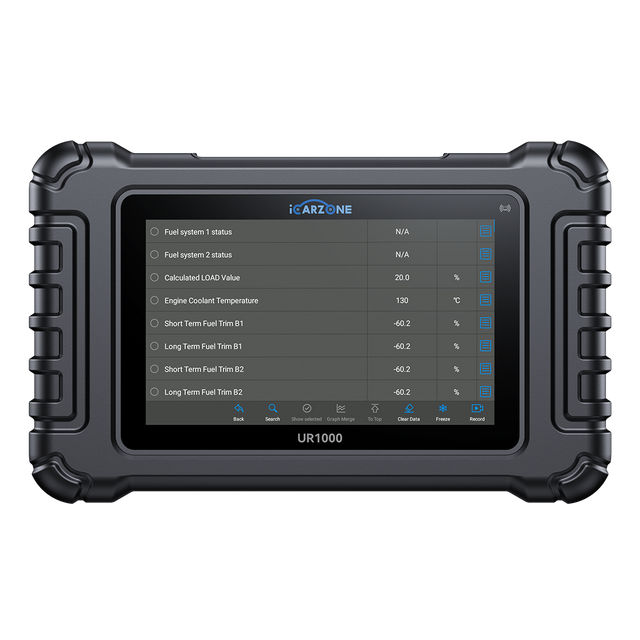
Preserve P2160 evidence, compare it with the correct physical checks and confirm the exact UR1000 coverage before running any supported command.
Save baseline and post-repair records. Clearing a code is not a repair. The product snapshot was checked September 21, 2026; confirm the current official page.
How to Diagnose P2160 in 6 Steps
These six steps organize the P2160 investigation without replacing the OEM decision tree. Use the exact engine, transmission, emissions configuration or controller procedure to choose tools, power state and limits.
P2160 Quick Diagnostic Path
-
1
Preserve the complete diagnostic event
- Save all related module records, freeze frame, symptoms, operating condition and recent service history.
- Do not erase the event or substitute a guessed threshold. Power state, measurement point, isolation rules and connector access come from the service procedure. Stop and arrange qualified help if the vehicle is unsafe, hot, pressurized, unstable or affected by high-current, fuel-system or driveline hazards.
-
2
Identify the exact architecture
- Use VIN-specific service information to identify the exact speed-source map, sensor B wiring, connector condition, module input data, related output-speed or wheel-speed faults and driveline symptoms.
- Do not erase the event or substitute a guessed threshold. Power state, measurement point, isolation rules and connector access come from the service procedure. Stop and arrange qualified help if the vehicle is unsafe, hot, pressurized, unstable or affected by high-current, fuel-system or driveline hazards.
-
3
Inspect safely accessible areas
- Look for damaged wiring, water, corrosion, loose grounds, incorrect parts or disturbed connectors before replacing components.
- Do not erase the event or substitute a guessed threshold. Power state, measurement point, isolation rules and connector access come from the service procedure. Stop and arrange qualified help if the vehicle is unsafe, hot, pressurized, unstable or affected by high-current, fuel-system or driveline hazards.
-
4
Compare scan data with physical evidence
- Use supported live data with the required meter, pressure, scope or mechanical checks; keep electronic evidence separate from physical proof.
- Do not erase the event or substitute a guessed threshold. Power state, measurement point, isolation rules and connector access come from the service procedure. Stop and arrange qualified help if the vehicle is unsafe, hot, pressurized, unstable or affected by high-current, fuel-system or driveline hazards.
-
5
Prove the failed branch before choosing parts
- Complete the appropriate circuit, pressure, speed or mechanical test with approved equipment.
- Do not erase the event or substitute a guessed threshold. Power state, measurement point, isolation rules and connector access come from the service procedure. Stop and arrange qualified help if the vehicle is unsafe, hot, pressurized, unstable or affected by high-current, fuel-system or driveline hazards.
-
6
Verify without erasing the evidence trail
- Save post-repair findings, complete required setup and verify current and pending faults.
- Do not erase the event or substitute a guessed threshold. Power state, measurement point, isolation rules and connector access come from the service procedure. Stop and arrange qualified help if the vehicle is unsafe, hot, pressurized, unstable or affected by high-current, fuel-system or driveline hazards.
How to Fix P2160 and Verify the Repair
Repair a proven wiring or connector fault
Correct the documented circuit branch and verify it under the required condition.
Repair the verified physical-system branch
Replace or repair the pump, sensor, target, line or mechanical component only when physical evidence supports it.
Complete required setup, relearn or service action
Use manufacturer instructions only when the VIN and test result match.
Replace a confirmed controller or module
Use this branch only after external circuits and loads have been proven good.
Diagnosis
VIN-specific quoteVIN-specific quote. Ask which test result supports the proposed branch and which physical measurements remain.
Circuit, connector or sensor work
VIN-specific quoteVIN-specific quote. Confirm access, terminal repair, sensor location and retest time.
Module, pump, driveline or programming work
VIN-specific quoteVIN-specific quote. Separate component replacement from setup, calibration and verification.
Verification and additional work
VIN-specific quoteVIN-specific quote. Separate further diagnosis, programming if applicable, taxes and post-repair verification.
These are alternative repair paths, not a package of charges to add together. Ask for a written breakdown of diagnosis, parts, labor, required setup and verification. The P2160 code alone cannot establish a repair price or warranty entitlement.
If a permanent DTC remains after repair, an erase command or battery disconnect cannot force its removal. The vehicle must meet the applicable verification criteria. Distinguish a retained permanent record from an active fault and inspection readiness.
P2160 OEM Differences and DIY Limits
Manufacturer examples show why the generic label is only a starting point. Confirm the exact vehicle architecture and service information before applying a branch to P2160.
Speed information may come from a transmission output sensor, transfer-case sensor, wheel-speed network or module-calculated source depending on the vehicle.
Separate scan evidence from physical proof of the exact speed-source map, sensor B wiring, connector condition, module input data, related output-speed or wheel-speed faults and driveline symptoms.
Check the current setup, adaptation, relearn or monitor requirements. Do not assume a generic reset completes the work.
Related code pages organize questions only; they do not transfer thresholds, pinouts, prices, coverage or repair conclusions.
- Save the complete scan and warning information.
- Record operating conditions and recent service.
- Inspect safely accessible components with the correct power state.
- Follow the owner manual response to the warning.
- Use qualified help for unsafe behavior.
- Do not force an unidentified actuator, pump, valve, sensor or circuit.
- Use approved measurement and isolation procedures.
- Leave unfamiliar adaptations and programming to equipped personnel.
Frequently Asked Questions About P2160
What does P2160 mean?
Does P2160 prove a failed part?
Can I drive with P2160?
Should I clear P2160 before testing?
Can UR1000 diagnose P2160?
What should I check first for P2160?
Why did the code return after repair?
What confirms the repair is complete?
Sources and Technical Review Notes
- Autel OBD-II diagnostic-code reference — Generic DTC wording and adjacent code-family distinctions; OEM procedure controls the actual vehicle.
- California BAR On-Board Diagnostic Test Reference — Readiness, permanent-record and verification boundaries; not a repair procedure.
- iCARZONE UR1000 official product JSON — Current product name, price snapshot, availability, image source and advertised capability boundary.
- Operation CHARM service-manual library — OEM service-information example source for speed-sensor architecture and VIN-specific procedures.
0 comments