
P2711 Code: Gear Disengages Unexpectedly

P2711: Identify the Engagement Fault
Preserve the full transmission record before resetting adaptations or choosing parts.
DIAGNOSTIC FOCUS
- FAULT TYPE
- Unexpected Mechanical Gear Disengagement
- FIRST CHECKS
- Full TCM entry, engagement symptoms and transmission identity
This code alone does not justify replacing the clutch, mechatronic unit or complete transmission.
P2711 means Unexpected Mechanical Gear Disengagement. P2711 alone does not justify replacing the clutch, mechatronic unit or complete transmission. Save the full fault record, identify the reporting controller and use the current vehicle-specific procedure.
If engagement is unreliable, stop and arrange recovery. Record the complete transmission event and confirm the applicable OEM wording before testing or resetting adaptations.
What Does the P2711 Code Mean?
P2711 is described as unexpected mechanical gear disengagement in the cited Audi DSG application. The full manufacturer entry matters: do not treat the short five-character code as a complete description of every transmission’s monitor or a confirmed mechanical parts diagnosis.
The diagnostic question is why the observed transmission state did not match the controller’s expected engagement behavior. Useful evidence may include commanded gear, available shaft speeds, clutch status and related faults. Those data must be interpreted using the exact transmission strategy rather than an assumed universal relationship.
A clutch adaptation routine is not a diagnosis. Clearing learned values can remove context or change how a fault presents without repairing an underlying problem. Preserve the original records and use only the setup routines called for by the verified service procedure after their prerequisites have been met.
Record the complete code, any suffix, reporting module and current/history status. The same short description does not establish a common circuit layout across vehicles.
A clutch command is a request, while actual engagement requires the prescribed speed, pressure or mechanical evidence. A reported adaptation value is not automatically a measurement of clutch wear.
Save available freeze frame and note first engagement, acceleration from a stop, selected gear, temperature and any shudder or loss of drive. A reset or disconnected connector can change the evidence before the cause is found.
P2711 Symptoms, Severity, and Driving Safety
Save the exact display message and full TCM fault entry. The visible warning alone does not identify the failed component.
Record the operating condition without assuming the published Audi example applies to another transmission.
Loss or unpredictable return of propulsion is a safety concern; do not keep repeating the event in traffic.
Document whether drive or reverse selection is affected and arrange recovery if engagement cannot be trusted.
Cold and warm operation may differ. Preserve the original temperature context for the correct verification plan.
Supply, speed or actuator faults can redirect the decision tree and may exclude a narrowly scoped bulletin.
Unexpected disengagement can compromise reliable propulsion. Avoid towing, heavy load and repeated engagement attempts while the cause is unresolved. The code does not establish a safe remaining distance or a guaranteed low-cost adaptation remedy.
P2711 Causes and the Evidence That Separates Them
The following are possible diagnostic branches, not a ranking of failure rates. Their relevance depends on the installed transmission engagement-control. Begin with the branch identified by the OEM decision tree and the complete code pattern.
Incomplete fault identification
A generic label may hide the manufacturer subcode needed for the correct diagnosis.
How to prove it: Record the complete TCM entry and identify the gearbox before selecting a service path.
Check firstSpeed or state information fault
Invalid information may prevent a reliable comparison of commanded and actual engagement.
How to prove it: Check relevant speed and controller-state faults and validate the required data.
Check firstSupply or connection issue
An interrupted electrical path can affect transmission control.
How to prove it: Compare fault timing and perform the prescribed loaded supply and connection checks.
Verify directlyHydraulic or actuator response
The control request may not produce the intended clutch or gear response.
How to prove it: Follow the exact pressure, position or actuator tests rather than inferring failure from a command PID.
Verify directlyClutch or internal mechanical condition
An internal condition may prevent the expected engagement behavior.
How to prove it: Use application-specific evidence and any exactly applicable service instruction before disassembly.
Verify directlyRepair compatibility or setup
An incorrect part or incomplete required setup may produce a new complaint after service.
How to prove it: Verify the repair record, part application and required calibration or learning prerequisites.
Final branchIf the warning followed clutch, mechatronic, transmission-fluid or software service, compare the timing with the original complaint. Recheck disturbed connections and part compatibility, but do not treat recent work alone as proof of causation. A component should earn replacement through a failed test.
Using JU2000 MAX During P2711 Diagnosis
On supported vehicles, iCARZONE JU2000 MAX retrieves accessible faults, available freeze frame and live data. Save the P2711 event before clearing it so the technician has the original evidence.
The official product page describes system diagnostics and bidirectional control. Confirm the exact VIN, controller, software and requested function before purchase. Every PID, active test or adaptation is not guaranteed on every vehicle.
Use supported transmission access on JU2000 MAX to save the full fault record, available clutch or gear data and relevant speed traces. Confirm the exact gearbox functions. The product’s active-test and coding features do not guarantee a particular DSG basic-setting routine or OEM programming operation.
iCARZONE JU2000 MAX All-in-One Diagnostic & TPMS Kit
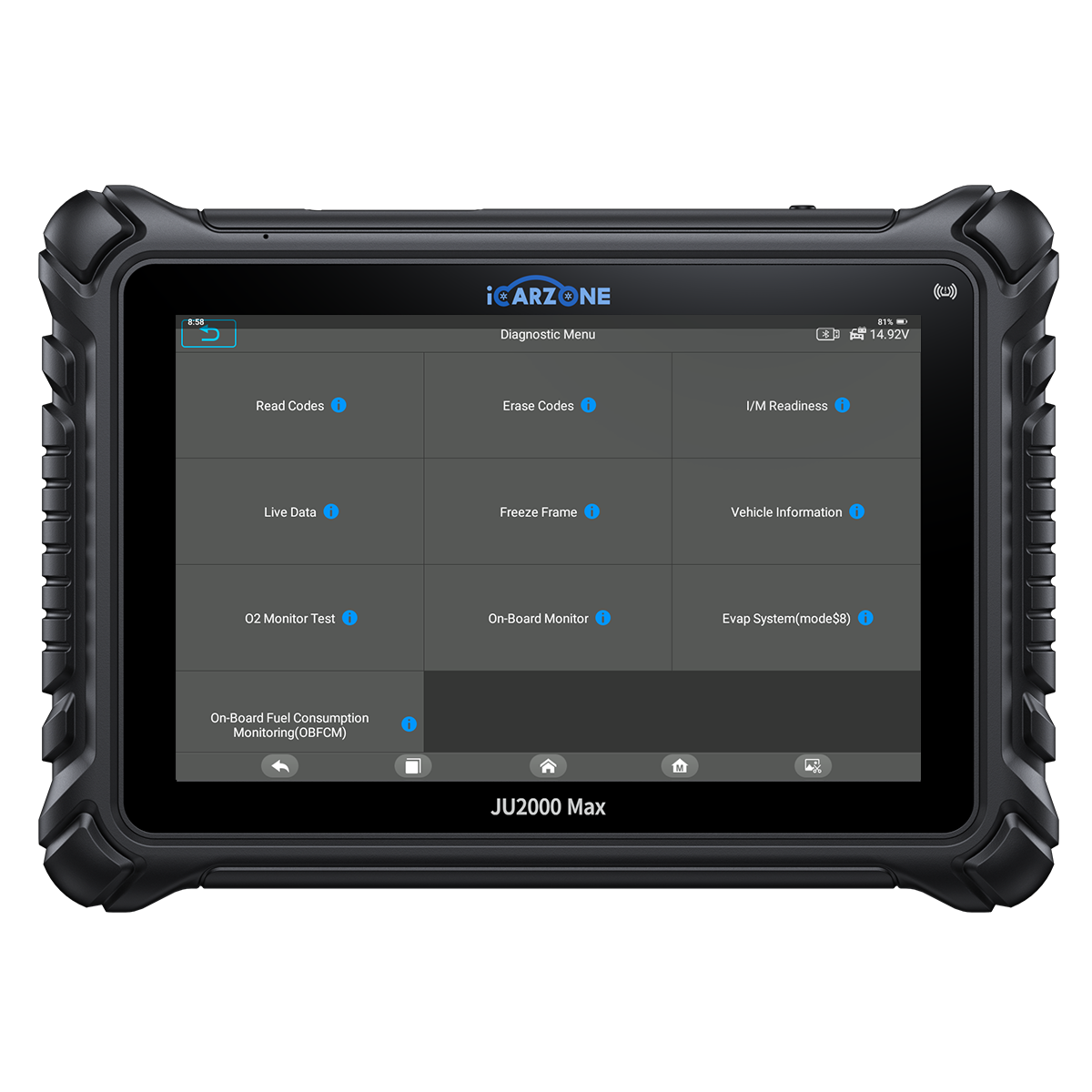
Keep the original TCM event and supported engagement data before any reset, learning routine or mechanical repair.
Use the prescribed external equipment and current service information. A missing menu is a coverage question, not proof of failure. Price checked September 27, 2026; confirm the current offer on the product page.
How to Diagnose P2711 in 6 Steps
Use these six decisions alongside the VIN-specific procedure. Record conditions, measurements and comparison limits; never substitute another vehicle’s specification.
P2711 Quick Diagnostic Path
-
1
Save the complete original event
- Save all module faults, descriptions, suffixes, status and available freeze frame before clearing P2711. Preserve companion-code timing when investigating a shared condition.
- Document first engagement, acceleration from a stop, selected gear, temperature and any shudder or loss of drive. Note whether the warning preceded clutch, mechatronic, transmission-fluid or software service. Do not reproduce an unsafe symptom.
-
2
Match the complete code and transmission
- Identify the gearbox and obtain the full manufacturer fault entry, not only P2711.
- Check symptoms and companion codes against the current service information before applying a bulletin.
-
3
Check reliable inputs and supplies
- Review speed, supply and communication faults and the available engagement data.
- Use the diagnostic prerequisites to establish that the controller has valid information before interpreting clutch behavior.
-
4
Test commanded versus actual response
- Use the specified clutch, hydraulic or actuator procedure with the required safety controls.
- Do not infer wear or a failed mechatronic unit from a single adaptation number or command percentage.
-
5
Choose a supported repair path
- If evidence identifies an external fault, correct it before reevaluating engagement. If an exact bulletin applies, follow its current service procedure.
- Do not repeatedly reset adaptations hoping for a permanent cure, or substitute another gearbox’s learning sequence.
-
6
Verify the repair under the right conditions
- Repeat the failed check, complete any required setup and compare the result with the original evidence. An extinguished lamp alone is not verification.
- Follow the OEM verification process and retain the final scan. Explain incomplete checks or remaining faults before releasing the vehicle.
How to Fix P2711 and Verify the Repair
Correct an identified signal or supply issue
Repair the proven external defect and repeat the engagement assessment with valid inputs.
Repair a demonstrated control problem
Use measured hydraulic or actuator evidence to select the correct service unit.
Perform justified clutch or internal work
Match the complete fault and application before authorizing a clutch or transmission repair.
Complete required setup and verification
Carry out only the prescribed learning or calibration after prerequisites and physical repairs are satisfied.
Diagnostic time
VIN-specific quoteRequest a quote that identifies the test needed to distinguish an external input problem from actuator, hydraulic or internal clutch work. A code scan alone is not completed diagnosis.
Wiring and access
VIN-specific quoteQuote proven terminal, harness and access work separately. Correct the cause of heat, abrasion or contamination to reduce repeat damage.
Proven component repair
VIN-specific quoteRequest the exact part, its failed test and required installation items. The correct service unit depends on the vehicle and demonstrated defect.
Setup and final verification
VIN-specific quoteInclude setup only when required, plus final verification. Local rates and taxes vary; these are alternative paths, not four automatic charges.
Ask which finding supports each proposed P2711 repair. Separate confirmed defects from conditional work and retain the original and final reports.
If a reset briefly changes the complaint, that does not prove the cause was software or adaptation. Preserve the new record and compare actual engagement behavior with the original event before further work.
P2711 OEM Differences and DIY Limits
Audi TSB 2029069/3 concerns specified 2009–2010 A3 and TT DSG vehicles. It requires the full entry 19143 P2711 004, more than 18,500 miles and the stated complaint conditions; it discusses excess clutch drag. Those restrictions prevent treating its clutch repair as a generic P2711 remedy.
Match gearbox type and the complete manufacturer entry before interpreting generic fault text.
Keep commanded clutch state, learned values and measured engagement response as separate pieces of evidence.
The failed engagement check must pass after the supported repair and any required setup, under the correct verification conditions.
Outside an exactly matching application, obtain the current OEM definition and decision tree. Bulletin existence does not establish warranty coverage, universal failure frequency or that every mechatronic or clutch component needs replacement.
- Save the complete scan and warning text without clearing it.
- Record the conditions and service history accurately.
- Inspect only safely accessible areas under the specified power state.
- Follow the owner manual response to every active warning.
- Use qualified assistance when symptoms make operation unsafe.
- Do not jump, backfeed or force an unidentified circuit or actuator.
- Use the exact isolation procedure and specified test equipment.
- Leave required disassembly, learning or programming to equipped personnel.
Frequently Asked Questions About P2711
What does P2711 mean?
Will a DSG adaptation reset fix P2711?
Does P2711 prove the mechatronic unit failed?
Does the Audi bulletin apply to every DSG?
Can I drive if the transmission drops out of gear?
Should I clear P2711 before diagnosis?
Can JU2000 MAX help diagnose P2711?
What confirms a successful P2711 repair?
Sources and Technical Review Notes
- Audi TSB 2029069/3, September 2013 — Narrow DSG fault-entry and application example; not a universal P2711 repair verdict.
- Tags: DTC iCARZONE JU2000 MAX OBD-II P2711
0 comments