
P3439 Code: Cylinder 5 Exhaust Valve Control Circuit Low

P3439: Prove the Valve-Control Circuit
Confirm the generic code family, then separate wiring, actuator, oil and mechanical evidence.
DIAGNOSTIC FOCUS
- FAULT TYPE
- cylinder 5 valve-control circuit identity and OEM definition
- FIRST CHECKS
- VIN/module-specific circuit and response evidence
The DTC alone does not prove a failed component.
P3439 means Cylinder 5 Exhaust Valve Control Circuit Low. Preserve the complete event and identify the reporting module before clearing it.
The DTC describes a controller observation, not a guaranteed failed part. Compare command, circuit and physical response using the exact vehicle procedure.
What Does the P3439 Code Mean?
P3439 is reported when the controller detects the code-specific condition: Cylinder 5 Exhaust Valve Control Circuit Low (source conflict with supplied high/deactivation-intake label). The exact monitor, circuit and enable conditions depend on the vehicle and reporting module.
This label describes a controller observation, not a parts verdict. Separate command, electrical evidence and physical response using the exact OEM procedure.
Component location, thresholds, cylinder or solenoid mapping and repair steps vary by application. Do not transfer one OEM’s value or bulletin to another vehicle. P3439 belongs to the cylinder-deactivation and valve-control family, but its generic label is specifically the cylinder 5 exhaust valve control circuit low. The neighboring intake/deactivation codes are different branches, even when they share an oil-control assembly or engine valley harness. Low is an electrical classification; it does not state that the exhaust valve is stuck, that cylinder 5 has no compression or that the injector has failed. Start by confirming cylinder numbering and the installed deactivation architecture. Inspect the connector and harness for oil contamination, abrasion and a short-to-ground, then compare the commanded control with the actual electrical response. If the circuit and actuator pass, use the engine procedure for oil pressure, lifter locking behavior, cam motion and compression. A flashing MIL, ticking, oil-pressure warning or severe misfire changes the safety decision because continued running may increase mechanical damage. Do not use a generic oil-pressure or resistance value. Finish by repeating the exhaust-control monitor and separately checking misfire or compression evidence.
Record complete code text, suffix, reporting module and status before deciding what hardware is named.
Compare command, scan interpretation and physical response with the prescribed test.
Save freeze frame and note temperature, load, operating mode, recent work and companion codes.
P3439 Symptoms, Severity, and Driving Safety
The MIL may appear while cylinder deactivation is disabled.
Rough running or a misfire raises urgency because the valve-control fault may coexist with mechanical damage.
A tick or valvetrain noise changes the diagnosis toward oil/lifter or mechanical inspection.
Fuel economy may worsen when the controller keeps all cylinders active.
Oil-pressure or camshaft companion codes materially change the safety priority.
A stored low-circuit code can occur without an obvious drivability complaint.
Assess the actual warning and system behavior. A stored code with normal operation still deserves diagnosis, and the code alone cannot establish a safe remaining distance.
P3439 Causes and the Evidence That Separates Them
These are code-specific diagnostic branches, not a ranking of failure rates.
Circuit identity or connector fault
P3439 is exhaust-valve control low; the adjacent P3436 is intake/deactivation high. Confusing them sends testing to the wrong circuit.
How to prove it: Read the full code and trace the cylinder-5 exhaust-control connector before probing.
Check firstHarness short or feed loss
A low classification can result from a short-to-ground, lost supply or damaged terminal.
How to prove it: Test the control wire and supply under the engine’s specified power state.
Check firstActuator electrical fault
The oil-control/valve-control solenoid can fail electrically while the valvetrain remains mechanically intact.
How to prove it: Compare coil/current response with the engine-specific procedure.
Verify directlyOil pressure or contamination
Cylinder-deactivation hardware may depend on clean oil and correct pressure for its hydraulic action.
How to prove it: Check oil level/condition and pressure only with the prescribed method.
Verify directlyLifter or valvetrain fault
A mechanical lifter, locking pin or cam problem can create noise or misfire after the electrical circuit passes.
How to prove it: Use compression, relative-compression or mechanical timing checks where directed.
Verify directlyController driver branch
The PCM driver is a late possibility after the circuit and actuator are proven.
How to prove it: Verify command at the controller and exclude harness faults before module work.
Final branchRecent work can identify a disturbed area to inspect, but it does not prove causation. A component should earn replacement through a failed test.
Using JU2000 MAX During P3439 Diagnosis
On a supported vehicle, iCARZONE JU2000 MAX can preserve accessible fault status, freeze frame and supported data before clearing P3439. Coverage and available PIDs remain VIN-dependent.
Use the scanner to organize ECU evidence and compare supported command/response data. It cannot directly prove wiring, terminal tension, waveform, pressure, flow, injector current, fan current or mechanical wear.
Pair scan data with the current OEM procedure and appropriate physical tools. Confirm the exact vehicle, controller and requested function before purchase.
iCARZONE JU2000 MAX All-in-One Diagnostic & TPMS Kit
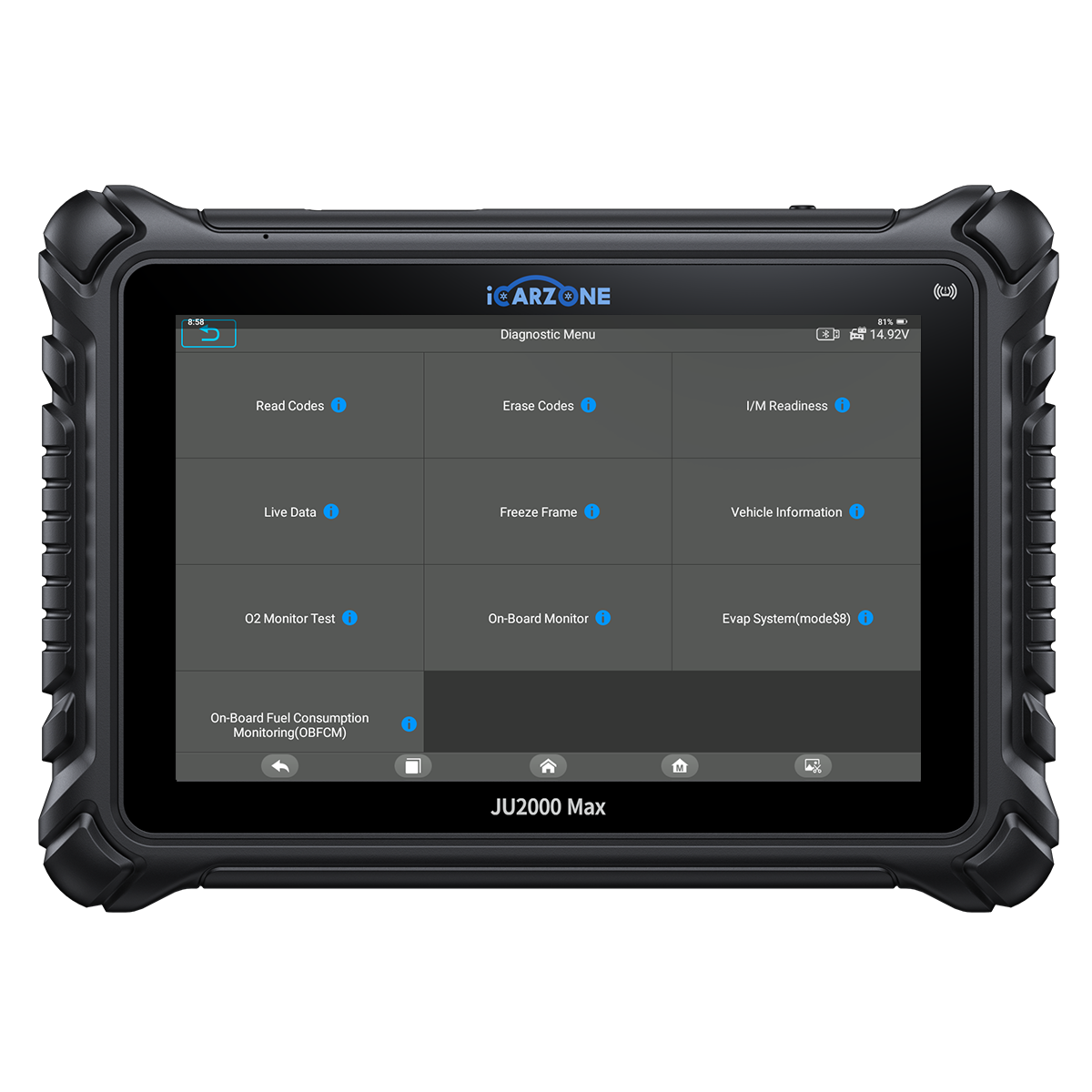
Preserve the P3439 fault event and compare supported data before authorizing parts or module work.
Use only supported functions for the identified VIN and controller. ECU coding or an active test is never universal, and a scan result does not replace physical proof.
How to Diagnose P3439 in 6 Steps
Use this six-step sequence with the VIN-specific procedure. Record conditions, measurements and comparison limits; never substitute another vehicle's specification.
P3439 Quick Diagnostic Path
-
1
Read full text, module, suffix and engine architecture; do not assume the supplied high label.
- Record the exact condition and measurement required by the OEM procedure.
- Do not replace a component until the failed branch is documented.
-
2
Confirm whether the engine uses cylinder 5 exhaust control or deactivation/intake control.
- Record the exact condition and measurement required by the OEM procedure.
- Do not replace a component until the failed branch is documented.
-
3
Inspect circuit, supply and terminals under the exact power state.
- Record the exact condition and measurement required by the OEM procedure.
- Do not replace a component until the failed branch is documented.
-
4
Compare command and physical valve-control response using OEM tests.
- Record the exact condition and measurement required by the OEM procedure.
- Do not replace a component until the failed branch is documented.
-
5
Check oil pressure/condition only where the service procedure directs it.
- Record the exact condition and measurement required by the OEM procedure.
- Do not replace a component until the failed branch is documented.
-
6
Resolve the definition conflict before repair and repeat the correct monitor.
- Record the exact condition and measurement required by the OEM procedure.
- Do not replace a component until the failed branch is documented.
How to Fix P3439 and Verify the Repair
Restore the circuit
Repair the proven cylinder-5 exhaust-control feed, return, terminal or harness defect.
Test the actuator
Replace or service the actuator only after its control test fails.
Check oil/valvetrain evidence
Use the exact engine procedure for oil pressure, lifter and mechanical checks.
Verify cylinder operation
Repeat the correct exhaust-control monitor and misfire check.
Diagnostic time
VIN-specific quoteRequest a quote that separates scan review from the test needed to identify the failed branch. A code read alone is not completed diagnosis.
Wiring and access
VIN-specific quoteQuote proven terminal, harness and access work separately, including the cause of heat, abrasion, contamination or water entry.
Proven component repair
VIN-specific quoteAsk for the exact part, failed test and supporting installation items. The correct service unit depends on the vehicle.
Setup and final verification
VIN-specific quoteInclude programming, relearn or calibration only when required. These are alternative paths, not four automatic charges.
Ask the shop to connect each proposed repair to a finding and preserve the original and final reports. Separate confirmed defects from conditional work.
If the code returns, compare the new event with the baseline and reopen the correct branch. Another replacement part or a reset is not a substitute for a failed test.
P3439 OEM Differences and DIY Limits
HELLA identifies P3439 as Cylinder 5 Exhaust Valve Control Circuit Low and distinguishes it from the adjacent intake/deactivation and circuit-high codes. The supplied list’s intake/high description must not determine this article’s diagnostic branch.
P3436 is the adjacent intake/deactivation high code.
It is not direct valve-lift or compression evidence.
Flashing MIL, noise or oil warning requires stopping.
The generic definition does not establish cylinder numbering, actuator location, voltage limits or serviceability. Obtain those details from the current OEM information for the exact engine and reporting module.
- Save the complete scan and warning text without clearing it.
- Record conditions, recent work and symptoms accurately.
- Inspect only safely accessible areas with the specified power state.
- Follow the owner manual response to every active warning.
- Use qualified assistance when symptoms make operation unsafe.
- Do not jump, backfeed or force an unidentified circuit or actuator.
- Use the exact isolation and measurement procedure.
- Leave pressurized, high-current, internal, programming or disassembly work to equipped personnel.
Frequently Asked Questions About P3439
What does P3439 mean?
Does P3439 prove a failed part?
Can I keep driving with P3439?
Should I clear P3439 first?
Can JU2000 MAX diagnose P3439?
Will replacing the named component fix P3439?
Is the definition identical on every vehicle?
What confirms a repair?
Sources and Technical Review Notes
- HELLA OBD-II P-code list, lines P3433-P3440 — Lists P3433 intake/deactivation open, P3434 intake/deactivation performance, P3435 intake/deactivation low, P3436 intake/deactivation high, P3437 exhaust circuit, P3438 exhaust performance, P3439 exhaust low and P3440 exhaust high. This establishes the generic label only; no vehicle-specific test is inferred.
- Tags: DTC iCARZONE JU2000 MAX OBD-II P3439
0 comments