
U0121 Code: Lost Communication With ABS Module — Causes & Fix

U0121 means one of your vehicle's computers can no longer talk to the ABS (anti-lock brake) control module over the CAN data bus. It's a network communication fault — not a broken brake — and the cause is usually something cheap like a weak battery, a corroded connector, or damaged wiring. Your normal brakes still work, but ABS and stability control may switch off until it's fixed.
U0121 = "Lost Communication With Anti-Lock Brake System (ABS) Control Module" — a control module (often the PCM) is no longer receiving data from the ABS module over the shared CAN bus network.
Modern cars link their computers — engine, ABS, body, instrument cluster — on a shared CAN bus so they can exchange data like wheel speed. When a module stops "hearing" the ABS module, it stores U0121 and usually lights the ABS, traction, and stability warnings. The most common reasons are simple and cheap: low battery voltage, a blown fuse or bad ground, or a corroded connector — not a dead module.
Diagnostic priority: (1) scan ALL modules + freeze frame and note companion codes; (2) load-test the battery and check charging — fix this first; (3) check the ABS fuses and ground points; (4) try to reach the ABS module with a scanner and probe CAN-High/Low; (5) inspect the CAN wiring and ABS connector; (6) only replace (and program) the module if it's proven unreachable with good power.
What does U0121 actually mean?
The letter U marks this as a network / communication code, not a powertrain (P) code. Every modern vehicle runs its control modules on a shared high-speed data network — the CAN bus — so the engine computer, transmission, ABS, body control module, and instrument cluster can all trade information dozens of times a second. The ABS control module (sometimes called the EBCM, Electronic Brake Control Module) uses that network to share wheel-speed and brake data.
U0121 sets when a module — most often the PCM — sends a message expecting the ABS module to answer, and the reply never comes. That silence can mean the ABS module lost power or ground, the CAN wires between them are broken or shorted, a connector is corroded, or — less often — the module itself has failed. Because it's a communication fault, the fix is usually about restoring the connection, not replacing brake parts.
What are the symptoms of U0121?
Unlike many emissions codes, this one usually announces itself on the dash:
- ABS warning light on — the primary indicator, usually steady
- Traction control / stability lights on — TRAC, ESC/ESP, or VSA; these systems depend on ABS data
- ABS doesn't engage — the pedal may not pulse during a hard stop; reduced skid protection on slippery surfaces
- Check Engine or other warning lights — depending on make and what else dropped off the bus
- Speedometer or gauge glitches — when shared wheel-speed/network data is interrupted
- Limp mode or no-shift (some vehicles) — a few applications reduce power or hold the transmission as a precaution
- Sometimes only the stored code — intermittent or history faults can leave no live symptom
Is U0121 serious?
It's a safety-related code, but rarely an expensive one. Here's the realistic picture:
- Weak battery / charging issuecheap fix · $0–$300
- Blown fuse, bad ground, or connectorcheap fix · $0–$120
- ABS / traction / stability disabledlonger stops & no skid help on slippery roads
- CAN wiring damagemay take other modules offline too
- Failed ABS module (rare)$150–$1,200 incl. programming
What causes a U0121 code? Ranked by frequency
Low Battery Voltage / Charging Fault
30% of casesThe most common — and cheapest — trigger. Modules need a stable 12V to stay on the bus; a weak or dying battery, a failing alternator, or a recent jump-start (voltage spike) makes one or more modules drop offline and sets communication codes. Always load-test the battery and check charging output before chasing anything else.
Fix: $0–$300 charge / battery / charging repairDamaged CAN Bus Wiring (Open / Short)
22% of casesThe CAN-High and CAN-Low wires that carry data to the ABS module often route through the wheel well and under the chassis, where abrasion, rodent damage, road salt, or a previous bad repair can break or short them. A break in the line cuts the ABS module off the network. Inspect the harness along its run and probe CAN-High/Low for the correct signal.
Fix: $20–$600 wiring repairCorroded / Loose Connector at the ABS Module
18% of casesMoisture, road salt, and vibration degrade the pins inside the ABS-module connector. A single high-resistance or backed-out terminal stops the module from communicating. Disconnect the negative battery cable, unplug the connector, and inspect for green corrosion, water, burnt or melted plastic, and bent or spread pins.
Fix: $10–$200 connector / pinsBad Ground
12% of casesA corroded or loose chassis ground can knock a module off the bus and create intermittent communication faults. On some platforms a single dirty ground point is a well-known, sub-$10 fix that mimics an expensive module failure. Clean ground straps and connection points to bare metal and re-torque them.
Fix: $0–$30 clean / repair groundBlown Fuse or Failed Relay
8% of casesIf the ABS module's power feed loses a fuse or relay, the module goes dark and can't answer on the bus. Check the ABS-related fuses and relays first — they're cheap and fast. A fuse that blows again immediately points to a short downstream worth tracing before replacing parts.
Fix: $2–$40 fuse / relayFailed ABS Control Module
6% of casesInternal circuit-board degradation, a failed microcontroller, or corrupted software can stop the module from responding. This is real but uncommon — confirm the module has good power and ground and still can't be reached before condemning it. Replacement usually requires programming/coding to the vehicle.
Fix: $150–$1,200 module + programmingGateway / Other Module or Recent Module Swap
4% of cases · RareA faulty gateway module or a failed bus terminating resistor can disrupt traffic, and replacing or adding an unrelated module (or a back-probe/tuner left plugged in) sometimes triggers U0121. If several U-codes appear together, suspect the network itself rather than the ABS module alone.
Fix: varies — diagnose the networkWhat you'll need
Tools
- Scanner that reads ALL modules (incl. ABS) + CAN data iCARZONE UR800 ›
- Digital multimeter (voltage, ohms, continuity)
- Battery / charging-system tester (load test)
- Back-probe pins / test leads (to read CAN-High & CAN-Low)
- Electrical contact cleaner + dielectric grease
- Wiring diagram + ABS connector pinout for your vehicle
Parts & supplies
- Battery (if weak)$120–$300
- ABS fuse / relay$2–$40
- Connector / terminal pins / pigtail$10–$60
- CAN wiring repair supplies$10–$40
- Ground strap / hardware$5–$25
- ABS module (used / aftermarket, if needed)$150–$600
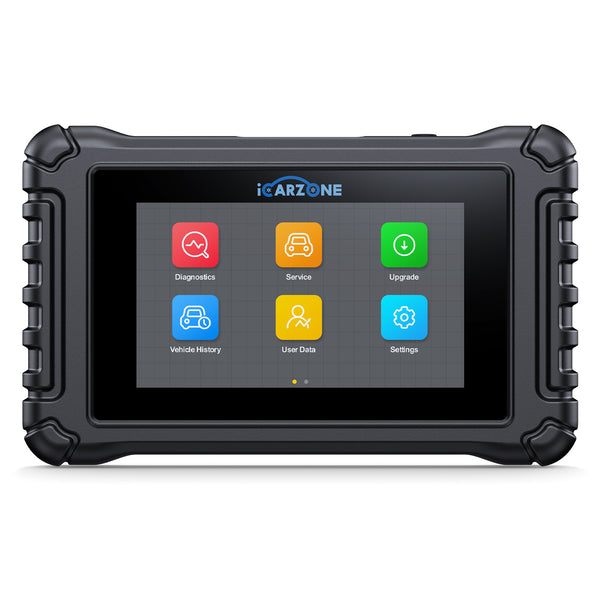
iCARZONE UR800 — 5" LCD OBD2 Scanner
A basic code reader only talks to the engine — U0121 lives on the brake/network side. The UR800 reads all modules, so you can try to reach the ABS module directly, see whether it answers, and pull the ABS-specific codes hiding behind the communication fault. Live data and freeze-frame help you spot a voltage or wiring problem, and bidirectional tests let you verify components before buying parts.
- 5" LCD 854×480 touchscreen
- All-system / all-module access
- Reads ABS, SRS, BCM & more
- Live data graphing + freeze-frame
- Bidirectional / active tests
- 2-yr warranty + lifetime updates
How do you fix a U0121 code?
Work cheap-to-expensive. The battery/charging check in Step 2 is free and fixes a large share of these codes — never skip it to jump straight to the module.
Scan every module and note the companion codes
- Use a scanner that reads all modules, not just the engine. Record U0121 plus any companion U-codes (U0001, U0073, U0100, U0140, U0155) and freeze-frame.
- Several communication codes together point to a shared CAN, power, or ground fault — not the ABS module by itself. A lone U0121 points more toward the ABS module's own power, ground, wiring, or connector.
Test the battery and charging — your free first step
- Load-test the battery; check resting voltage (~12.6V) and charging voltage with the engine running (13.7–14.7V).
- Low or unstable voltage is a leading cause of communication codes — recharge or replace a weak battery and fix any charging fault before going further.
- Recently jump-started or had work done? A voltage spike or a backed-out terminal from that job is a common trigger.
Check the ABS fuses and ground points
- Inspect the ABS-related fuses and relays. A blown fuse or failed relay drops the module off the bus; replace and re-test.
- Locate and clean the relevant chassis grounds to bare metal, then re-torque. A single corroded ground is a known, cheap fix on several platforms.
- If a fuse blows again immediately, trace the short before replacing anything else.
Try to reach the ABS module and probe the CAN bus
- With the scanner, attempt to access the ABS module directly. "Module unreachable" means no power/ground or a broken CAN link; if it connects, read the ABS-specific codes behind the fault.
- Confirm power and ground at the ABS module connector with a multimeter.
- Back-probe CAN-High and CAN-Low (each roughly 2.5V, fluctuating with data). A flat or out-of-range reading points to a wiring or termination fault.
Inspect the CAN wiring and ABS connector
- Disconnect the negative battery cable, then unplug the ABS connector and inspect for corrosion, water, burnt plastic, and bent or spread pins.
- Follow the CAN wiring along its run — especially through wheel wells and under the chassis — for abrasion, rodent damage, or a poor previous repair.
- Repair the wiring/connector, clear the codes, and see whether communication is restored.
Replace the ABS module — final step
- Only after you've confirmed the module has good power and ground and still can't be reached. Internal module failure is the least common cause.
- A replacement usually needs programming/coding to the vehicle (VIN-matched, pre-programmed units simplify this).
- Clear the codes and verify the ABS, traction, and stability lights are out and the module communicates on a road test.
How much does U0121 cost to fix?
Most U0121 repairs are inexpensive — a charge, a ground, a fuse, or a connector. Costs only climb if the CAN wiring needs significant repair or the ABS module truly has to be replaced and programmed.
| Repair | DIY | Shop | You save | Type |
|---|---|---|---|---|
| Diagnosis (scan all modules + battery test) | $0 (free with tool) | $90–$170 | Up to $170 | Free First Step |
| Clean / repair ground | $0–$15 | $50–$150 | Up to $150 | DIY Easy |
| ABS fuse / relay | $2–$40 | $50–$130 | Up to $120 | DIY Easy |
| Battery (replace) | $120–$300 | $150–$400 | Up to $250 | DIY Moderate |
| Connector / terminal repair | $10–$60 | $90–$250 | Up to $240 | DIY Moderate |
| CAN bus wiring repair | $20–$150 | $150–$600 | Up to $580 | Often Shop |
| ABS module programming / coding | $0–$150 (capable tool) | $80–$250 | Up to $250 | Shop Friendly |
| ABS control module (replace + program) | $150–$600 | $400–$1,200 | Up to $600 | Often Shop |
Which vehicles are most prone to U0121?
U0121 is a generic code that can appear on almost any modern make. A few platforms are especially well-documented for network/ground issues that set it — and on those, a known cheap fix often beats guessing. Deep-dives below.
| Make | Model / platform | Years | Primary cause & notes | Risk |
|---|---|---|---|---|
| GM / Chevrolet / GMC / Cadillac | Silverado, Sierra, Tahoe, Suburban, Escalade, Corvette | 2007–2019 | High-speed GMLAN bus; corroded grounds & harness terminals. Documented multi-U-code TSB. | High |
| Ford / Lincoln | F-Series, Explorer, Escape, Fusion | 2008–2020 | Connector corrosion + battery/charging; check CAN wiring at the ABS module. | Medium |
| RAM / Dodge / Chrysler / Jeep | 1500, Grand Cherokee, Charger, Durango | 2008–2020 | Power-distribution (TIPM) & ground issues; weak battery a common trigger. | Medium |
| Toyota / Lexus | Camry, Tundra, RAV4, RX | 2007–2020 | Battery/charging & connector faults; module failure uncommon. | Low |
| Honda / Acura | Accord, CR-V, Pilot, MDX | 2007–2019 | VSA/ABS connector & ground; check voltage first. | Low |
| Nissan / Infiniti | Altima, Titan, Pathfinder, QX | 2007–2019 | Battery/wiring; intermittent comm faults on low voltage. | Low |
| VW / Audi / BMW / Mercedes | Various (CAN / gateway-based) | 2006–2018 | Gateway & CAN wiring; connector corrosion; coding often needed after module work. | Medium |
Why a weak battery is the #1 trigger
It surprises people that a brake-network code so often comes down to electrical power, but it's the single most common cause — and the cheapest to rule out:
- Modules need stable voltage. When battery voltage sags (a tired battery, a failing alternator, or a cold morning), modules can momentarily drop off the CAN bus and set communication codes like U0121 — often as history codes that aren't even present anymore.
- Jump-starts and battery work. A voltage spike from an incorrect jump-start, or a loose/backed-out terminal after battery service, frequently triggers it. Re-check connections you (or a shop) recently touched.
- Test, don't guess. Load-test the battery and confirm charging output before inspecting wiring or modules. If the code is intermittent, a marginal battery is the prime suspect.
Action plan: load-test battery → verify 13.7–14.7V charging → clean battery terminals and grounds → clear the code and see if it returns before going deeper.
Multiple U-codes? Suspect the network, not one module
If U0121 shows up alongside other communication codes, the problem is usually shared wiring, power, or ground — not the ABS module:
- Read the pattern. U0121 with U0073 (bus off), U0100 (ECM/PCM), U0140 (BCM), or U0155 (cluster) points to a network-wide fault — a main CAN wiring problem, a bad ground, a power-supply issue, or a faulty gateway/terminating resistor.
- GM trucks & SUVs. A well-known example: a single corroded ground (a documented point behind the driver's kick panel on some GM trucks) causes a whole cluster of GMLAN U-codes — cleaning it has fixed cases that were quoted a $1,000+ module.
- Symptoms widen. Network-wide faults can add no-crank, door locks cycling, gauge sweeps, or no-shift behavior — clues that you're chasing the bus, not the brakes.
Check for a TSB / recall: at NHTSA.gov enter your VIN or year/make/model for bulletins and campaigns related to CAN/communication or ABS modules on your platform. NHTSA recalls & TSBs ›
Should you DIY or call a mechanic?
DIY if you…
- Can load-test a battery and check charging voltage
- Have a scanner that reads all modules, not just the engine
- Can check fuses, clean grounds, and inspect a connector
- Are comfortable back-probing CAN-High / CAN-Low
- Want to rule out the cheap causes before any module
- Want to save $90–$600 over shop diagnostic + labor
Use a mechanic if…
- Multiple U-codes suggest a network-wide fault you can't trace
- The CAN wiring damage is buried or hard to access
- The ABS module is confirmed dead and needs programming
- The car won't start/shift or shows widespread electrical faults
- You don't have an all-system scanner or a multimeter
- The fault is intermittent and hard to catch
Frequently asked questions
Is it safe to drive with a U0121 code?
Your normal brakes still work, so you can stop the car — but the anti-lock, traction, and stability systems are likely disabled. That means longer stopping distances and no skid protection in a panic stop or on wet/icy roads. Drive gently, avoid hard braking, and fix it within days rather than weeks, especially before bad-weather driving.
What's the most common cause of U0121?
Power and connection problems — not a failed module. A weak battery or charging fault, a blown fuse or bad ground, and a corroded ABS-module connector together account for most cases. Internal ABS-module failure is real but uncommon, which is why a battery test and a connector inspection come first.
Can a bad battery really cause U0121?
Yes — it's one of the leading triggers. Control modules need a stable 12V to stay on the CAN bus. When voltage sags from a tired battery or failing alternator, a module can momentarily drop offline and set a communication code, often as a history code. Always load-test the battery and check charging before chasing wiring or the module.
How much does it cost to fix U0121?
Often very little. A ground clean is under $15, a fuse a few dollars, and a connector repair $10–$60 DIY. A battery is $120–$300. CAN wiring repair runs $20–$150 DIY or more at a shop. Only a confirmed-dead ABS module is expensive — $150–$600 in parts plus programming, or $400–$1,200 at a shop. Many cases land under $100.
What scanner do I need to diagnose U0121?
One that reads all modules — not just the engine — so it can reach the ABS module, show whether it answers on the bus, and pull the ABS-specific codes behind the fault. The iCARZONE UR800 ($299.99) is a 5-inch all-system scanner with live data, freeze-frame, and bidirectional tests, with coverage across most domestic, Asian, and European platforms.
Why do I have U0121 plus several other U-codes?
That pattern usually means the problem is the network itself, not the ABS module. U0121 alongside U0073, U0100, U0140, or U0155 points to a main CAN wiring fault, a bad ground, a power-supply issue, or a faulty gateway. Start with battery, grounds, and shared wiring — fixing one root cause often clears all of the codes at once.
Quick verdict
- Step 1 — free first: scan all modules, note companion codes, and load-test the battery + charging. $0 with a capable scanner.
- Step 2 — cheap wins ($0–$60): fix weak power, clean a ground, replace a fuse, or repair a corroded ABS connector. Most cases stop here.
- Step 3 — the module: replace and program the ABS module only after confirming it's unreachable with good power, ground, and wiring.
Reach the ABS module, not just the engine
The iCARZONE UR800 reads all your vehicle's modules and CAN data — so you can see whether the ABS module answers and find the real fault before buying parts, across 58 vehicle makes.
0 comments