
C0020 Code: ABS Pump Motor Command and Response

C0020: ABS Pump Motor Command and Response
Preserve the full suffix, pump command state and available monitor/event data before considering a motor or hydraulic unit.
DIAGNOSTIC FOCUS
This overview summarizes the verified guide below; it is not an additional repair conclusion.
C0020: ABS Pump Motor Control. Preserve the full suffix, pump command state and available monitor/event data before considering a motor or hydraulic unit.
This record does not prove a failed pump motor, an HCU replacement requirement or normal base-brake operation. Stop safely and arrange qualified inspection or towing if pedal feel, braking, steering or stability behavior changes. Follow the owner manual and warnings. Neither a five-character code nor a clean scan proves normal braking or a safe remaining driving distance.
What Does the C0020 Code Mean?
C0020 appears in brake/chassis diagnostics. The reviewed Scanator catalog uses ABS Pump Motor Control. That terminology identifies a monitor family, not a failed part. Preserve the OEM wording and suffix before applying it to a particular vehicle.
The controller commands a pump and monitors the response defined for that vehicle. A command is not proof that current reached the motor, and an electrical response is not a direct measurement of useful hydraulic pressure. Keep those observations separate before choosing an electrical or hydraulic test.
Mazda bulletin 04-002/13 covers certain 2010–2011 Mazda3 DSC vehicles built before February 1, 2011, with its stated VIN limit. It distinguishes C0020:1C command/monitor disagreement from C0020:71 response timing and discusses a pump brush-contact condition. The suffix and the prescribed troubleshooting outcome matter; neither base code authorizes hydraulic-unit replacement.
Save VIN, reporting module, full text and suffix. Generic catalog wording is not a substitute for the current OEM definition.
Preserve active/history status, available freeze frame, warnings, recent service and companion faults before clearing.
Compare command with the prescribed monitored response under approved workshop conditions. A pump that can be heard is not automatically a pump that passes the OEM monitor.
C0020 Symptoms, Severity, and Driving Safety
Record the exact lamp, message and timing. A warning identifies a concern without proving the failed part.
Stop for abnormal braking. Do not infer that assistance or ABS remains available merely because the pedal feels familiar.
Compare the ABS pump-motor control path record with available OEM data in its proper operating state.
Preserve the event and its original conditions. A clean dashboard does not establish that the affected monitor passed.
Save the work order and inspect the relevant disturbed branch. Timing alone does not establish cause.
Save all modules. A shared prerequisite or secondary warning can change the diagnostic order.
Stop safely and arrange qualified inspection or towing if pedal feel, braking, steering or stability behavior changes. Follow the owner manual and warnings. Neither a five-character code nor a clean scan proves normal braking or a safe remaining driving distance.
C0020 Causes and the Evidence That Separates Them
These are alternative diagnostic branches, not ranked failure rates or a shopping list. Select a branch from the full event and a test that can distinguish it from the alternatives.
Application or interpretation mismatch
A generic label must match the ECU, full suffix and VIN-specific implementation. Resolve a wording conflict before choosing a physical component.
How to prove it: Match the full OEM text, suffix, reporting ECU and installed equipment before selecting a test.
Check firstElectrical prerequisite not satisfied
Check the prescribed feed, ground and operating state for the ABS pump-motor control path. A visual fuse or connector inspection does not establish the loaded circuit condition.
How to prove it: Record the required loaded supply and ground checks at the permitted test points.
Check firstConnector, terminal or harness fault
A poor connection can interrupt the monitored response without proving a failed component. Inspect the actual branch and distinguish newly introduced service records from the baseline.
How to prove it: Use the OEM schematic, terminal checks and permitted electrical tests; do not borrow another model’s pins or values.
Verify directlyPhysical response or monitored-function fault
Correlate the monitored function with its prescribed physical test. A command alone does not establish electrical or hydraulic response.
How to prove it: Correlate the prescribed physical test with the recorded ECU information.
Verify directlyConfiguration, software or secondary record
A matching OEM notice can change a test branch; it is not a universal cure. Preserve calibration identity and distinguish secondary warnings from the original event.
How to prove it: Preserve every module’s baseline, current calibration identification and warning state; authorize programming only through the matching OEM procedure.
Verify directlyConfirmed component failure or unresolved intermittent event
Consider internal failure after required external checks. An event not reproduced remains a limitation; replacing a part experimentally does not prove the cause.
How to prove it: Retain failed-test proof or clearly document an event that could not be reproduced.
Final branchA plausible explanation is not yet a confirmed cause. Record the failed test, its operating state and the applicable OEM specification before approving a component.
Using JU2000 MAX During C0020 Diagnosis
On a supported VIN, iCARZONE JU2000 MAX can organize accessible faults, available freeze frame and supported live data. Preserve the C0020 event before clearing; ECU access depends on the vehicle and installed software.
The scanner shows ECU-provided information. It does not directly measure terminal contact, wire integrity, target condition or hydraulic performance. Any output test still requires the OEM safety prerequisites.
The official JU2000 MAX page advertises full-system diagnostics and bidirectional functions. Confirm the exact VIN, ECU and requested function before purchase; broad features do not guarantee this code’s active test or manufacturer programming.
iCARZONE JU2000 MAX All-in-One Diagnostic & TPMS Kit
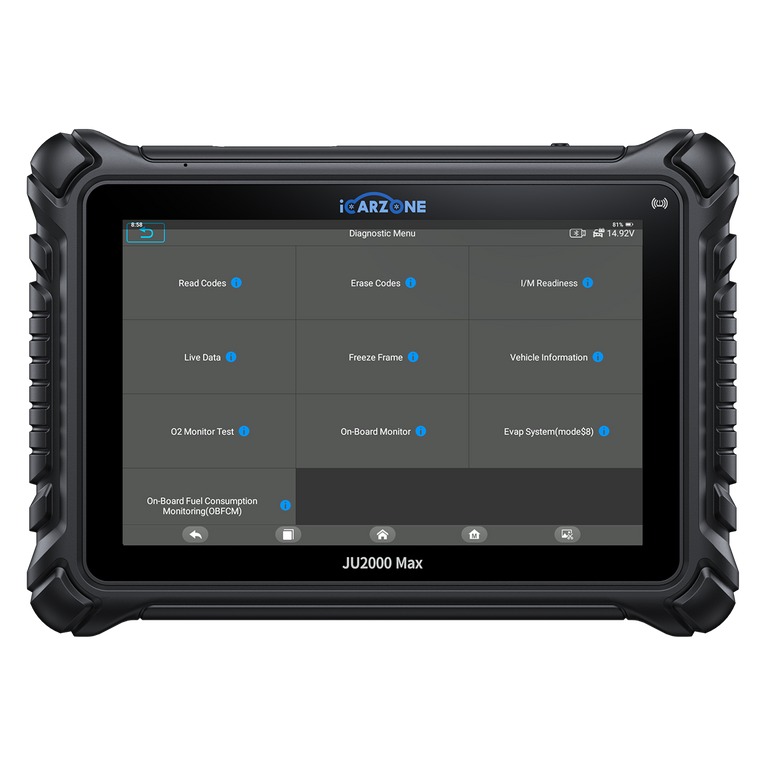
Preserve the ABS pump-motor control path evidence and confirm exact ECU coverage before purchase.
Displayed prices were checked October 15, 2026 and can change. Check current coverage and availability. No inventory quantity, delivery date or repair outcome is promised.
How to Diagnose C0020 in 6 Steps
Use these six decisions alongside the current VIN-specific service procedure. They organize the evidence and safety boundaries; they do not supply universal pins, thresholds, hydraulic instructions or programming steps.
C0020 Quick Diagnostic Path
-
1
Save the original record
- Preserve every module before clearing
- Preserve the full suffix, pump command state and available monitor/event data before considering a motor or hydraulic unit. Save the reporting ECU, current/history status, suffix, available event data and companion codes. Record conditions accurately rather than reconstructing them after memory is cleared.
-
2
Identify the actual implementation
- Match VIN, module and full OEM wording
- Match the current OEM definition, full suffix, installed equipment and VIN restrictions. A generic catalog or historical bulletin cannot establish this vehicle’s test limits.
-
3
Check prerequisites
- Use the prescribed operating state
- Confirm the permitted battery, supply, ground and system-state checks before a functional test. Respect electrical and brake safety precautions. Record which prerequisite passed; do not import a universal voltage, resistance or waiting period from another vehicle.
-
4
Inspect the relevant path
- Separate visible clues from measured failure
- Identify the pump feed, ground, connector and control path from the VIN diagram. Use the required loaded tests; do not jumper the motor or defeat its controller. Keep photographs and the service timeline. An intact exterior cannot prove the internal circuit, while a disturbed connector can introduce new records that need to be marked separately.
-
5
Prove the selected branch
- Correlate scan evidence with the physical test
- Compare command with the prescribed monitored response under approved workshop conditions. A pump that can be heard is not automatically a pump that passes the OEM monitor. Use only the supported function and the OEM specification. If evidence remains ambiguous, authorize further diagnosis rather than several alternative assemblies.
-
6
Verify and document
- Compare original and final conditions
- Verify the original pump-control monitor and required brake-system checks, including any prescribed bleeding after an authorized hydraulic repair. Save the final report and any required setup result. If warnings or the original symptom remain, disclose them. A cleared record and a completed repair are separate states.
How to Fix C0020 and Verify the Repair
Restore a proven external circuit
Repair the failed feed, ground, terminal or harness using the OEM method, then verify connection integrity and routing.
Correct the demonstrated physical branch
Service only the sensor, target, actuator, hydraulic or mechanical branch supported by the actual diagnostic outcome.
Complete required software or setup
Use a matching current OEM procedure. Record the controller and completed operation; scanner features do not guarantee manufacturer programming.
Verify the original monitor
Compare the original event with the final scan and required brake-system checks. Disclose remaining warnings or symptoms.
Diagnostic scope
VIN-specific quoteRequest an allowance tied to the relevant controller and failed-test decision, rather than an unexplained code-reading fee.
Parts and access
VIN-specific quoteSeparate the proven component, labor, access, fluids and taxes; alternative branches are not prices to add together.
Required setup
VIN-specific quoteInclude bleeding, programming or calibration only when required for the selected vehicle and repair.
Final verification
VIN-specific quoteInclude the specified brake/stability checks and final scan; warranty coverage requires its own vehicle and policy check.
No universal repair price or failure rate is provided. Request a VIN-specific written estimate after the cause is proven.
Keep the original scan, failed-test proof, repair scope and final verification together.
C0020 OEM Differences and DIY Limits
The cited case has vehicle, build, engine, equipment or regional restrictions. Match current VIN information before applying it.
The OEM source supports the application example in the meaning section; it does not establish the same condition on every vehicle with this base code.
Confirm current OEM information and the recorded operating state. Preserve evidence that separates the selected branch from plausible alternatives.
Do not transfer another model’s pin assignments, test limits, fuse numbers, software operation or replacement decision. Confirm full module wording and the installed system first.
Generic terminology does not establish architecture, test values or safe driving. Resolve scanner wording differences explicitly.
- Save the scan and complete suffix without clearing the event.
- Record warning messages, pedal feel and the actual service timeline.
- Inspect only safe external areas with the vehicle secured.
- Ask which failed result supports the proposed repair.
- Leave hydraulic opening and actuator commands to qualified service.
- Follow the exact OEM electrical and brake safety procedure.
- Do not bypass safety circuits, warnings or diagnostic security.
- Stop if braking, steering or stability behavior is abnormal.
Frequently Asked Questions About C0020
Does a pump noise prove the ABS motor circuit is good?
What should I save before diagnosing C0020?
Does C0020 prove the named part failed?
Can I keep driving with C0020?
Can JU2000 MAX diagnose this event?
Will clearing C0020 repair it?
What if the warning is intermittent?
Why can the description differ between scanners?
Sources and Technical Review Notes
- Scanator Generic OBD2 Codes List — Catalog terminology only; OEM wording and full suffix control application.
- Mazda 04-002/13 — C0020 and U0415 on restricted Mazda3 vehicles — Bounded primary OEM example; current application must be confirmed.
- Official iCARZONE JU2000 MAX product page — Current price and product claims; exact vehicle/functions remain conditional.
- Tags: C0020
0 comments