
P0B25 Code: Hybrid Battery A Voltage Low

P0B25: Hybrid Battery A Voltage Low
The source worksheet's temperature-related label conflicts with the OEM definition. This article follows the verified hybrid-voltage meaning and retains that discrepancy in the research record.
DIAGNOSTIC FOCUS
- FAULT TYPE
- Hybrid Battery A Voltage Low
- FIRST CHECKS
- Save the hybrid-controller scan and warning messages, identify the battery-monitoring architecture and refer high-voltage diagnosis to qualified personnel.
The source worksheet's temperature-related label conflicts with the OEM definition. This article follows the verified hybrid-voltage meaning and retains that discrepancy in the research record.
P0B25: Hybrid Battery A Voltage Low. Save the hybrid-controller scan and warning messages, identify the battery-monitoring architecture and refer high-voltage diagnosis to qualified personnel.
The source worksheet's temperature-related label conflicts with the OEM definition. This article follows the verified hybrid-voltage meaning and retains that discrepancy in the research record.
What Does the P0B25 Code Mean?
P0B25 is a hybrid-battery voltage-low code, not an intake-air temperature code. It requires the complete hybrid-controller description and the manufacturer's identification of battery A. A low reported voltage does not by itself distinguish an actual energy-storage problem from a sensing, connection or prerequisite fault.
Volkswagen's February 2014 Touareg quick-reference specification book lists P0B25 as Hybrid Battery A Voltage Low in the CGFA hybrid application. That source confirms the fault family; it is not permission to copy its thresholds, open a battery pack or assume equivalent battery organization on another hybrid.
The source worksheet's temperature-related label conflicts with the OEM definition. This article follows the verified hybrid-voltage meaning and retains that discrepancy in the research record. Save the original fault status, the reporting controller and the conditions that produced the event. Current, pending and historical records carry different information. Do not erase that distinction before the first inspection.
Retain the reporting controller, complete description and suffix. A shortened scan label is not a diagnosis.
Separate a reported value or circuit assessment from the physical condition it appears to describe.
Save the hybrid-controller scan and warning messages, identify the battery-monitoring architecture and refer high-voltage diagnosis to qualified personnel.
P0B25 Symptoms, Severity, and Driving Safety
Record when this occurs, its fault status and recent service. It does not independently identify a failed part.
Record when this occurs, its fault status and recent service. It does not independently identify a failed part.
Record when this occurs, its fault status and recent service. It does not independently identify a failed part.
Record when this occurs, its fault status and recent service. It does not independently identify a failed part.
Record when this occurs, its fault status and recent service. It does not independently identify a failed part.
Record when this occurs, its fault status and recent service. It does not independently identify a failed part.
High-voltage components can retain dangerous energy. Do not open the traction battery, remove service disconnects, probe orange cables or attempt forced charging from this guide. Stop for smoke, heat or a stop warning. Follow the owner manual and actual warning state. No fixed safe driving distance can be established from this code.
P0B25 Causes and the Evidence That Separates Them
These are possible diagnostic branches, not a parts list. Select the branch from the complete event, exact application and failed test.
Actual traction-battery voltage condition
Investigate only when supported by this vehicle's full fault description.
How to prove it: Preserve the complete hybrid scan, warning text and operating state; verify the voltage-low definition for the exact VIN.
Check firstVoltage-sensing path problem
Investigate only when supported by this vehicle's full fault description.
How to prove it: Limit owner inspection to safe external observations and service history; do not access the traction-battery enclosure.
Check firstBattery connection fault
Investigate only when supported by this vehicle's full fault description.
How to prove it: Have a qualified hybrid technician establish the low-voltage and communication prerequisites before interpreting pack data.
Verify directlyLow-voltage supply prerequisite
Investigate only when supported by this vehicle's full fault description.
How to prove it: Use the manufacturer's approved high-voltage diagnostic procedure to separate reported voltage from a proven battery condition.
Verify directlyBattery-monitor communication problem
Investigate only when supported by this vehicle's full fault description.
How to prove it: Choose repair, monitoring-circuit or battery service only from qualified results; do not use forced charging as a diagnostic shortcut.
Verify directlyController or pack fault after qualified tests
Investigate only when supported by this vehicle's full fault description.
How to prove it: Complete the OEM hybrid-system verification and final scan, including the original readiness or reduced-propulsion complaint.
Final branchSimultaneous faults do not prove a common cause. Record event order and test results; use the current procedure for vehicles outside the cited example.
Using JU2000 During P0B25 Diagnosis
On a supported vehicle, iCARZONE JU2000 can preserve accessible codes, available freeze frame, live data and diagnostic reports before clearing P0B25. Its official page describes system diagnostics and bidirectional functions; exact access and commands vary by VIN and software.
Save the hybrid-controller scan and warning messages, identify the battery-monitoring architecture and refer high-voltage diagnosis to qualified personnel. A displayed value or successful command must still be compared with the applicable diagnostic method.
Confirm the exact VIN, controller, required PID and active test with iCARZONE before purchase. General coverage claims do not establish commercial-vehicle, hybrid-controller or OEM programming access.
iCARZONE JU2000 All-System Bidirectional Scan Tool
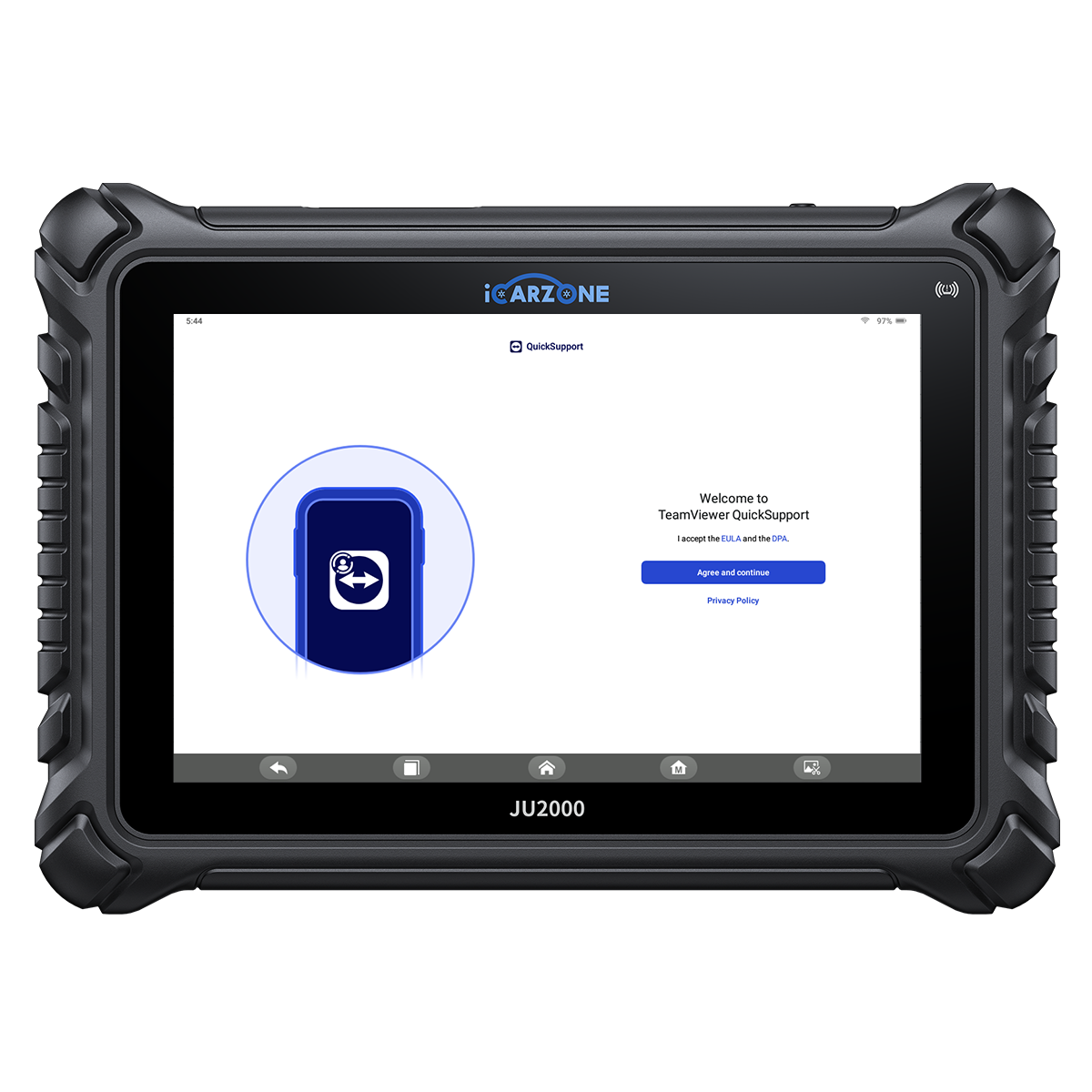
Save the hybrid-controller scan and warning messages, identify the battery-monitoring architecture and refer high-voltage diagnosis to qualified personnel. Confirm the exact VIN, controller access and requested function before purchase.
The source worksheet's temperature-related label conflicts with the OEM definition. This article follows the verified hybrid-voltage meaning and retains that discrepancy in the research record. The scanner does not replace physical measurements, specialized safety equipment or current workshop information.
How to Diagnose P0B25 in 6 Steps
Use these six decisions with the current OEM procedure. Preserve the original event and stop when unsafe conditions or failed prerequisites prevent a valid next test.
P0B25 Quick Diagnostic Path
-
1
Identify and preserve the event
- Preserve the complete hybrid scan, warning text and operating state; verify the voltage-low definition for the exact VIN.
- Record the conditions and result; resolve failed prerequisites before interpreting the next test.
-
2
Inspect the relevant condition
- Limit owner inspection to safe external observations and service history; do not access the traction-battery enclosure.
- Record the conditions and result; resolve failed prerequisites before interpreting the next test.
-
3
Establish valid prerequisites
- Have a qualified hybrid technician establish the low-voltage and communication prerequisites before interpreting pack data.
- Record the conditions and result; resolve failed prerequisites before interpreting the next test.
-
4
Separate the diagnostic branches
- Use the manufacturer's approved high-voltage diagnostic procedure to separate reported voltage from a proven battery condition.
- Record the conditions and result; resolve failed prerequisites before interpreting the next test.
-
5
Choose the proven repair path
- Choose repair, monitoring-circuit or battery service only from qualified results; do not use forced charging as a diagnostic shortcut.
- Record the conditions and result; resolve failed prerequisites before interpreting the next test.
-
6
Verify the original condition
- Complete the OEM hybrid-system verification and final scan, including the original readiness or reduced-propulsion complaint.
- Record the conditions and result; resolve failed prerequisites before interpreting the next test.
How to Fix P0B25 and Verify the Repair
Restore a proven low-voltage prerequisite
Authorize from the failed OEM test, then complete the required installation, setup and functional verification.
Repair an identified monitoring fault
Authorize from the failed OEM test, then complete the required installation, setup and functional verification.
Perform qualified battery-system service
Authorize from the failed OEM test, then complete the required installation, setup and functional verification.
Verify safe hybrid operation after repair
Authorize from the failed OEM test, then complete the required installation, setup and functional verification.
Diagnostic work
VIN-specific quoteRequest a diagnostic allowance and the failed test supporting the proposed repair. Reading a code and proving its cause are different services.
Parts and labor
VIN-specific quoteObtain VIN-specific parts and itemized installation labor. Include only seals, fluids or connectors actually required by the proven repair.
Software and setup
VIN-specific quoteWhere required, request the applicable OEM reference, software version and completion record. Scanner marketing does not establish manufacturer programming access.
Verification
VIN-specific quoteInclude the prescribed functional check and final scan. Ask how the original complaint and relevant monitor will be verified.
Request an itemized VIN-specific estimate after the cause is proven. Separate diagnosis, parts, labor, required setup and verification; check warranty terms. No universal repair price or failure rate is assigned.
Keep original and final scans, repair details, required software information and the verification result together. Those records help assess a returned fault without repeating an unsupported parts replacement.
P0B25 OEM Differences and DIY Limits
The OEM example above is conditional. Match model, engine, build scope, full fault description and companion faults before applying its repair decision. Current VIN-specific service information takes precedence.
Match the exact application stated in the meaning section. A bulletin is not a universal repair instruction.
The source worksheet's temperature-related label conflicts with the OEM definition. This article follows the verified hybrid-voltage meaning and retains that discrepancy in the research record.
Save the hybrid-controller scan and warning messages, identify the battery-monitoring architecture and refer high-voltage diagnosis to qualified personnel.
The code does not establish interchangeable parts, sensor locations, connector pins or monitor thresholds. Keep the cited example within its stated scope and use current instructions for other vehicles.
- Save an accessible scan without clearing the original event.
- Record warnings, operating conditions and recent service.
- Inspect only safely accessible external areas with the system secured.
- Ask the repairer to explain the failed test and verification plan.
- Perform high-voltage, hot-fluid, pressurized or internal-system work only with qualified equipment.
- Use the OEM procedure for circuit isolation, powered measurements and output tests.
- Complete programming or calibration only when required and properly supported.
- Stop testing when warning messages or abnormal operation make continuation unsafe.
Frequently Asked Questions About P0B25
What does P0B25 mean?
What should I check first for P0B25?
Can I keep driving with P0B25?
Will clearing P0B25 fix the problem?
Does the cited OEM repair apply to every P0B25 vehicle?
Can JU2000 diagnose this code?
How much does a P0B25 repair cost?
What if P0B25 returns after repair?
Sources and Technical Review Notes
- Volkswagen 2014 Touareg CGFA Quick Reference: P0B25 — Supports the stated definition or bounded OEM example; current VIN instructions remain necessary.
- NHTSA: Electric and Hybrid Vehicle Safety — General high-voltage safety and professional handling boundaries.
- Official iCARZONE JU2000 product page — Current public product capabilities, price and primary product image; no code-specific coverage guarantee.
- iCARZONE OBD-II Code Center — Related educational guides; not a substitute for manufacturer test specifications.
0 comments