
P0C17 Code: Drive Motor Position Not Learned

P0C17: Confirm the Required Learning
A not-learned result does not by itself prove a failed motor or resolver.
DIAGNOSTIC FOCUS
- FAULT TYPE
- Drive-motor position learning state
- FIRST CHECKS
- Vehicle variant, recent work and prerequisites
A generic reset menu does not establish support for an OEM motor-learning routine.
P0C17 identifies drive motor position sensor not learned. Determine which electrified powertrain and controller reported the fault. Review recent motor, inverter and related service work, then use the exact OEM learning procedure and safety prerequisites.
Preserve the full scan before clearing. A code identifies a monitor result, not a failed replacement part or a safe driving distance.
What Does the P0C17 Code Mean?
Motor-position information helps the electrified powertrain control its drive motor. A not-learned result describes a required learned state that has not been established or accepted. It is not equivalent to a circuit-high, circuit-low or shorted-sensor diagnosis. Preserve the complete descriptor and reporting module before interpreting the base code.
OEM procedures demonstrate why application matters. Kia published a resolver-learning workflow for selected 2017 Optima hybrid and plug-in hybrid vehicles. Mazda published a motor-speed learning requirement after high-voltage inverter replacement on specified CX-90 and CX-70 plug-in hybrids. These examples do not establish that their menus or sequence apply to another hybrid.
An incomplete procedure, an unmet prerequisite and an underlying fault that prevents learning must be separated. Recording that a command was sent is not proof that learning completed. Save the actual routine result, companion faults and original repair history. Do not replace a motor solely because a scan tool displays not learned.
P0C17 identifies drive motor position sensor not learned.
Match the required routine to the vehicle and distinguish prerequisite failure, routine failure and confirmed completion.
The base code does not establish a failed traction motor, resolver or inverter, or a universally available reset.
P0C17 Symptoms, Severity, and Driving Safety
Preserve the exact displayed warning and controller status rather than translating every warning into a battery failure.
Assess the actual vehicle behavior and owner-manual instructions. Do not force a road test to complete a routine.
Record exactly which component and software work occurred and whether the required OEM procedure was completed.
Intermittent concerns require the saved event and status. A presently normal display does not disprove the original fault.
Save companion warnings and module faults to identify prerequisite problems and the event sequence.
Record recent battery, wiring, component and software work. Timing is evidence, not proof of causation.
Hybrid-system warnings and unreliable propulsion require qualified assessment. The code does not establish that the vehicle can safely be driven or specify a permitted distance.
P0C17 Causes and the Evidence That Separates Them
Use the exact vehicle procedure to separate these possibilities. They are not a ranking of common failures; the base code cannot select the repair.
Required learning was not completed
Applicable component replacement may require a specific learned state. A general clear-code operation does not complete a separately required routine.
How to prove it: Match the actual repair to the current OEM procedure and confirm a recorded successful result.
Check firstA prerequisite prevents learning
Companion faults, system state or other specified prerequisites can prevent the routine from being accepted. Do not invent a universal battery or temperature threshold.
How to prove it: Read the routine instructions and failure result. Resolve the identified prerequisite before repeating the operation.
Check firstUnderlying position or system fault
A genuine component, connection or controller concern may prevent a valid learning result, but not learned alone does not identify it.
How to prove it: Follow the failed-routine and companion-code diagnostic branch with qualified hybrid equipment and safety precautions.
Verify directlySupporting supply or ground
A supporting electrical fault can affect several functions. Check companion codes and the VIN diagram before treating each stored code as a separate component failure.
How to prove it: Test the specified supply and ground under OEM conditions. Do not invent a universal voltage-drop or resistance limit.
Verify directlyInstallation or recent work
Review disturbed connections, installed parts and required setup when the fault follows service work. Timing alone does not prove causation.
How to prove it: Match installation and required setup to the VIN before repeating a reset.
Verify directlyController or software
Consider this branch after the required external checks. A bulletin for another application does not authorize programming this vehicle.
How to prove it: Confirm current OEM applicability, software and prerequisites. Record the required verification after any justified update.
Final branchDo not confuse motor-position learning with battery registration, steering calibration or an ordinary engine idle relearn.
Using JU2000 During P0C17 Diagnosis
On a supported vehicle, iCARZONE JU2000 can preserve accessible system faults, available freeze frame and relevant live data. Save a report before erasing the event.
JU2000 can help preserve accessible hybrid-controller faults and supported data on compatible applications. Confirm exact controller access separately. This guide does not claim that JU2000 performs Kia KDS/GDS resolver learning or Mazda MDARS motor-speed learning.
The official page describes full-system diagnostics and bidirectional controls on supported applications. Exact controller access, PIDs, active tests and routines depend on the VIN and software. A general feature does not prove support for this procedure.
iCARZONE JU2000 All-System Bidirectional Scan Tool
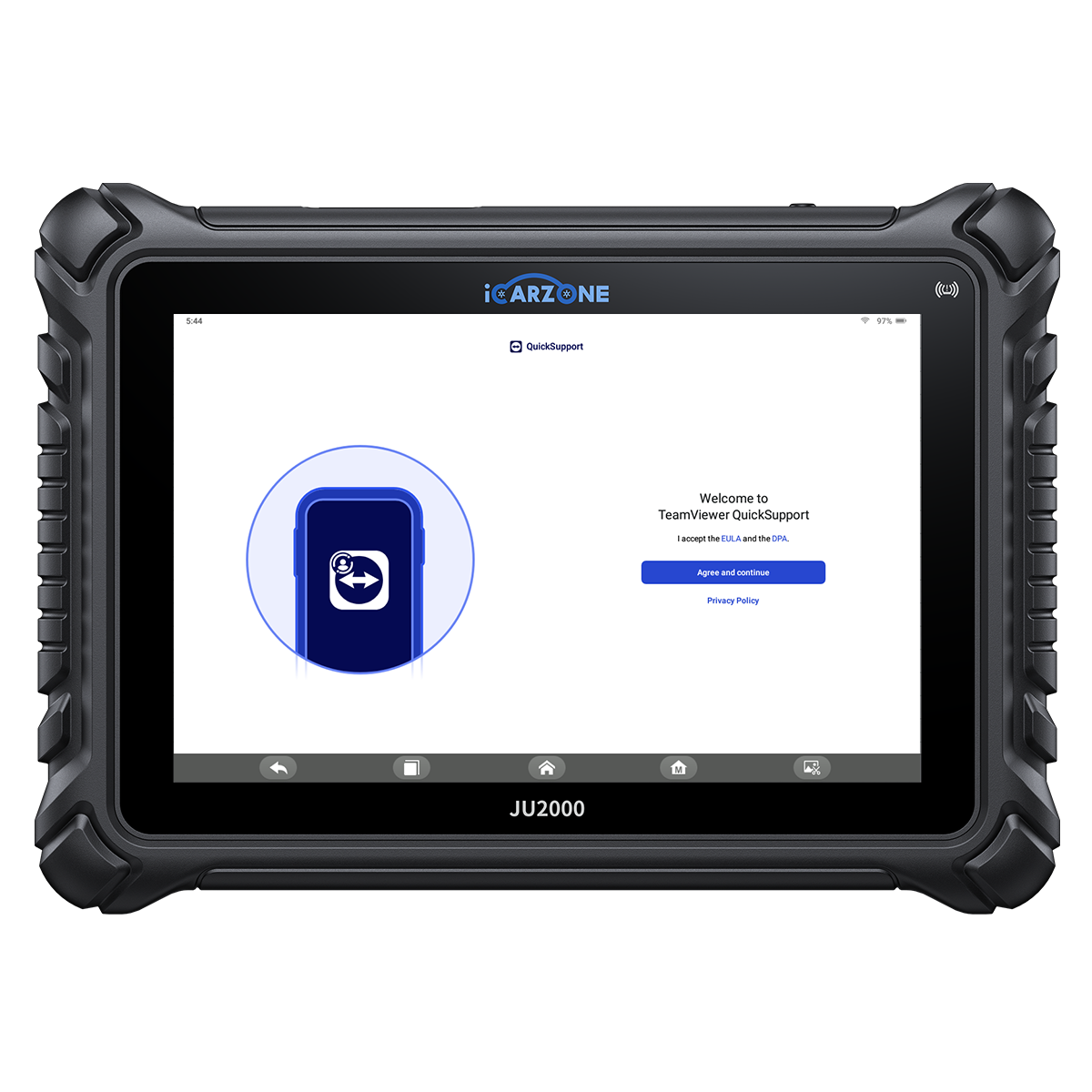
Save the hybrid fault record and service history before requesting the exact OEM learning workflow.
Confirm the exact vehicle and required function with iCARZONE before purchase. Use OEM-required equipment where specified. Scanner data does not replace physical measurement or remove active-test safety prerequisites.
How to Diagnose P0C17 in 6 Steps
Preserve evidence, identify the application and follow its diagnostic branches. Resolve a failed prerequisite before moving to a more intrusive test.
P0C17 Quick Diagnostic Path
-
1
Preserve the complete event
- Save the full OEM wording, suffix, module, active/history status and available freeze frame. Record operating conditions, warnings and recent work.
- Keep companion codes. Missing scanner access is a tool limitation, not proof of vehicle failure.
-
2
Identify the precise hybrid application
- Match the VIN, hybrid or plug-in hybrid variant, reporting controller and full descriptor. Obtain the current procedure for the actual component work.
- For a Kia or Mazda example, verify model, production or model-year scope and repair trigger. Similar vehicle names do not establish applicability.
-
3
Review the original work and prerequisites
- Check the repair record for motor, inverter and related work and whether a required learning step was omitted or failed. Save the routine result rather than a verbal claim that a reset was done.
- A qualified technician should check the specified conditions and companion faults. Do not repeatedly run a routine that has an unresolved prerequisite.
-
4
Perform the approved diagnostic or learning branch
- Use the OEM-required equipment and instructions. If learning fails, preserve its failure stage and follow the associated diagnostic branch before replacing parts.
- Do not substitute an unrelated reset menu or improvise high-voltage measurements. Confirm successful completion using the actual acceptance result.
-
5
Choose an evidence-supported repair
- Use current VIN-specific diagnostics and applicable bulletins. Ask which finding excludes the alternative branches before authorizing a part.
- Confirm required programming or learning and equipment support. A generic menu name does not establish an OEM capability.
-
6
Verify the original monitor and save the outcome
- Record successful completion of the required OEM routine, then perform its specified post-service checks and save the final scan. A cleared P0C17 without completed learning is insufficient.
- Save the final scan and verification conditions. Distinguish command acceptance, code clearance, monitor completion and demonstrated repair. Compare returning faults before replacing another part.
How to Fix P0C17 and Verify the Repair
Complete a proven missing procedure
When the applicable repair requires learning and prerequisites are satisfied, complete the specified routine using supported equipment. Document acceptance.
Repair what prevents valid learning
If a prerequisite or underlying fault is demonstrated, correct that condition before repeating learning. Do not use motor replacement as a substitute for diagnosis.
Correct the demonstrated external condition
Repair the proven connection, installation or supporting path using the OEM method. Record the failed test and the correction.
Complete required setup and verification
Perform required setup with approved equipment and prerequisites, then verify the original monitor. Code clearance alone is insufficient.
Diagnosis
VIN-specific quoteAsk for a VIN-specific diagnostic quote identifying the checks and evidence included.
Parts and labor
VIN-specific quoteSeparate proven repairs from exploratory replacement. The code cannot price the required work.
Required procedures
VIN-specific quoteInclude programming, learning or fluid handling only where the repair requires it.
Verification
VIN-specific quoteSpecify how the original concern will be verified; check applicable warranty coverage separately.
Separate a missed service step from a hardware repair in the estimate. State the routine, its prerequisites and its actual completion result.
These are planning categories, not prices to add together. Obtain a local quote connecting each operation to a demonstrated fault and stating what remains uncertain.
P0C17 OEM Differences and DIY Limits
Kia TSB guidance applies to selected 2017 Optima JF HEV/PHEV vehicles built in the specified May–November 2016 interval. Its motor and hybrid starter-generator resolver workflow is an application-specific service procedure.
Confirm the complete Kia or Mazda publication scope and the actual service trigger.
Match the required routine to the vehicle and distinguish prerequisite failure, routine failure and confirmed completion.
OEM learning equipment and high-voltage training may be required; general bidirectional capability is not proof of routine support.
Mazda SA-071/24 addresses specified 2024–2025 CX-90 PHEV and 2025 CX-70 PHEV applications after high-voltage inverter replacement, including an MDARS motor-speed learning requirement. It does not authorize a generic scanner routine or the same repair on unrelated models.
- Save the full code, module and available event data.
- Record warning messages and recent repair history.
- Check the owner manual before deciding whether to move the vehicle.
- Collect the vehicle and repair records and save accessible fault information without opening high-voltage components.
- Do not jumper unidentified terminals or bypass a monitored circuit.
- Do not open or probe a system without its OEM safety procedure.
- Do not disconnect orange high-voltage wiring, command motor movement or attempt isolation without the required qualification.
- Do not use a clear-code result as proof that the cause is repaired.
Frequently Asked Questions About P0C17
Does P0C17 prove the motor is bad?
Will clearing the code complete learning?
Does the Kia procedure apply to a Mazda PHEV?
Can I use any reset menu with a similar name?
What should I save before clearing the code?
What should the repair estimate explain?
Can iCARZONE JU2000 diagnose and clear this fault?
Why can a code return after a part was replaced?
Sources and Technical Review Notes
- Snap-on diagnostic trouble-code reference — Base description only; not OEM monitor thresholds, pinouts or a repair authorization.
- Kia Optima resolver-learning bulletin — Selected 2017 JF HEV/PHEV production and service scope.
- Mazda SA-071/24 motor-speed learning guidance — Specified CX-90/CX-70 PHEV applications after HV inverter replacement.
- Official iCARZONE JU2000 product page — Current product, price and image check; all vehicle-specific functions require separate confirmation.
0 comments